
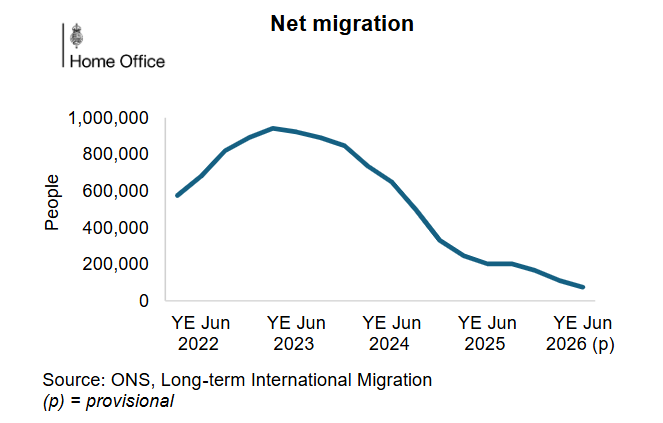
Net migration has fallen by 62 percent, largely driven by tighter immigration restrictions. Experts warn, however, that persistently low migration could have consequences for the country's workforce and public finances.
Net migration to the United Kingdom fell to an estimated 77,000 in the year ending June 2026, its lowest level since 1997, excluding the COVID-19 pandemic, according to figures released by the Office for National Statistics (ONS) on Thursday (November 26).
An estimated 738,000 people moved to the UK during the period, while 661,000 left the country. The difference between these figures, known as net migration, was 77,000.
The ONS attributed much of the decline to fewer arrivals from outside the European Union, while the number of people leaving the UK remained relatively stable.
Government claims success linked to policies
In a press release from the British Home Office (Interior Ministry) on November 26, the government claimed success. "When this government came into office, the migration system was far from fair. Net migration had soared to record levels, abuse of the visa system was rife and criminal gangs decided who entered the country," they stated.
"Asylum decisions had all but stopped. Tens of thousands of people were being accommodated in hotels at public expense. Those with no right to be here had little reason to think they would ever have to leave. Two years on, while much more remains to be done, the progress is clear."
According to the British government: "Net migration is down 92 percent from its 2023 peak, [...] Small boat arrivals are falling, the numbers in hotels and in asylum accommodation overall have fallen and returns are up. This did not happen by accident. This government took action."
Action taken
According to the press release, the government took a number of actions that resulted in this reduction, including:
- raised the minimum salary for skilled work visa to £41,700, skills threshold to degree level and ended overseas recruitment of care workers
- raised the English language requirement to A-level equivalent standard
- cut more than 100 occupations from access to overseas recruitment and made access to immigration dependent on investing in British skills and training
- doubled the standard qualifying period for permanent settlement from 5 years to 10 – meaning 500,000 people will need to wait longer
In terms of tackling the asylum system and small boat arrivals from across the Channel, the government added that it had:
- closed around 70 asylum hotels, leaving around 140 in use, down from 400 at the 2023 peak
- restarted asylum-decision making, with 96,000 claims decided in the last year – moving people faster out of taxpayer-funded accommodation
- imposed visa brakes on nationals with high rates of asylum claims via legal routes and threatened to block visas for countries refusing to take back their citizens
- made refugee status temporary, subject to review every 30 months, and paused refugee family reunion
Analysis
In an analysis, Ben Brindle, a senior researcher at the University of Oxford's Migration Observatory, explained that the data was partly attributable to the reversal of many of the policies introduced under former Conservative Prime Minister Boris Johnson.
These included limiting the ability of care workers and most international students to bring family members to Britain and increasing scrutiny of employers sponsoring overseas care workers following reports of exploitation in the sectors. Additionally, in July 2025, the overseas recruitment route for care workers was closed and access to work visas for certain occupations, including chefs and butchers were restricted.
Between January and June 2026, visa grants to international students fell by 38 percent compared with the same period the previous year. Visas granted to skilled workers and their dependants declined by the same percentage.
Implications for the economy
Brindle suggested that the economic implications of falling migration depend largely on the characteristics of the people who are no longer coming to Britain.
"The decline has not been evenly spread — it's been driven by groups that generally make positive or broadly neutral contributions to public finances, such as migrant workers in care or middle-skill jobs," Brindle wrote.
A reduction in arrivals could also affect the availability of workers, including in sectors that employ migrants who originally entered Britain on non-work visas.
However, Brindle stressed that employers could respond to labor shortages by training domestic workers, improving wages and working conditions, or introducing automation.
Analysis by the Office for Budget Responsibility (OBR) examined the economic implications of declining net migration.
Fewer people entering the country means fewer potential workers, limiting the economy's capacity to produce goods and services. However, the OBR saw no overall negative impact on GDP. Increased investment in equipment, technology and infrastructure is expected to improve productivity. Stronger economic growth and investment are expected to offset the negative impact of lower migration.
Read AlsoUK: Report finds use of force and undue restraint during some deportations