
Five EU countries and Rwanda are exploring setting up a "return hub" for people facing removal from Europe. Governments say it will increase returns and disrupt smuggling networks -- but migration researchers found there is little evidence that deterrence policies change people’s decisions to move.
Rwanda and five EU member states are planning a "return hub" that would receive people who no longer have a right to remain in one of the five EU countries and face enforceable removal decisions. Governments say the model will increase returns and disrupt people-smuggling networks, but a new factsheet from the Mixed Migration Centre (MMC) shows there is little evidence it would deter people from traveling to Europe.
Austria, Denmark, Germany, Greece and the Netherlands announced on November 16 that they were jointly exploring the facility with Rwanda. Under the model being discussed, the hub would not assess asylum claims. It would receive people who have already gone through asylum and immigration procedures in one of the five countries and no longer have a right to remain there. They would also be subject to an enforceable return or removal decision.
The governments aim to reach an agreement on establishing the return hub and to initiate the first transfers by 2027. They say the scheme would comply with EU, Rwandan and international law, including human rights law, and that no one would be transferred where there is a real risk of inhuman or degrading treatment.
Read AlsoWhat is the EU-Rwanda return hub scheme?
What the hub would offer
People transferred to Rwanda would initially be received in an open, temporary welcome center, where basic needs would be met. They would then be moved to community accommodation and receive support for local integration and vocational training.
As part of the program, they would be offered a residence permit and the opportunity to remain in Rwanda, including access to the labor market, education, healthcare and the legal system. There would also be the option to leave voluntarily to their country of origin or another country where they can legally enter and stay, with support from international organizations and the Rwandan government.
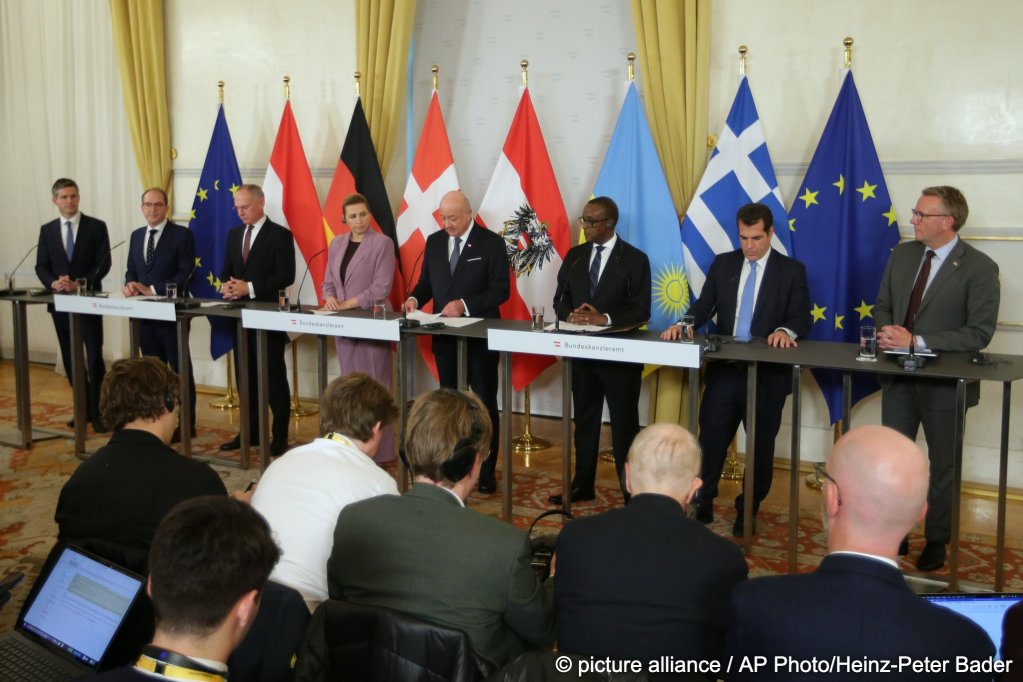
The European Commission would act as an observer. The International Organization for Migration (IOM) would provide technical input on the return hub process and, at Rwanda’s request, is prepared to provide care and assistance to migrants, subject to the necessary safeguards.
The UN Refugee Agency (UNHCR) says it is in constructive discussions with the five EU member states and Rwanda. It says it aims to preserve the integrity of asylum systems and international protection for people in need in the five EU countries, and is advising, in a good offices capacity, on the return hub process’ compliance with international human rights standards.
Read AlsoReactions continue to the European 'return hub' plan for Rwanda
A step towards 'a new asylum system'
In several press relases, the governments frame the proposal as a response to a long-standing gap in EU migration policy. Many people who receive return or removal decisions do not actually leave the EU. They argue that a return hub could make returns more effective while reducing the role of smuggling networks.
Rwanda’s Interior Minister, Vincent Biruta, presented the partnership as both a humanitarian and economic initiative, "Rwanda is a welcoming country for refugees and migrants, and we are committed to working with European partners to provide a safe, legal and dignified solution for migrants."
He added that this would also "contribute to correcting the global imbalance in economic opportunities, which is a key driver of irregular migration, including among Africans."
Biruta stated that this partnership "will ultimately save lives by helping to stop criminal human smugglers who profit from migrants making desperate, dangerous journeys.”
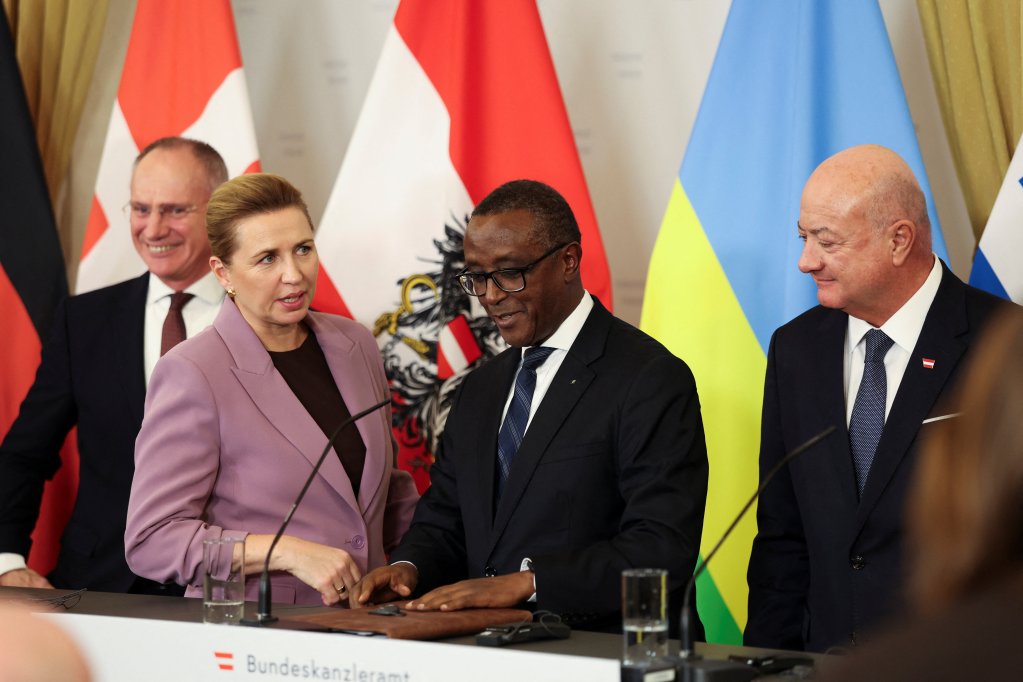
The five EU governments cast the plan as a way to strengthen returns and reduce irregular migration. Austria’s Interior Minister, Gerhard Karner, said: "Austria, Germany, Denmark, the Netherlands and Greece have taken a leading role in establishing return hubs in countries outside of Europe."
While Denmark’s Minister for Immigration, Morten Bødskov, described the announcement as a major step towards a new EU asylum system which "doesn’t reward the industry of human smugglers and foreign nationals without legal residence because of our difficulty in returning them."
The Netherlands' Asylum and Migration Minister, Bart van den Brink, took a similar approach stating that returns are central to a functioning asylum system and presented the hub as offering people an alternative to remaining in Europe without legal status, decribing the move as "a new chance for migrants to settle in Rwanda."
Alexander Dobrindt, Germany’s interior minister, described return hubs as offering "a positive approach for people without the right to stay and with no prospects in Europe, whose countries of origin do not cooperate in the repatriation process."
Greece’s Migration and Asylum Minister, Thanos Plevris, linked the proposal directly to reducing irregular migration and increasing removals.
In a press release, the German Interior Ministry said the parties were "confident" they could develop a "dignified and legally robust return hub model."
Read AlsoDenmark plans close cooperation with Rwanda on various issues — including migration
Doubts over deterrence
Bram Frouws, director of the MMC, told InfoMigrants that the available evidence does not support claims that return hubs would prevent people from setting out in the first place.
"There is no evidence that the existence of return hubs would deter people from making these journeys," he said.
Three in four people surveyed by the Mixed Migration Centre said they would still try to reach Europe, while only six percent said the prospect of a return hub would make them consider giving up.
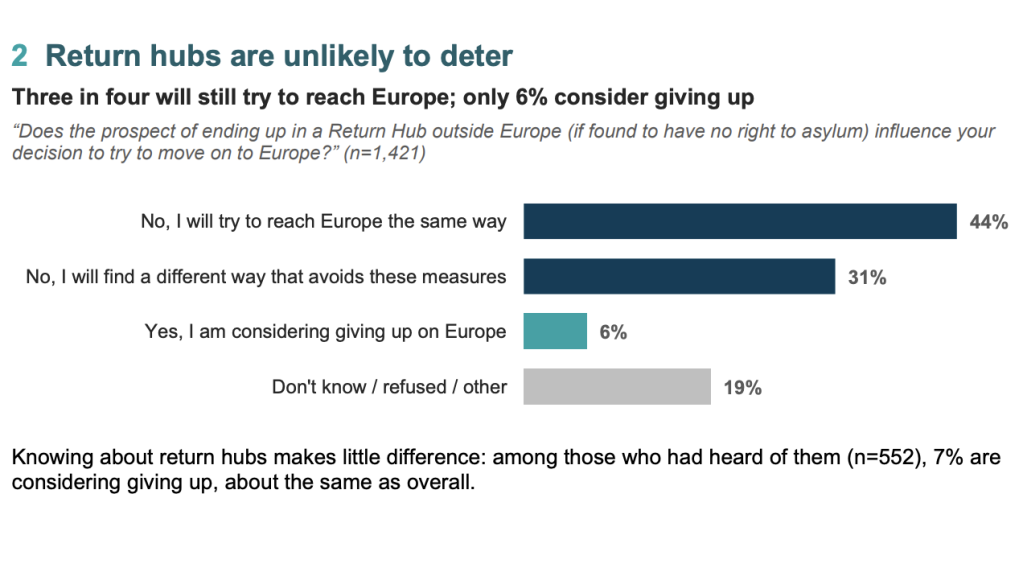
He said people may believe that the likelihood of being sent to such a hub is low, particularly where they think they may still have a chance to remain in Europe. Even among those who had heard of the plans, he said, many did not appear to think the policy would apply to them.
More than a third of the 1,500 people surveyed had heard about return hubs, according to Frouws. "This was surprising because respondents were generally well informed about the risks of the journey, but far less familiar with asylum policy," he noted.
Read AlsoEurope’s externalized migration policies face a human rights test
Multiple drivers of migration
Speaking to InfoMigrants, Frouws said deterrence alone could not address migration while people continued to face a range of pressures to leave their homes and strong incentives to move.
"As long as people have strong drivers to leave their homes, they will continue to move," he said.
He argued that restrictive measures could make journeys longer and more dangerous, while leaving smugglers able to profit from people’s need to move.
"Smugglers will facilitate this," he said. "Longer and more dangerous journeys mean more irregular migration."
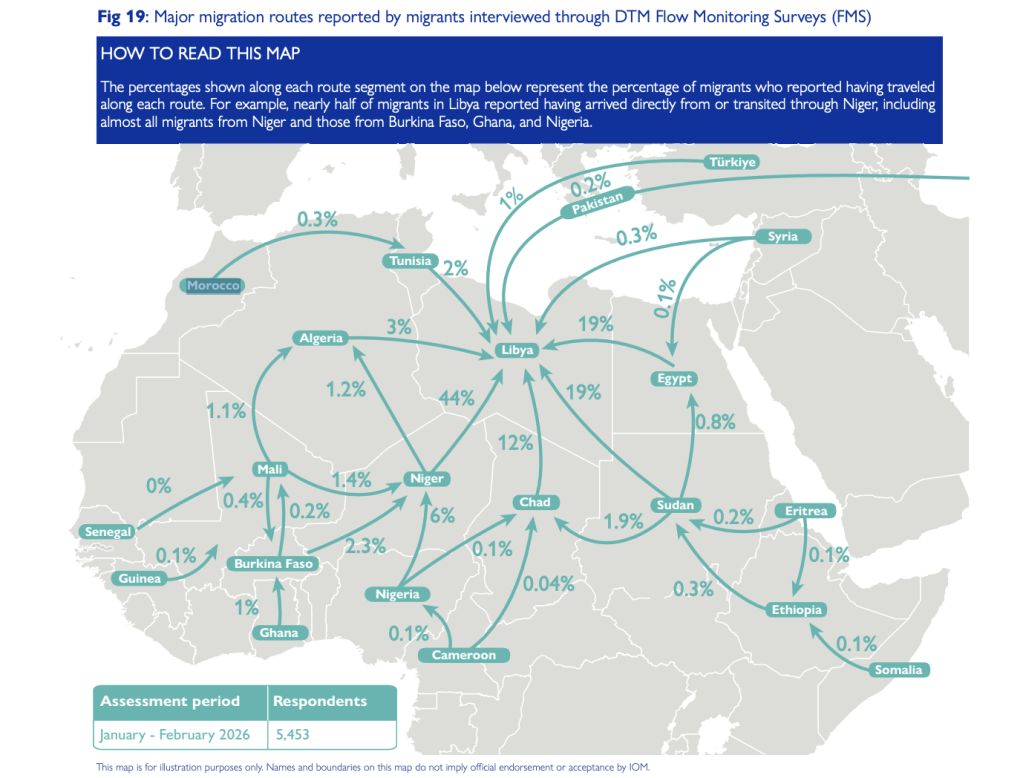
Frouws said legal pathways should form part of a broader migration policy developed with countries along migration routes. He pointed to labor migration in particular, arguing that Europe has a demand for workers and that accessible, affordable legal routes could offer people realistic alternatives to dangerous journeys.
"Legal pathways are part of the answer," he said. "People need access to accessible and affordable forms of movement."
Read AlsoBrussels proposes turning Frontex into the EU’s central returns agency
Questions over safeguards
The governments say an independent mechanism will oversee how the model works in practice. Under the EU Return Regulation, any arrangement involving onward return from a third country must set out what happens if onward return is not possible and include an independent body or mechanism to monitor its implementation.
But Frouws said many questions remain about how safeguards would operate in practice.
"There are still a lot of question marks," he explained. "Who is going to do the independent monitoring? And is it truly independent?"
He said it still remained unclear what legal status people would have in Rwanda, how free they would be to move, and what would happen if they could not be returned to their country of origin.
"What will their status be exactly?" he asked. "What happens if they cannot go back to their country of origin?"

Frouws told InfoMigrants the centers were not intended to be closed detention facilities and that people should be free to leave. But he warned that, where people have limited rights and few alternatives, restrictions on movement could in practice be severe.
He also noted that more than half of the people surveyed by the MMC said they would wait until they were released from a return hub and then attempt to reach Europe again.
This underlined the limits of a policy focused on removal rather than the reasons people migrate, Frouws argued.
"There is no expectation on our side that return hubs would actually address the drivers or the reasons that people migrate," he said.
Read AlsoFive EU countries announce concrete plans for Rwanda deportation hub scheme
EU rights agency
A spokesperson for the European Union Agency for Fundamental Rights (FRA) told InfoMigrants that the agency has previously outlined the safeguards needed for return hubs in third countries.
For each person transferred, there must be a clear and enforceable return decision based on an individual assessment, the FRA said. Transfers must also comply with existing EU rules, including the prohibition of arbitrary detention and of transfers that would expose people to serious harm or inhuman or degrading treatment.
"Particular attention must be paid to people in vulnerable situations," the spokesperson said. "Minimum standards for conditions and treatment, as well as effective and independent human rights monitoring, must also be in place."
The spokesperson at FRA also emphasized that arrangements with third countries should be legally binding and clearly define the responsibilities of the countries involved, the rights of people transferred, and the arrangements for transfers to and from the hub.
A fundamental rights impact assessment, including possible risks and measures to mitigate them, should be carried out before an agreement is finalized, the spokesperson added. People must also be able to challenge decisions affecting them before an independent court, including where new circumstances raise concerns about their safety.
The FRA said it has not examined the proposed arrangement with Rwanda. Publicly available information suggests that discussions on the exact arrangements are still ongoing, meaning the agency cannot yet assess whether the proposal meets these requirements.
"The key consideration in such an assessment would be whether the agreement and the safeguards put in place ensure that transfers by EU member states comply with the fundamental rights obligations arising under EU law," the spokesperson said.
Read AlsoRwanda: Kigali emerges as site for Europe’s first migrant 'return hub'
Europe's reliance on partners
Frouws also raised concerns about Europe's dependence on partner governments. He said financial support and political cooperation could give countries such as Rwanda leverage over European states, particularly on an issue as politically sensitive as migration.
"Europe tends to make itself very dependent on countries -- not just Rwanda," he said, noting cooperation agreements with several North African states. "There is a power shift towards these countries."
Governments that cooperate on return hubs may seek financial benefits, international legitimacy or greater latitude from European criticism, Frouws warns. Rwanda, he argued, has pursued a broader campaign to improve its international image.
It may, Frouws said, be to some extent, that the choice of potential host countries was shaped by geography, with countries located along migration routes more likely to be drawn into such arrangements. He said political willingness also mattered, as some governments may see cooperation with Europe as a way to secure financial support, international legitimacy or greater latitude from criticism. While states such as Ghana have rejected hosting return hubs on their soil.
Critics warn of risks
Shortly after the joint announcement by the five governments on November 16, more than 55 organizations from 15 countries opposed the plans in a joint statement. They argued that the model would allow people to be sent to countries with which they may have no connection, shifting responsibility for their safety and rights beyond public scrutiny.
The organizations said that some governments were rebranding return hubs as "welcome centers" or "opportunities," language they said masked forced removal. They pointed out that the plan involved removing people to a country they had never lived in, without family, networks or meaningful prospects.
They also warned that the arrangement could make migration routes more dangerous. They pointed to research on Eritreans who left Israel under a "voluntary departure" program to Rwanda and Uganda. That research, based on 19 interviews, found that people said promises of protection and work permits were not fulfilled and that many later made dangerous onward journeys toward Europe.
The organizations further argued that Rwanda does not meet the human rights standards required under the Return Regulation, citing concerns about detention conditions, arbitrary arrests, impunity and the independence of the courts, although these claims are contested, not least by the Rwandan government and the European countries hoping to push ahead with the return hub.
Read AlsoAlbanian Prime Minister rejects once more the idea of hosting EU migrant return hubs
A contested model
The governments present the proposal as a response to the difficulty of carrying out removals. And the joint statement says that very few of all migrants staying in the EU irregularly "actually leave in accordance with a return decision," arguing that a return hub could help close that gap while also disrupting smugglers' business model.
However, Frouws said the scheme should be judged not only on whether it removes people from Europe, but on whether it protects rights, operates transparently and addresses the conditions that lead people to move in the first place.
"There is no expectation on our side that return hubs would address the drivers or the reasons that people migrate," he said.
For the governments, the proposal is intended to increase returns and reduce the role of smuggling networks. For Frouws, the central question is whether it can do so without simply making journeys more dangerous or shifting responsibility -- and risk -- beyond Europe. Even if you accept the argument of European states, that this would provide deterrence, Frouws remains skeptical.
"There is no silver bullet," he said. "Deterrence alone will not work."
Read AlsoEU ministers mull new ways to curb irregular migration
Update: This article was updated on 27 November to amend the link and screenshot of the MMC’s Factsheet: Will Return Hubs Deter Irregular Migration?