
Following the capsizing of a migrant boat off the Italian island of Lampedusa, a six-year-old girl remains missing. The remaining migrants on the boat have meanwhile been taken to safety by the Italian coastguard. The crew of Sea-Eye 5 was also busy this week, rescuing 45 migrants in two operations, including 13 women, 12 children and two babies.
The Italian ANSA news agency reported on November 19 that the Italian coastguard managed to save roughly 50 people, taking them to safety on Lampedusa overnight. The agency added that there were 10 women and three minors among those who were rescued.
Coastguard officials apparently had to react promptly to the shipwreck, as people had just fallen overboard into the cold waters of the Mediterranean.
According to local authorities, the six-year-old child is the only missing person after the capsizing of the boat.
Read AlsoItaly: Newborn dies after migrant rescue at sea near Lampedusa
Authorities later said that the rescued migrants came from various West African countries, including Burkina Faso, Benin, Cameroon, Ivory Coast, Gambia, Guinea and Mali.
ANSA added that the small migrant vessel had departed from the city of Sfax in Tunisia, which for years has been a hotspot for smugglers taking irregular migrants to Europe for financial gain.

Read AlsoMediterranean crossing: Debunking the lies that smugglers tell migrants
Sea-Eye 5 crew rescues 45 migrants in Libyan SAR
Also on Wednesday (November 18), the crew of the private rescue ship Sea-Eye 5 rescued 45 migrants in the Libyan SAR zone. Among them according to a press release from the organization behind the ship Sea-Eye, 13 women, 12 children and two babies.
The migrants were rescued in two separate operations, noted Sea-Eye. In the first operation, on Wednesday morning, Sea-Eye responded to a Mayday call and found a boat carrying 31 migrants.
According to the Sea-Eye 5 crew, the boat was unseaworthy and didn't have any rescue tools or navigation aides on board. The crew bought all 31 people, including 11 women and 12 minors on boar their ship.
On Wednesday evening, after a long search, the crew of Sea-Eye 5 found another boat in difficulty, that according to the migrants on board had been at sea for several days.
Several people had to be pulled from the water on this boat, because the boat on which they were on was already breaking up. All 14 people on board this boat were also taken on board the Sea-Eye 5.
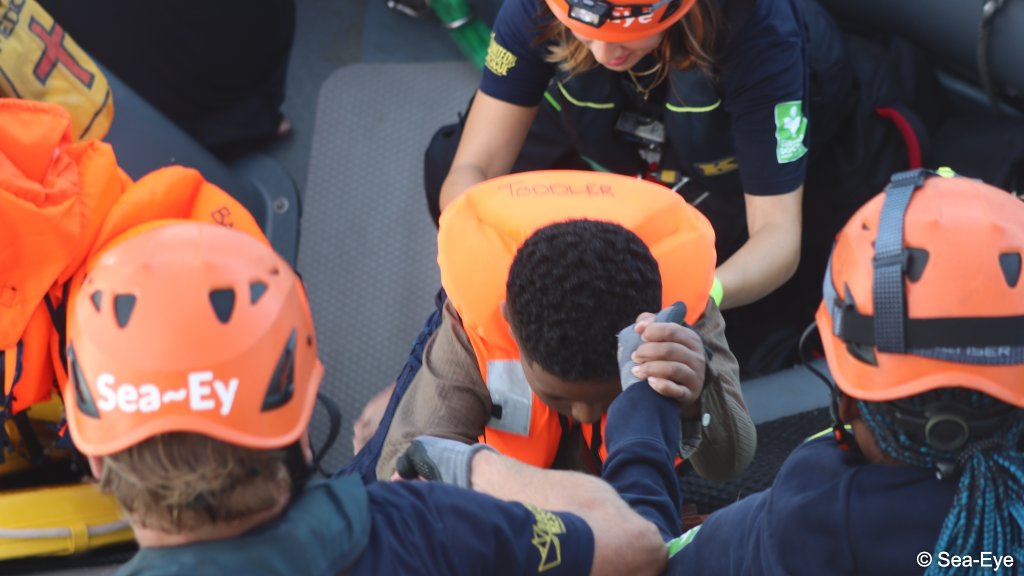
Patricia Darlington, from the organization German Doctors, which offers medical aid on board the Sea-Eye 5, explained that the Mediterranean crossing is "particularly dangerous" for children. They often get seasick more quickly and suffer more starkly. Due to their lower body mass, their bodies are also liable to cool much quicker than adults, especially if they are cold and wet for a prolonged period of time.
Being on a boat on the open sea, especially at night is also terrifying for them, especially as many of them don't really understand what they are doing there or where they might be going, explained Darlington.
Several of the group of 45 have already been medically evacuated from Sea-Eye 5, noted the press release. One woman was in the evacuated group, since she had been badly burnt by the mix of fuel and salt water in the bottom of the boat. Her partner and their two babies were also taken off the boat, alongside her mother and a ten-year-old child. They were evacuated via an Italian coastguard ship, noted Sea-Eye.
The crew is now headed for the Sicilian port of Messina for disembarkation. They were scheduled to arrive in the early hours of Friday morning. However, according to a Sea-Eye press release, the crew was meant to delay arrival. The captain of the Sea-Eye argued against this order, saying the weather situation and the state of those rescued means they should be able to disembark on land at the earliest possible opportunity.
Irregular migration continues unabated
For years, Lampedusa has remained one of the islands at the forefront of the migration narrative; because the island is one of the main arrival points for unseaworthy small migrant vessels heading for Europe from North African shores.
In addition to this route in the Central Mediterranean, there also are multiple other migratory routes into Europe — each accompanied by their own dangers.
Read AlsoWhy the Mediterranean route is becoming more deadly for migrants
According to the International Organization for Migration (IOM), nearly 36,000 people have gone missing or are confirmed to have died along these migratory sea routes since 2014.
However, since many shipwrecks never get noticed or therefore not reported, the actual number of deaths is believed to be much higher.
Read AlsoAlmost 8,000 died on migration routes in 2025 worldwide, estimates IOM
with dpa