
This week, since five European countries announced their plan to set up a 'return hub' in Rwanda, debate has continued on the subject. Human rights monitors, political opposition in Rwanda and aid groups have expressed criticism. Supporters, on the other hand, claim the scheme will deter dangerous sea crossings.
On Monday (November 16), five European Union member states -- Germany, Denmark, Greece, the Netherlands, and Austria -- announced concrete plans to establish a joint migrant deportation hub in Rwanda, marking the first such facility created outside the bloc.
The five EU nations reportedly aim to have the pilot facility in the East African country operational as early as next year.
The initiative targets individuals who have no legal right to remain in Europe but cannot be returned directly to their countries of origin, representing a significant shift in European migration policy.
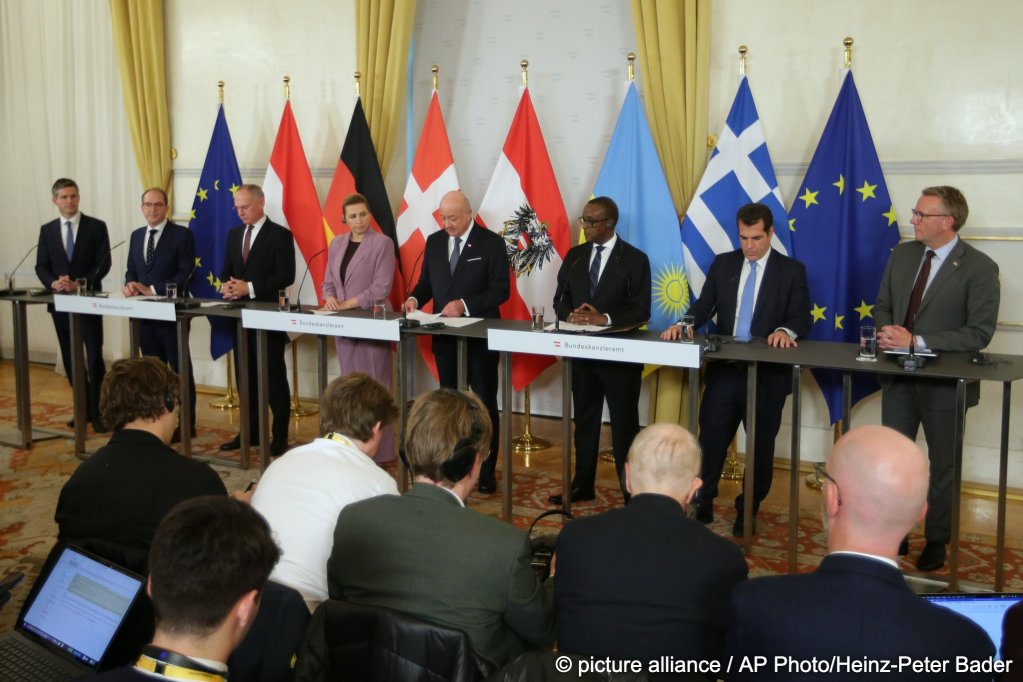
The proposed "return hubs" would receive non-EU nationals who have been issued with enforceable departure orders but cannot be repatriated directly to their origin countries. Data for the number of migrants issued with notices to leave but who don't actually leave varies from country to country across the bloc. However, in June this year, a post on the European Parliament website indicated that in 2025, those who were asked to leave but did not do so was roughly one in four, or between 20 and 28 percent. This state of affairs was what pushed some, like the center-right Dutch politician Malik Azmani from the VVD party to argue for the measures included in the new European pact on asylum and migration thaat was introduced in June this year.
According to preliminary details, the facility in Rwanda will initially operate as a pilot hosting around 100 individuals, with each of the five participating states contributing roughly 20 returnees.
Defending the initiative, prominent migration expert Gerald Knaus told news agency KNA that he believed the arrangement could act as an effective deterrent.

Knaus argued that establishing clear signals -- that crossing the Mediterranean irregularly would not lead to European residence -- could ultimately save lives. "A moral catastrophe is that thousands of people drown in the Mediterranean every year -- in 2025, the number exceeded 2,000," Knaus emphasized, noting that ending sea deaths while upholding protection standards constitutes a moral victory.
He insisted deportees would not face persecution in Rwanda, highlighting that the UN Refugee Agency (UNHCR) has relocated over 3,000 vulnerable migrants from Libya to Rwanda since 2019 without issue.
Read AlsoBrussels proposes turning Frontex into the EU’s central returns agency
UN, Rwandan politicians, rights groups voice criticism
However, the plan has encountered fierce resistance from international human rights bodies. UN High Commissioner for Human Rights Volker Türk voiced serious concerns regarding Rwanda's human rights record, news agency dpa reported.
"The solution does not lie in single measures -- often very costly -- of finding countries far away to deal with one aspect of migration governance, or in externalizing human rights obligations," Türk is quoted in a press release published on Wednesday (November 18).
Türk urged European leaders to address the root causes of displacement, such as global inequality and violent conflict, while pointing out that managed migration offers economic benefits for aging European societies facing labor shortages.
Domestic opposition inside Rwanda has also spoken out forcefully against hosting European return centers, as news agency dpa reported.
Frank Habineza, leader of the Democratic Green Party of Rwanda, rejected the concept of receiving migrants forcibly relocated from Europe.
"What we fundamentally reject is bringing these people here against their will," Habineza reportedly stated to reporters. Questioning why migrants who reached Europe should be sent to East Africa, he added that European nations "should not shirk their responsibilities" and expressed concern that the proposal would strain Rwanda's already scarce public resources.
German refugee advocacy organizations and church representatives have joined the chorus of criticism, news agency epd reported. Karl Kopp, executive director of Pro Asyl, labeled the plan a failure and pledged legal assistance to affected individuals.
"Rwanda is not a model democracy. Opposition members are detained there and, in some cases, tortured," Kopp cautioned, casting doubt on whether human rights standards there can be guaranteed.

'Inhuman, inefficient and costly'
Similarly, Bishop Christian Stäblein of the Protestant Church in Germany warned that the EU risks destabilizing fragile partner states and creating political dependency on authoritarian regimes.
Humanitarian organizations have voiced similar ethical concerns regarding externalized facilities, news agency KNA reported.
German Catholic welfare organization Caritas warned of arbitrary detentions, inadequate healthcare, and potential degrading treatment in off-shore return centers. Meanwhile, Gesine Ames of the Catholic aid organization Misereor argued that outsourcing responsibility is "inhumane, inefficient and costly."
Political pushback has also emerged within Germany's governing coalition, with Development Minister Reem Alabali Radovan expressing skepticism over unanswered legal and operational questions.
Read AlsoEurope’s externalized migration policies face a human rights test
Rwanda seen as efficient partner
Despite these concerns, European governments view Rwanda as an efficient partner capable of swift implementation, news agency AP reported.
Under President Paul Kagame, Rwanda's government has built a reputation for bureaucratic efficiency and low tolerance for petty corruption.
Rwandan Interior Minister Vincent Biruta defended the proposal, stating it will "save lives by helping to stop criminal human smugglers who profit from migrants making desperate, dangerous journeys," and reiterated that Rwanda remains a welcoming nation for displaced persons.
The current deal follows years of European efforts to tighten border controls and explore off-shore processing schemes, news agency AFP reported. Previous externalization attempts have faced severe legal and political hurdles.
A prominent bilateral deal signed between the United Kingdom and Rwanda in 2022 was struck down by the UK Supreme Court in 2023 on safety grounds before being formally scrapped in 2024. Similarly, Italy's initiatives to process male migrants in centers in Albania have faced continuous judicial challenges and delays in Italian courts.
Nevertheless, broader legislative changes across the European Union have paved the way for the current proposal. Following gains by far-right and anti-immigration parties across member states, EU lawmakers voted to ease regulations governing third-country detention centers.
Under newly established EU rules, individual member states or coalitions are empowered to negotiate bilateral agreements to deport non-citizens to external return hubs, setting the stage for the five-nation agreement with Rwanda.
with KNA, AP, AFP, epd, dpa