
Dublin's Central Criminal Court has sentenced a man of Algerian background to life in prison for the attempted murder of several children outside a primary school in Dublin three years ago. Although he is an Irish citizen, the attack and his background provoked anti-migrant protests and outrage across Ireland.
Ireland's Central Criminal Court in the capital Dublin has sentenced the perpetrator of a gruesome attack on a group of children in November 2023 to life in prison.
Riad B. — an Algerian-born 52-year-old man with no previous convictions — seriously injured several children with a kitchen knife outside a primary school on the day of the attack.
Riad B. migrated to Ireland from his native country, Algeria, 25 years ago. He eventually gained Irish citizenship — despite reportedly never fully integrating into life in the island republic.
He attended his court hearings with the help of a an interpreter, as his language proficiency in English or Gaelic were not sufficient for a trial to be held without linguistic assistance.
Reports say that during the sentencing he appeared unmoved, speaking to his interpreter in a casual manner.
Violent riots across Dublin after attack
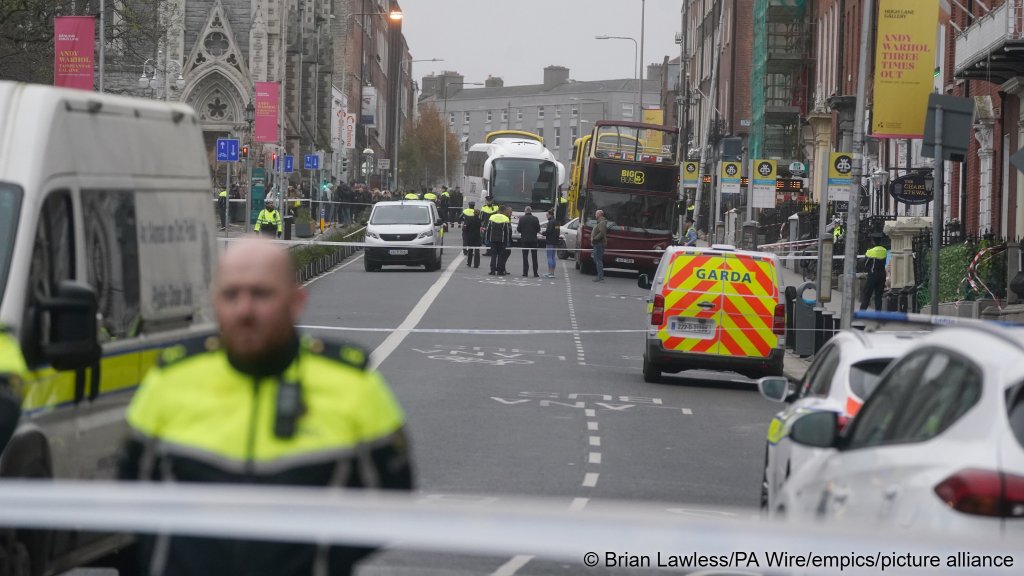
The public uproar that followed the attack in 2023 saw the biggest deployment of riot police in Irish history, with violent riots breaking out across the Irish capital Dublin, some of which was found to be motivated by anti-immigrant sentiment. Rumors spread soon after the attack that it had been perpetrated by a migrant, although it was later clarified that the suspect did infact hold Irish citizenship.
Ireland's police chief at the time, Drew Harris, described the rioting as being driven by a "lunatic, hooligan faction driven by a far-right ideology."
During the riots, multiple vehicles were set on fire, including police cars and public transportation, while shops were looted and buildings vandalized, resulting in police officers arresting 34 people.
Three policemen suffered considerable injuries during the events.

One child victim paralyzed for life
During the case, the court heard moving testimony from the victims of the attack; in particular, legal practitioners highlighted the case of a five-year-old girl, who has suffered life-altering brain injury as a result of the attack.
Three years after sustaining her injuries, the child remains paralyzed, has to be fed through a gastric tube, and can only communicate by blinking.
According to Judge Hunt, her life has been irreparably altered, stressing that she would never be able to live independently, and had little chances of ever improving.
The judge pointed out that a childcare worker at the scene also sustained several life-threatening physical injuries, from which she since had mostly recovered; however, the profound psychological consequences of the attack had apparently left her unable to return to her profession.
Read AlsoDublin riots subside after days of anti-immigration violence at asylum seeker hotel
No mitigating circumstances
The motive for the attack could not be established to the fullest satisfaction of the court.
During a police interview, Riad B. reportedly admitted that at the time of the attack, he had felt "upset" about a negative decision on receiving benefits, stating that he "did not mean to hurt anybody."
Then, however, he denied all eight charges brought against him throughout the proceedings — despite CCTV footage clearly linking him to the attack.
The court also heard that Riad B. had suffered brain injury as part of a surgical treatment to remove a tumor in 2021; his defense team argued that this had led to subsequent long-term impairment, affecting his judgement and cognitive function.
Central Criminal Court Judge Tony Hunt, however, ruled that a verdict of not guilty pleading insanity would not be applicable, especially as the jury in the case had found that Riad B. possessed the necessary intent to be convicted.
Hunt stressed that the assailant's medical circumstance in the "unprecedented case" became irrelevant when compared to the enormity of the "sinister actions on that infamous day."
The judge furthermore highlighted that the exceptional degree of the "entirely unprovoked" attack involving helpless children as victims could not be mitigated by any claims of incapacitation.
In his closing statement, Judge Hunt classified the attack as a "profound assault on the most fundamental values protected by the criminal law."
Read AlsoIreland: Growing numbers of attacks on Indians and South Asian migrants causing consternation
In Ireland, a life sentence does not necessarily mean lifelong imprisonment; depending on the gravity of the crime, some can be released after serving fewer than 15 years, although there are some contemporary cases whereby certain inmates have spent over 30 years in prison.
A stabbing attack that took place last year in Belfast, Northern Ireland (part of the United Kingdom), prompted similar protests and assaults on public property, with the mood across the island of Ireland increasingly turning against immigrants.
Read AlsoBetween fear and chaos: Migrants in Belfast wake up to destruction and questions about the future