
Smuggler's fees. Ransoms. Bribes to intermediaries. A new report by the UNODC traces the wider financial operations of migrant smuggling into Europe and unpacks pricing and the trust built into installment payment arrangements.
The United Nations Office on Drugs and Crime (UNODC) follows the money that changes hands in the migrant smuggling route to Europe and estimated that around 500 million dollars (around 446 million euros) went into paying for transport on sea routes to Europe in 2025.
The money, noted the UN agency, was paid to access four main routes, the eastern Mediterranean route, usually from Turkey or the Middle East (mostly Lebanon or Syria) or North Africa (mostly Libya) towards Greece; the Central Mediterranean route (mostly North Africa towards Italy or Malta); the Western Mediterranean route (mostly Morocco and Algeria towards Spain and Spanish Islands like the Balearics); or lastly the Atlantic route from the coast of western Africa towards the Spanish Canary Islands archipelago.
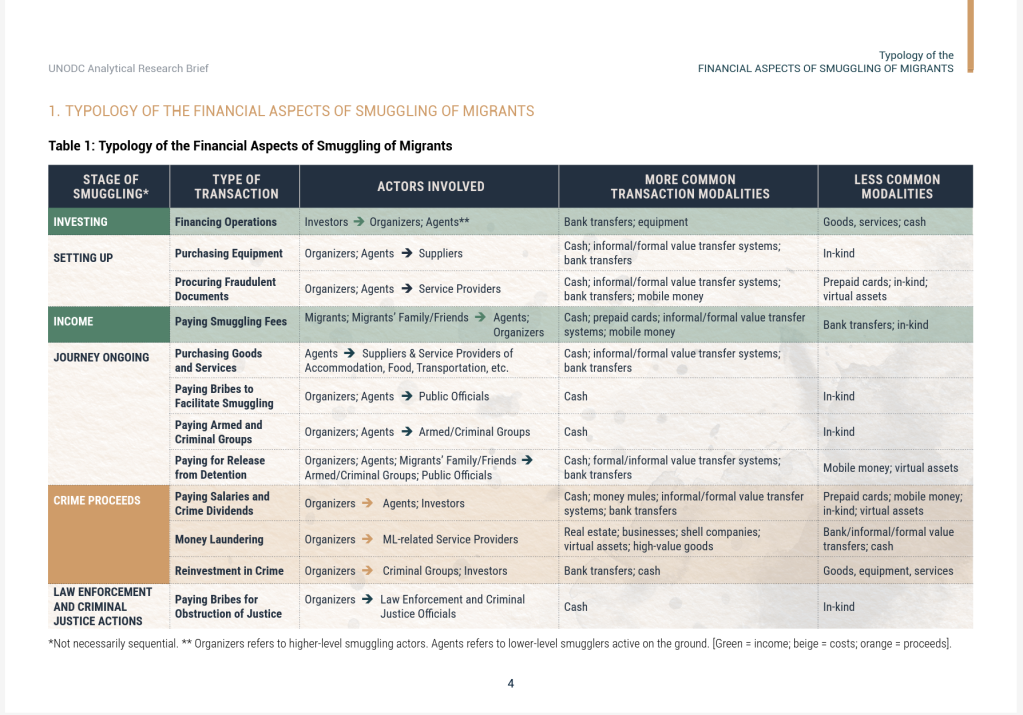
The report, "The Typology of the Financial Aspects of Smuggling of Migrants", was released on Wednesday (October 21) and detailed who pays whom, for what purpose, and through which channels. Using a combination of published reports, migrant interviews and surveys, and interviews with investigators and prosecutors, the report went beyond a price list of smuggling fees and covers the costs and payments structures that uphold this underground economy.
According to the report, costs include financing boats and the money that goes into paying intermediaries which include bribes to officials, payments to armed groups and the laundering of proceeds. The money does not necessarily follow the same route as the person traveling. Fees may remain in the country of departure, while proceeds reach countries outside the migration route.
The report highlights how money does more than finance a journey. The way it changes hands shapes the trust dynamic between migrants and smugglers.
Prices vary by route
The report found that around 190,000 to 209,000 people were smuggled along the four main sea routes to Europe in 2025. Although not all who used these routes were smuggled.
The results of a migrant survey conducted by the International Organization for Migration (IOM) in 2025, using a smuggling module co-designed with UNODC, found that the routes into Europe are priced differently.
Among surveyed migrants on the Central Mediterranean route, 45 percent reported smuggling fees above 7,500 US dollars (around 6,692 euros), making this route the most expensive. The Central Mediterranean route leads mainly from North Africa across the Mediterranean Sea towards Italy and Malta. Libya has been an important transit point for people using this route.
On the Western Mediterranean route, 52 percent reported paying between 1,000 and 5,000 US dollars (between around 892 euros and 4,462 euros). Meanwhile, most respondents on the Northwest African Atlantic route, coming up to about 57 percent reported paying below 1,000 US dollars (around 892 euros).
The UNODC report cautioned that these are not necessarily prices for comparable journeys. Higher Central Mediterranean fees may reflect longer journeys from South Asia, combining flights, overland travel, and a sea crossing.
Costs also depend on whether or not fraudulent documents and transport are supplied, whether bribes need to be paid, what kinds of enforcement risks there might be and the kind of packages promised. Some smugglers might offer repeated attempts for arrival at a destination. Smugglers may charge more to people they perceive as wealthier too.
Read AlsoIOM warns that migration routes to Europe are becoming more dangerous
Buying passage, but paying for trust
The UNODC also explored how although money is meant to purchase a seat on a migrant boat, for migrants and their families, when payment is released can matter as much as the amount.
Some pay everything before departure. Others agree to pay on arrival or release installments after reaching specified stops. Under another arrangement, known as "pay as you go," migrants pay different smugglers for separate stages.
The IOM survey found that 57 percent of migrants paid in full before departure, while around a quarter paid different actors along the way. Installments can provide some leverage where personal trust is limited. Relatives or an intermediary may hold money until arrival is confirmed, giving smugglers an incentive to complete that stage.
But these arrangements and subtle control and exchange of power that it underwrites do not guarantee safety. Violence can overturn an agreement. Outstanding debts can also leave migrants vulnerable to exploitation or detention by smugglers.
In some cases, those unable to finance the whole journey may stop to work before paying for the next stage. West Africans, for example, spend years traveling towards North Africa this way.
Nearly half of surveyed women did not know the smuggling fee, compared with seven percent of men, indicating that the person traveling does not always have full visibility over the financial arrangements surrounding their journey.
Read Also
More deaths, fewer arrivals: Migration to Europe is becoming increasingly lethal
Cards, couriers and concealed payments
According to UNODC findings, smugglers have also constructed elaborate payment channels to conceal or launder their financial proceeds. For instance via the use of prepaid cards, which was also noted in earlier UNODC reports, to serve two purposes. They can help obscure the nature of the transaction, while allowing families to retain some control by withholding a PIN until arrival.
In other cases, smugglers use "money mules". Some Bangladeshi migrants traveling towards Libya and Italy were used reportedly as cash couriers. Individuals were said to have received around 500 US dollars (around 446 euros) to hand to a facilitator in Dubai.
However,according to the UNODC, cash still remained the dominant mode of payment with three-quarters of surveyed migrants reportedly having paid smuggling fees in cash. This also makes it harder to trace for law enforcement authorities, especially if the money filters back to societies that still largely use cash payments and avoid electronic forms of money exchange.
The report concluded that for migrants, the uncertainty of their journey extends beyond whether they will reach Europe. It includes whether the agreed price will hold and whether money intended to secure their passage will become the reason they are held.
Interestingly, the UNODC noted that "many of the people who were the object of smuggling offenses did not arrive at their destination. Among all those departing on the sea routes in 2025, 104,200 people were intercepted at sea and returned, and 3,404 lost their lives or were reported missing."
Read AlsoA culture of systemic abuse: Eritrean migrants recount violence in Libyan detention centers