
A grant totaling 45.3 million euros was announced yesterday (October 13) coinciding with the first ever visit of King Felipe VI and Queen Letizia to the Spanish enclave. More than two months on after a mass arrival of people from Morocco, Ceuta's local services are stretched and strained say local authorities.
Coinciding with King Felipe VI and Queen Letizia’s visit to Ceuta yesterday (October 13), Spain's Council of Ministers announced a 45.3 million euros direct grant to help the city cover costs related to the humanitarian crisis that began in late July with the mass arrival of people crossing from Morocco.
In a statement yesterday, the local government explained that the 45.3 million euros direct grant will help "ensure the city’s financial stability" and restore the normal provision of Ceuta’s essential services.
Specifically, the funding will support essential municipal services, including social services, public health, education, security, civil protection and the environment. Additionally, the Royal Decree-law exempts Ceuta from drawing up an economic and financial plan in 2026 and 2027.
Additional support in exceptional circumstances
Local authorities explained that exceptional circumstances now make it necessary to increase financial support for Ceuta to ensure the adequate provision of essential services, mitigate the negative effects that have occurred or are occurring as a result of the disruption to normal activity, and cover extraordinary expenses.
"The measures and aid included in this legislation provide resources in addition to those the government has already supplied since this exceptional situation began, such as aid for businesses and self-employed workers administered by the Tax Agency," read the statement.
According to Finance Minister Arcadi España, these measures were discussed during his visit to Ceuta last week. He explained that the amount "is not arbitrary" but was "agreed upon through dialogue" between the Ministry of Finance and the city’s government to, as he stressed, "ensure financial stability and adequate funding at this difficult time."
Funding will be allocated via two grants: 40.6 million euros to finance current expenditure and 4.6 million euros for capital expenditure.
These grants will finance extraordinary expenditures that fall within municipal responsibility such as social services, public health, cemeteries and funeral services, education, security, civil protection and emergencies, fairs, food supplies, markets, wholesale markets and street trading.
"We are ensuring Ceuta’s autonomy and adequate funding through dialogue, coordination and support for the city’s economic and institutional fabric," the Finance Minister said
Read AlsoCeuta: Last migrant camp cleared ahead of King's visit
Choosing to stay
At the end of July, an estimated 70,000 to 80,000 migrants crossed over to Ceuta by swimming from Morocco, or climbing the fence that separates the two territories. While many have voluntarily returned to Morocco thousands remain in Ceuta, although most of the informal tent cities were cleared ahead of the royal visit.
Those who remain describe life on the streets as rough. There have been reports of sexual assaults and diseases such as scabies are increasing. Despite pressure from worried relatives and limited support, many refuse to return to Morocco. Tighter border controls and additional Moroccan security deployments are making any new crossing attempts increasingly difficult.
Read AlsoMoroccan migrants refuse to leave Ceuta
Historic first visit to Ceuta
On Tuesday (October 13), King Felipe VI and Queen Letizia made an historic first visit to Ceuta. The royal couple paid a visit to the Sidi Embarek cemetery where those who drowned at sea during the July 30 and 31 crossing into the Spanish enclave are buried.
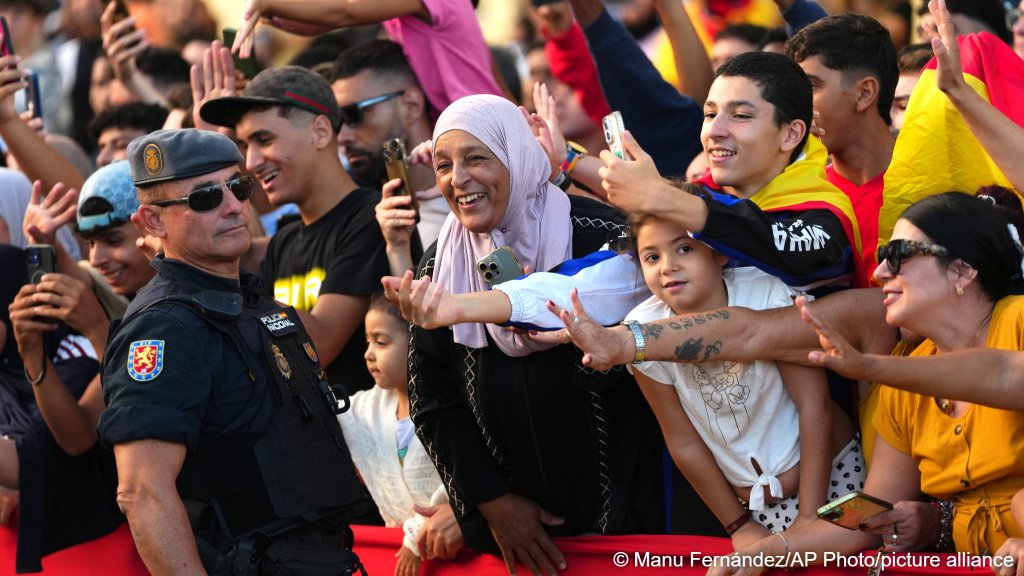
The king and queen continued onwards to visit Spain's other north African enclave Melilla on Wednesday (October 14). It marked the first official visit by the Spanish monarch to Melilla since his accession to the throne in June 2014. Reports indicate that this completes King Felipe’s official tour across all of Spain’s autonomous regions and cities.
Read AlsoCeuta: Royal visit and on-going crisis underscore social fractures in inter-racial communities