
After years of steady acceleration, asylum seekers in Germany are once again facing longer waiting times for court decisions on their appeals. Processing durations vary significantly across federal states.
Legal proceedings regarding asylum decisions in Germany are taking longer again. That’s according to news agency dpa citing a government response to an inquiry by Left Party MP Clara Bünger.
In the first half of this year, according to the government’s response, court appeals against decisions by Germany’s Federal Office for Migration and Refugees (BAMF) lasted an average of 15.3 months, up from 14.3 months in the previous year.
The reversal comes after four consecutive years of shortening court timelines, which reportedly peaked at an average of 26.5 months in 2021 before dropping to 16.7 months in 2024.
Processing times vary dramatically by state. In Saxony, proceedings averaged 20.4 months in the first half of the year -- the longest nationwide -- followed closely by Lower Saxony at 20 months.
By contrast, courts in Rhineland-Palatinate resolved cases in an average of 9.2 months, while Bavaria averaged 10.7 months.
Against that backdrop, Germany saw a sharp drop in the number of new asylum applications in the first half of 2026.
Read AlsoGermany's Dobrindt calls for rapid-response Frontex force, expedited deportations
Surging caseloads and complex country profiles
According to dpa, authorities attribute the delays to a rising volume of lawsuits and complex regional case profiles. Specific administrative courts face heavy loads from countries where protection claims are harder to evaluate.
For instance, courts in Saxony dealt with high numbers of claims from Venezuelan nationals, whereas Turkish asylum cases dominated caseloads nationwide.
Bünger pointed to increased BAMF rejections for applicants from countries with deteriorating human rights situations, including Iran, Russia, Afghanistan and Turkey. Around half of the reviewed asylum rejections concerning Iranian nationals were overturned by courts upon appeal.
By mid-August, more than 196,000 asylum cases were pending nationwide, up from 191,566 in January. Beyond rejected applicants, some lawsuits are filed by individuals granted subsidiary protection seeking full refugee status or family reunification, which remains heavily restricted.
Read AlsoGermany: Cuts to immigration budget likely to affect free asylum consultation services
Slightly faster initial decisions at BAMF
In contrast to court proceedings, initial decision-making at BAMF saw slight speed improvements. Initial asylum processing averaged 11.3 months in the first half of the year, down from 12.2 months last year.
Earlier backlogs had been exacerbated by temporary pauses in processing claims from Syrian nationals following political changes in late 2024. Between January and August, BAMF reviewed 10,064 protection statuses for Syrian refugees, revoking status in roughly 27 percent of cases.
Data released by BAMF for September 2026 showed that there were 5,276 new asylum applications in Germany, that, said BAMF, represented a slight increase on the numbers that applied for the first time in August 2026 (4,766).
Between the beginning of 2026 and the end of September, BAMF said that 55,366 people had registered an asylum claim, and that the federal office for Migration and Refugees had made decisions on 157,901 claims so far this year.
People from Afghanistan accounted for the greatest number of first-time asylum applications in September, followed by nationals from Syria and Turkey.
Appeal quota
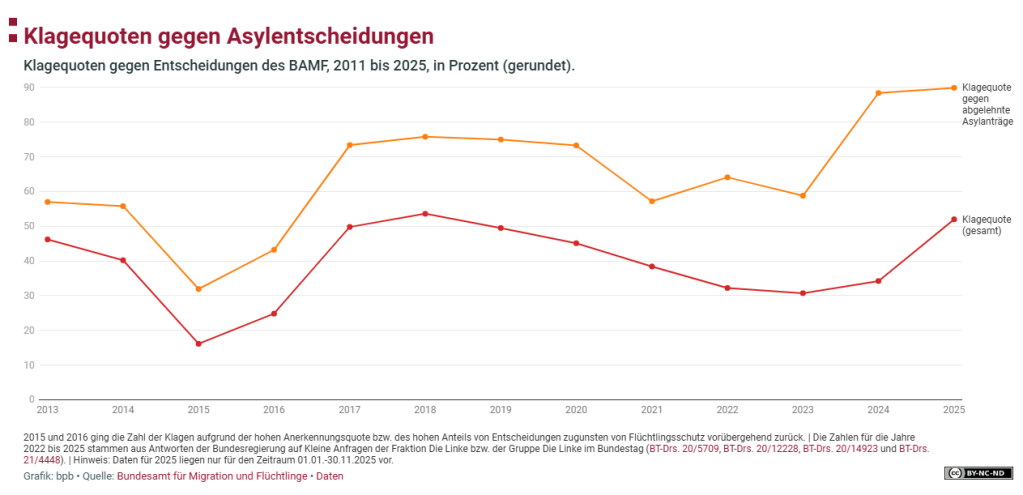
According to Germany's Federal Center for Political Education (der Bundeszentrale für politische Bildung -- bpb) between January and November 2025, a total of 149,995 decisions were legally challenged setting the appeal quota that year at about 52 percent.
That was already an increase on the two previous years, when the appeal quota stood at 34.2 percent in 2024 and 30.7 percent in 2023, stated the BPB.
The BPB article on appeals and asylum figures, released in August this year, also shows that the appeals quota rises even more when you take into account just those who are appealing refusals. In fact, more people appealed an asylum refusal in 2025 than they had the previous year. The BPB states 90,522 people appealed a refusal, representing a quota of 89.9 percent. In 2024, that quota stood at around 88.4 percent.
with dpa
Read AlsoSyria welcomes Belgian and German delegations to talk development and returns