
Spanish authorities rescued at least 740 migrants trying to reach the Canary Islands over the weekend and Monday morning. The president of the island group criticized what he called a lack of response by the central government to the increase in arrivals.
Salvamento Maritimo, the Spanish maritime rescue service, says it took 72 migrants on board in waters near Spain's Canary Island of Fuerteventura early Monday morning (October 12).
On X, Salvamento said the group was disembarked at 6am local time at the dock of Gran Tarajal.
Spanish news outlet Canarias7 moreover reported that on that boat, there was at least one woman and three minors.
The rescue comes after Spanish maritime services rescued 668 migrants on four separate vessels off the coast of Spain's Canary Islands of Gran Canaria, Lanzarote and El Hierro over the weekend, according to reporting by news agency EFE.
On Sunday afternoon, two makeshift wooden boats -- known in this region as cayucos -- reportedly arrived at the port of La Restinga on El Hierro carrying 356 people, including 19 women and 26 minors.
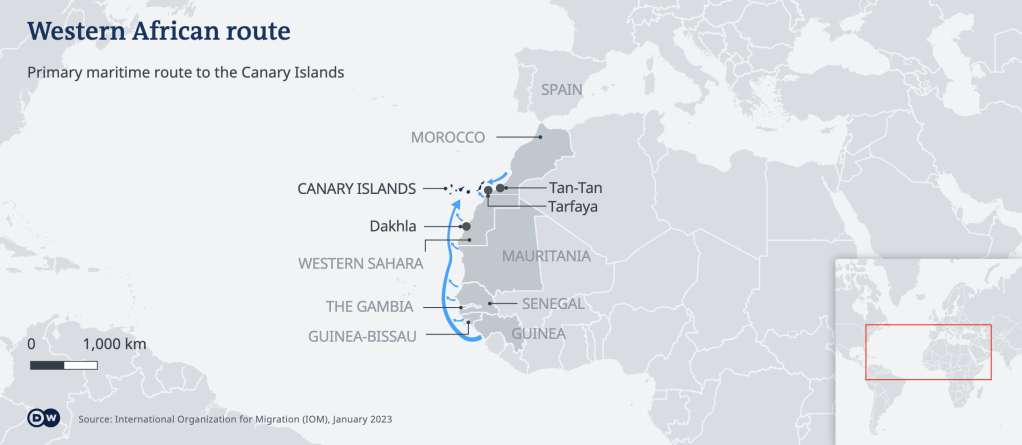
The first boat reached port under its own power after a six-day journey from Niodior, Senegal. The second boat was escorted into port after seven days at sea from Brufut, The Gambia. Two occupants were hospitalized upon arrival. The passengers were citizens of Senegal, Guinea-Conakry, Mali, and The Gambia.
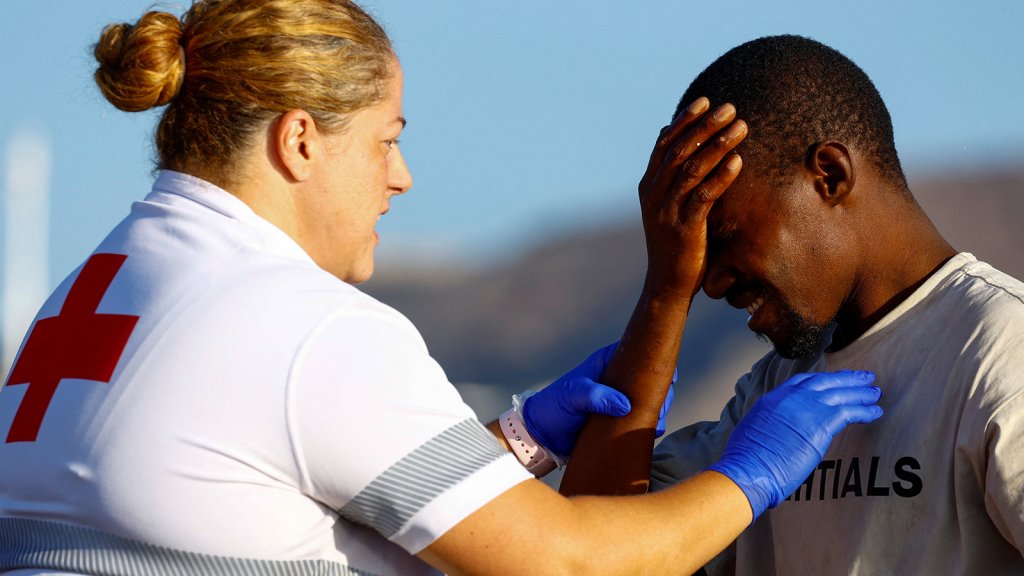
Earlier on Sunday, 216 people were brought to Arguineguín in Gran Canaria after being intercepted around 3.7 kilometers offshore. One person was airlifted to a hospital in critical condition.
Late Saturday evening, rescuers intercepted a vessel carrying 96 migrants about 92 kilometers northeast of Lanzarote. Emergency services attended to nine women and 16 minors. Occupants were nationals of Burkina Faso, the Comoros, Ivory Coast, The Gambia, Ghana, Guinea-Conakry, Liberia, Mali, Morocco, the Democratic Republic of the Congo, and Senegal.
'Lack of response'?
Meanwhile, Canary Islands President Fernando Clavijo on Monday (October 12) denounced what he called a "lack of response" to the recent increase in arrivals by the central Spanish government. According to EFE, more than 3,800 migrants have reached the islands since September.
Speaking in Madrid during National Day events, Clavijo warned that the new EU migration pact "could intensify" the "detention effect" in border regions -- which he stated is precisely what the European Union seeks.
"We are very concerned that we might see a repeat of the end of 2024," Clavijo said, referring to a period when 47,000 migrants arrived on the archipelago. He added that he remains waiting for Pedro Sánchez's government to react to "this new wave of migration."
Read AlsoNGO monitors Atlantic migration route to the Canary Islands from the sky
Deadlier crossing despite fewer arrivals
Last month saw at least two deadly attempts to reach the Canaries via the Atlantic migration route, which is considered by the United Nations to be one of the most dangerous in the world.
In early September, at least five bodies were recovered and more than 80 people were feared dead after a cayuco that left The Gambia 27 days earlier was found drifting south of Gran Canaria. Three of the 44 survivors remain in critical condition in hospital.
And in mid-September, three people died and one was left in a critical condition after a migrant boat got into difficulty off Lanzarote in the Canary Islands.
Data from the UN refugee agency UNHCR shows that from January until September 30 of this year, almost 20,000 people arrived in Spain by sea, a significant drop compared to the same period in 2025.
Around one third of all sea arrivals were registered in the Canaries, according to UNHCR.
Despite the recent increase, arrivals to the Canary Islands are still down this year: The first three months of this year saw an 82 percent drop compared to the same period in 2025.
Despite the drop in the number of arrivals, the Atlantic route from western and northwestern Africa to the Canaries has become more dangerous, with the death toll rising to 4.5 percent this year (up until July 9).
One reason is that boat journeys to the Canaries are starting further south: "While people used to leave from Morocco or Mauritania, they now start in The Gambia. These are extremely long journeys of more than two weeks, which increases lethality," a spokeswoman for the UN migration agency told InfoMigrants in July.
According to data published by the Missing Migrants Project, 290 migrants died or went missing so far this year (data was last updated on October 5) trying to reach the Canary Islands archipelago from Africa, a similar figure compared to the same period last year. The real number is almost certainly higher.
with EFE, Reuters