
The reportedly abysmal conditions at the Sintiki camp in northern Greece have sparked riots and tension between detainees and security forces. In an open letter detainees said that months of confinement are pushing them to contemplate suicide.
Zaher (name changed) left Sudan hoping to save the family he had left behind. His father and brother had died in the war. He survived and so did his mother and sister.
From Sudan, he landed in Libya where he endured three periods of imprisonment, the longest of which lasted a month.
Zaher found a way to get on a boat and after braving a two-day crossing of the Mediterranean, he reached Crete on July 20, 2025.
But arriving in Europe would not give him the security that he had sought.
"After we reached the beach, the authorities transported us by bus to a large, two-storey building. Upstairs there were five rooms and downstairs two large rooms. There were approximately 350 to 400 of us, the vast majority from Sudan and Egypt, plus a small number of Bangladeshis, about eight to ten. We stayed on the island for ten days," Zaher told InfoMigrants in 2025 when he was interviewed by the Arabic department.
Zaher was later transferred to Sintiki, a camp near Greece’s Bulgarian border.
Community chief Spyros Leonidas of nearby village Promachonas reportedly told the French news agency Agence France Presse (AFP) that the location of Sintiki was not even fit for a camp.
"It's inside a ravine. In winter, the temperature reaches -10 celsius and 45 degrees celsius in summer. A person cannot survive there, especially locked up for so many months," he said.
Driven to contemplating suicide
Zaher's accounts of life in detention echo the experiences of other detainees. Overcrowded accommodation where some say they are sleeping on cardboard, are given bad food and describe quarters that were infested by insects.
Over the summer, riots erupted at the Sintiki camp in the north of the country. In August, a group threw stones at the police, causing damage to the establishment. They also cut the wire fence and 41 people escaped, of whom 17 were later arrested, the ministry explained at the time.
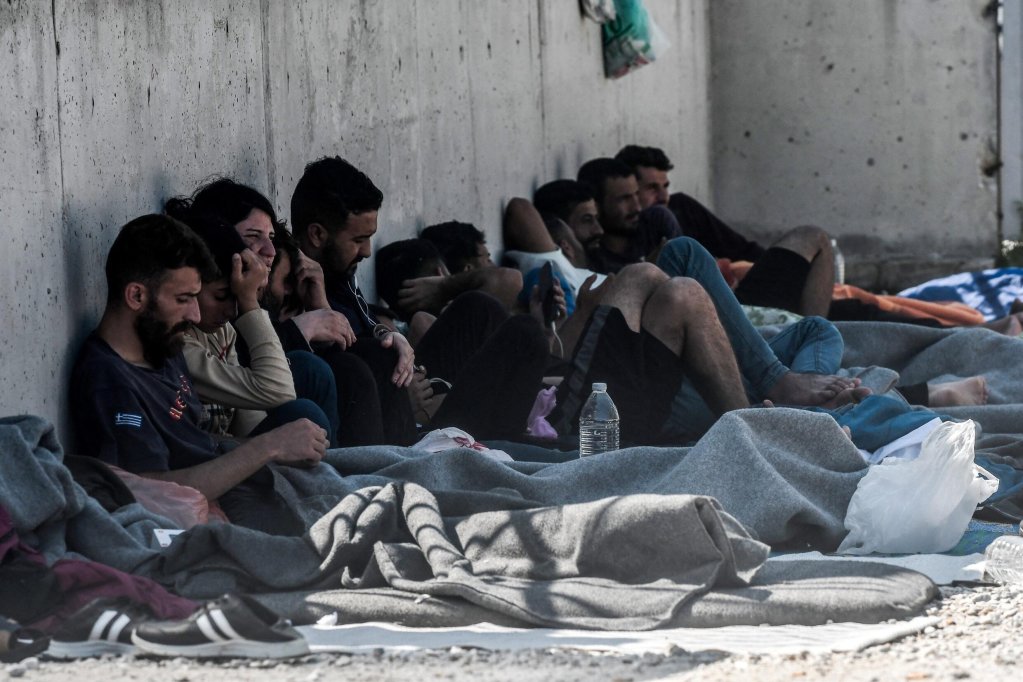
Desperate after more than a year of confinement, the detainees penned an open letter on August 26, 2026. The letter denounced conditions at the camp and warned that some were contemplating suicide.
"People here are like ticking time bombs," they wrote.
The letter described more than 300 people sharing four bathrooms and three taps, broken air conditioning, and accommodation with more than 15 occupants but only four or five beds. The detainees said they were crushed -- physically, psychologically and morally.
The contemplation of suicide, alongside hunger strikes and clashes with police, are attempts to make their prolonged suffering visible to authorities, they said.
Read Also
Greece: Migrants clash with police at detention center
Compounded trauma
For refugees fleeing war, confinement in a migrant detention center such as Sintiki can follow successive experiences of loss and insecurity. Zaher’s described experiences and that of other detainees detailed in an open letter indicate how trauma can accumulate and compound across borders.
A 2021 study of an emergency clinic in Moria, carried out by academics, some of whom were working with the Moria Medical Support Services at the time, and published in the US's National Library of Medicine, entitled "Mental health consequences of long-term stays in refugee camps: preliminary evidence from Moria" analyzed 856 consultations involving 634 patients. Longer residence in the camp was associated with acute mental health crises. The researchers cautioned that their study did not establish causation; neither can its findings be treated as measurements of distress at Sintiki.
Currently, a few hundred people are being held at the Sintiki center. The majority are reportedly from Bangladesh and Egypt. An Egyptian man told news site The Press Project that he had to share a small container with ten people, with no air conditioning in spite of extreme heat, and that he had slept for months on the ground, with only cardboard as a mattress. There have also been reports of diseases including scabies spreading through the camp, and bedbugs, cockroaches and rats roaming through the facility.
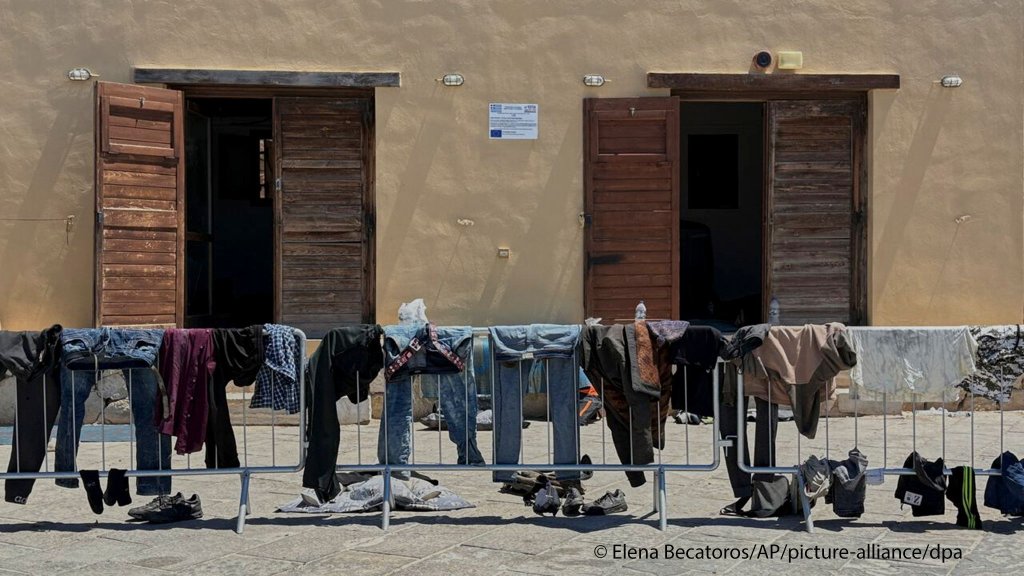
Local police have also criticized conditions at the camp. They recently called for the facility to be closed for renovations after an uprising at the center left parts of the camp damaged.
One guard at the center told AFP he understood people who rioted and tried to escape: "What are these people supposed to do? They can't take it anymore. They've reached breaking point."
The EU-funded Sintiki camp near Greece's border with Bulgaria has been hailed by Greece's current government as a 'model' for Europe. Migration Minister Thanos Plevris has argued that harsh conditions at the center, where rejected asylum seekers are detained, may help to deter people from setting off on irregular migration routes towards Greece. "Sintiki was a pilot project we ran with the aim of acting as a factor in reducing arrivals and increasing returns," he said in an interview in August.
Calling for inspection
Meanwhile, the Greek Council for Refugees has requested an Ombudsman inspection following complaints about food, sanitation, overcrowding and delayed medical care.
Following repeated complaints from asylum seekers regarding the conditions of detention at the Closed Facility in Sintiki, Serres, the Greek Council for Refugees requested the intervention of the Ombudsman to conduct an inspection of their detention conditions.
The Sintiki Facility was reported to have been converted into a Special Detention Facility in July 2025, as part of the decision to suspend asylum for three months, without the facility meeting the minimum relevant standards.
In this facility, since the suspension of asylum, the number of detainees has reportedly exceeded the official capacity of the facility, and there have been reports of appalling detention conditions as well as "serious deficiencies and inadequacies in basic security infrastructure." Local activists, lawyers and doctors all reportedly told AFP of their concerns about the facilities.
'Hygiene conditions are wretched'
Afroditi Stambouli, a doctor and former lawmaker, said: "In November 2025, when 30 people were arrested, some of them came to court in torn clothes and flip-flops."
She added that many suffered from skin diseases and other health issues.
"Hygiene conditions are wretched. Food is distributed once a day and there is no refrigerator to keep it, there is no washing machine, no cleaning supplies," she said.
The Greek migration ministry, reported AFP, says irregular entries have fallen by 15 percent in the first half of the year, and that it has largely eliminated legal pathways to asylum for migrants who entered the country irregularly.
Local Sintiki mayor Giorgos Tatsios, told AFP that local residents are now worried. "The villagers have started to feel insecure when they hear about incidents, uprisings and escapes. It's only natural," he told AFP.
Read AlsoGreece continues operation to stop migrants crossing border