
The Italian President Sergio Mattarella signed a decree on Thursday (October 1), allowing for a ban of face coverings in schools, as well as a cap on foreign pupils in classrooms.
Italy has introduced restrictions banning face coverings in schools and a 30 percent classroom quota for specified categories of foreign pupils. The measure was introduced by Prime Minister Giorgia Meloni and approved by her cabinet on Thursday (September 24). The decree was signed off by Italian President Sergio Mattarella on Thursday (October 1).
Provisions of the decree published in the government's Official Gazette prohibits participation in curricular and extracurricular school activities with the face covered or otherwise unrecognizable (Article 12). Exceptions will only be for certified medical or educational reasons. Violations carry fines of 200 –1,000 euros, payable by a parent or guardian when the offender is a minor.
Another provision (Article 13) sets a 30 percent cap on foreign students in school, which applies to first-year classes starting the 2027–28 school year. In primary schools, it would affect non-Italian citizens who were not born in Italy or have not attended at least two years of preschool. In secondary schools, it would affect non-Italian citizens who have not successfully completed at least three years in Italy’s education system.
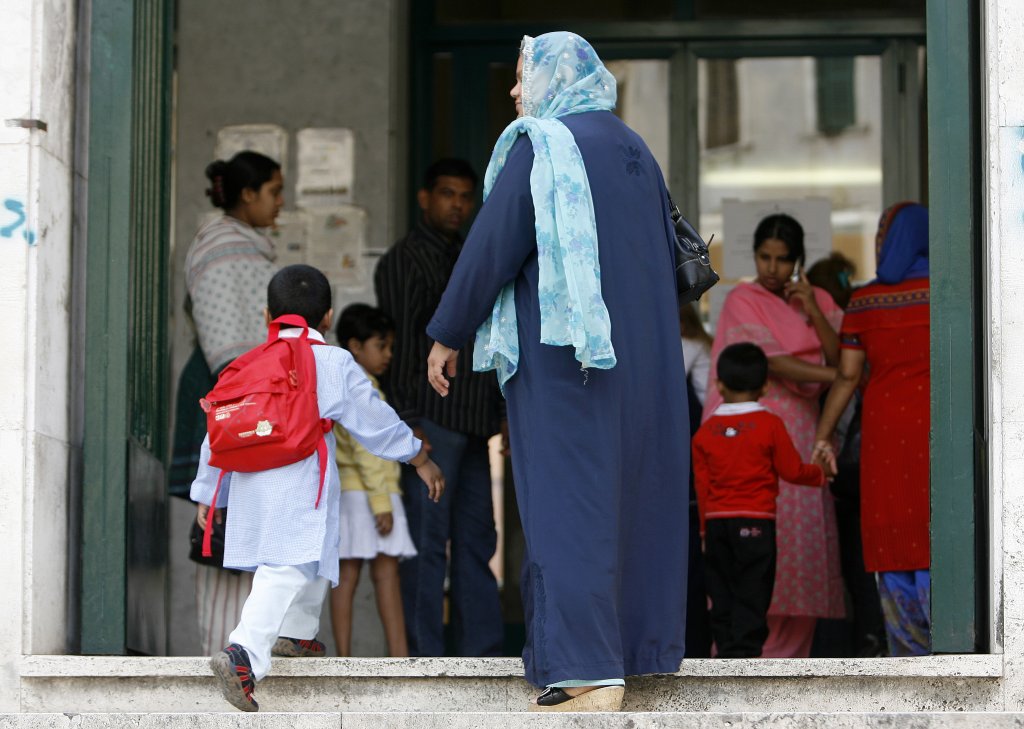
Under the new decree, where applications exceed the ceiling, education authorities must arrange distribution of students to nearby schools while considering proximity to pupils’ homes and exceptional family circumstances.
Schools will also be required to report parental language barriers that infringe children’s education to social services. Parents may then be required to attend free Italian courses targeting A2 proficiency. Fines may be imposed for non-attendance.
Italian Prime Minister, Giorgia Meloni, called her Cabinet's measures "tools of common sense that do not divide," adding that they will help integration by avoiding what the right-wing leader called "ghetto classes."
She went on to say the rules would lead to all students receiving the "same opportunities."
Italy previously introduced a 30 percent classroom limit in 2010. It was inadequately enforced, reportedly because of coordination failures.
Read AlsoItaly to ban burqa in schools, limit foreign pupils
Political strategy
A report by German public broadcaster, DW, indicates that nearly 12 percent of pupils in Italy are classified as foreign, although most are second-generation children born in the country who largely speak Italian.
Some analysts are critical of the decree and question whether Meloni’s measures address widespread educational problems or primarily serve to strengthen her political position.
Sara Silvestri, a professor of International Politics at the University of London criticized the provisions on face coverings saying that it was a "non-issue" since very few women wear a face covering at school in Italy.
Roberto D’Alimonte, a political scientist and chair of the department of political science at the Luiss Guido Carlo University in Rome, said that some northern areas have classrooms where 70–80 percent of students are foreign nationals or foreign-language speakers. This can complicate teaching and slow learning but D’Alimonte stressed that this is not a nationwide problem.
Experts point to Meloni’s competition with Roberto Vannacci, a former general leading the newly-founded Futuro Nazionale, or National Future. The party, is generally understood to have situated itself on the right of Meloni's coalition. According to a survey about the party conducted by the polling agency IPSOS in July this year, 56 percent of its voters classify themselves as "from the right" with and 22 percent saying they are "center-right" on the political spectrum. The party is polling at around eight percent and attracting voters from other right-wing parties, including Meloni’s Brothers of Italy (Fratelli d'Italia) party.
With a general election expected next year, this competition could potentially weaken Meloni’s position. She won the last election with a strong emphasis on being tough on migration and could be hoping to repeat that strategy again at the next election.
Therefore, some analysts suggest that emphasizing migration, Muslim religious practices and classroom integration allows Meloni to curry the approval of her supporters while attempting to prevent defections to parties further right than her.
Read AlsoItaly and Denmark push for return hubs outside EU in joint statement