
The Spanish authorities are still struggling to manage the situation in Ceuta, resulting from the mass arrivals in July. Over the last two weeks, police officers have been attempting to clear makeshift camps on the beaches and transfer people to temporary accommodation when they qualify.
Spanish police have begun transferring hundreds of migrants from the makeshift settlement at Benítez beach in Ceuta to the Temporary Center for the Care of Foreigners, housed in the Tarajal warehouses. The operation is another stage in clearing informal settlements following the mass arrival of more than 70,000 people from Morocco at the end of July.
Authorities reportedly cited safety concerns, including the beach’s proximity to a desalination plant and space for excess water runoff there ahead of autumn's expected rainfall. Some migrants have already lost their shelters to heavy rain.
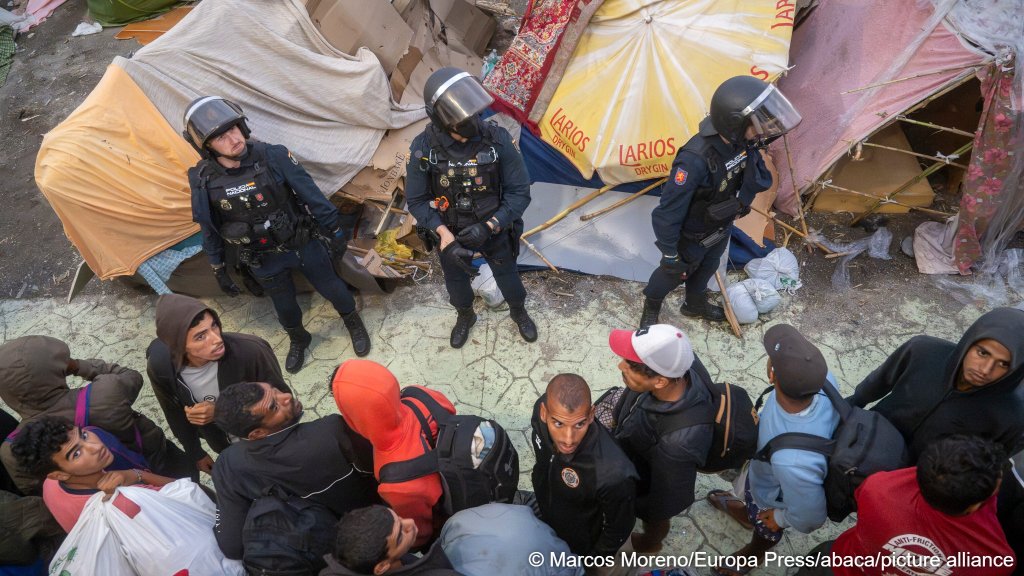
Separately, officers transported juvenile migrants from the Trampolín beach area for identification on Saturday (September 26) in order to facilitate their admission to Ceuta’s child-protection facilities.
Read Also
Ceuta: Border controls boosted amid rumors of another mass crossing attempt
Streamlining return procedures
In a monitoring report published on Tuesday (September 29), Territorial Policy Minister Ángel Víctor Torres released the following data, showing that there are:
- 2,493 minors in the regional child protection system -- 172 more than the previous week
- 213 minors relocated to mainland Spain: of this number, 69 were relocated with family reunification and 144 were relocated to different autonomous communities
- Triage for adults has now reached 3,220 -- 674 more than last week
- 8,243 people have returned -- of this number, 7,794 returned voluntarily and 449 were classified as expulsions
Immigration and Border Services have been reinforced with 96 additional officers, allowing for a rate of over 100 triage assessments per day. Between 25 to 30 percent of those assessed reportedly decided not to apply for international protection.
Read AlsoCeuta: Hundreds of migrants relocated to new center
Youth protests
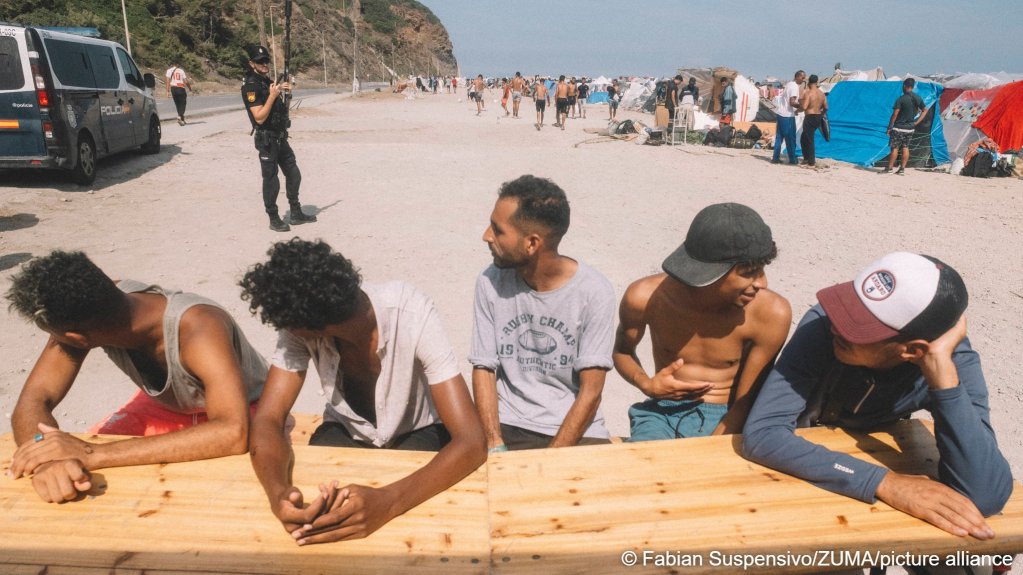
Meanwhile, young Moroccans who continue sleeping rough are protesting, asking Spain to protect minors and chanting for admission to a children’s center.
About a hundred unaccompanied Moroccan minors gathered earlier this week on the Trampolín beach to demand their transfer to reception facilities. The teens say they want a safe space to sleep in light of decreasing temperatures and the onset of rains.
Teenagers were reported to be holding banners with slogans such as "We only want one thing. That Spain protects minors." Protesters also chanted, "We want a minors' center!" clamoring for an intervention that would allow them to leave the shacks in which they have been living -- some since their arrival at the end of July.
Recent research helps explain why conditions after arrival matter. A study published in European Child & Adolescent Psychiatry examined 230 unaccompanied boys aged 15–17 living in residential care in Catalonia, Spain. About 57 percent were Moroccan. Researchers found associations between perceived discrimination and greater psychological distress and anxiety with some 21 percent reported to be experiencing depressive symptoms,
The research draws attention to the pressures young migrants encounter after reaching Spain and how some stress points experienced before and during migration continue to compound after arrival.
Putting the EU's migration policy to the test
The humanitarian situation in Ceuta continues to be a testing ground for the European Union's migration policies—and a test of Prime Minister Pedro Sanchez’s leadership. Under Sanchez's administration which has seen the mass regularization of undocumented migrants, Spain has emerged as an outlier amid the bloc's hard-line stance against irregular migration.
Now though, Sanchez is under pressure to demonstrate control while upholding his government's commitments to solidarity and migrants' rights. The conservative Popular Party and far-right Vox have made Ceuta a rallying point against Sanchez, framing migration as "destabilizing" to the government and national security.
Addressing the UN General Assembly on September 23, Sanchez resisted the framing stating, "I know that, at times like this, it's tempting to take the easy way out. Giving in to fear, treating migrants as enemies and flouting the law.. But my country, Spain, isn’t going to do that.”
How Sanchez manages the aftermath of the mass arrival in Ceuta will test his administration's resolve.
Meanwhile, on September 17, Interior Minister Fernando Grande-Marlaska asked the European Commission for legislation to accelerate return and asylum procedures. His ministry also announced 114.7 million euros in emergency funding for reception, processing and border measures in Ceuta and Melilla.
News agency Reuters reported on Thursday (September 29) that plans outlined in a draft Spanish decree would enable the authorities to override standard migration procedures and tighten rules on asylum seeking for migrants who arrived in Ceuta in July. The decree is designed to speed up applications and deportations for the over 10,000 migrants who remain in the tiny territory. If passed, the decree would mark a major strategic shift for the leftist, pro-immigration government under Sanchez.
Read AlsoCeuta: Documents show Spanish intelligence warned of crisis