
Over the past five years, 120 Dutch nationals have been arrested in Croatia for smuggling migrants either from Bosnia or on to Slovenia in overcrowded vehicles. These young people are lured on social media by traffickers who promise a safe journey and a large sum of money.
Since the beginning of the year, 46 Dutch nationals have been arrested in Croatia for suspected human trafficking, reveals the Dutch media outlet RTL Nieuws. These individuals were arrested while transporting undocumented migrants from Croatia to neighboring Slovenia or from Bosnia.
These are often young men, lured on social media — particularly Snapchat and Telegram — by the promise of easy money. A Dutchman named Jonathan, imprisoned in Croatia, claims he was offered 7,000 euros to transport migrants. With this sum, he hoped to pay off his debts.
RTL Nieuws, whose journalists posed as drivers interested in the journey, shed light on a practice well-organized by smuggling networks. "The traffickers did everything they could to convince us that the profits were high and the risks minimal," the media outlet explained.
Young Dutch men 'underestimate the risks and consequences'
The smugglers, contacted by phone, say "the journeys are actually very easy, simple, and safe" and that they "last between one and a half to three hours maximum. There are no checkpoints or borders to cross," the traffickers claim to the journalists. In case of arrest, they advise telling the police they are picking up hitchhikers.
In reality, the journey proved more dangerous than expected. Jonathan, who was only supposed to pick up "a few people," had to take at least nine migrants into his car at the border between Bosnia and Croatia. "These people were crying because they were so tightly packed together," explained his friend, contacted by RTL Nieuws.
Lawyer Zenzi Ophof of the legal collective Dutch & Detained told the Dutch media outlet that these young people are vulnerable and often deceived by traffickers. When they arrive in Croatia, they face pressure to transport more migrants. "Some say they were threatened if they didn't make more trips," she says.
"People think they can make easy money, but they underestimate the risks and consequences," Dutch prosecutor Petra Hoekstra told RTL Nieuws. "People have died of asphyxiation on these trips. This type of crime is therefore very serious. Some are getting rich off the backs of migrants and sometimes also off the backs of drivers," she continued.
More than 120 Dutch nationals have been arrested in the last five years. The recruitment of drivers online is an increasingly common method used by human trafficking networks, Europol, the European police agency, lamented. Dismantling these networks is therefore proving difficult: "Drivers often have little information about the overall operation of the network, which complicates their identification in relation to the organizers," the agency told the Dutch media.
Sentences have become heavier
Faced with the scale of the problem, Croatian judges have increased the gravity of their sentences. Previously, these smugglers were sentenced to fines of 15,000 euros to 20,000 euros, courts are now handing down prison sentences of several years.
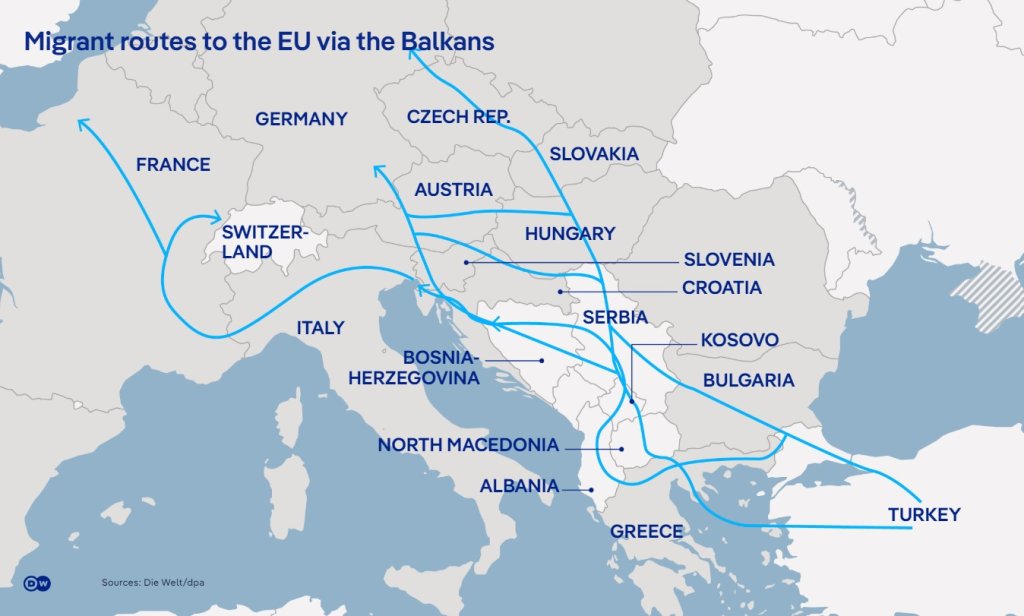
Croatia is a major transit country for undocumented migrants attempting to reach Western Europe via the Balkans. The migrants come primarily from Afghanistan, Pakistan, Syria, or Iraq.
More than 12,500 people used the "Balkan route" in 2025, according to the European border guard agency Frontex, a figure down 42 percent compared to 2024.