
Authorities in Mauritania say they saved 260 migrants from two boats, including children. Mauritanian authorities are playing an increasingly important role in intercepting migrants trying to reach Spain's Canary Islands.
"Early Sunday morning," the Mauritanian coast guard rescued "260 irregular migrants," including 17 children, from two boats off Nouakchott, Mauritania's capital on the Atlantic coast.
That's according to a post published on the Ministry of Fisheries and Maritime Economy Facebook page published later on Sunday (September 27).
The two vessels set off from The Gambian capital Banjul, located some 500 kilometers to the south, and were at sea for seven days before being spotted by Mauritanian coast guard units, according to the Facebook post.
News agency AFP, meanwhile, reported that the migrants on board the vessels were in a state of shock after running out of food as well as contending with fuel and navigation problems.
According to the Facebook post, the group consisted of 132 Senegalese nationals, 120 Gambians, four Guineans as well as two Nigerians and two Malians. It also states that among the group were 17 children and 61 women.
Read AlsoSpain: 165 migrants rescued off Spanish Canary Islands, one dead
Uptick in rescues, interceptions, deaths
The rescues come on the heels of another major rescue in early July, when 216 migrants were saved off the Mauritanian coast.
What's more, more than a thousand migrants trying to reach Spain's Canary Islands were intercepted in recent days and weeks by Mauritanian and Senegalese authorities. And in early July, at least 144 people were reported dead or missing off Mauritania after two boats bound for the Canary Islands ran into difficulty in the Atlantic.
Mauritania's coast guard has been playing an increasingly important part in ensuring that migrants are intercepted before they reach European soil.
In 2024, the European Union signed a partnership agreement with the West African country, pledging 200 million euros in funds to stop irregular migrants. Spain has often spearheaded many of the bilateral and wider EU negotiations with Mauritania and other departure countries in West Africa, like Senegal and Morocco, since most of those departing these countries head onwards on routes towards Spanish territories.
Rights groups say that the increase in sea patrols and interceptions of migrants en route to the Canary Islands have contributed to the drop in arrivals there, which started last year.
According to the Spanish Ministry of the Interior, 2025 saw a 40 percent drop in the number of migrants who successfully entered its territory irregularly, compared to the same period in the previous year.
Read AlsoCanary Islands: Migrant arrivals fell by more than 60 percent in 2025
Dangerous crossing
In the decade or so before that, in contrast, Spain's Atlantic archipelago witnessed a large increase in irregular migration from West Africa, with experts calling this the deadliest migration route in the world.
Driven by poverty and a lack of opportunities at home, thousands of mostly young migrants have for years attempted the dangerous Atlantic journey in precarious, overcrowded wooden fishing boats to reach the Canary Islands, seen as a gateway to the European Union.
Many turn to clandestine routes as legal channels remain out of reach due to strict European visa policies and enhanced border surveillance.
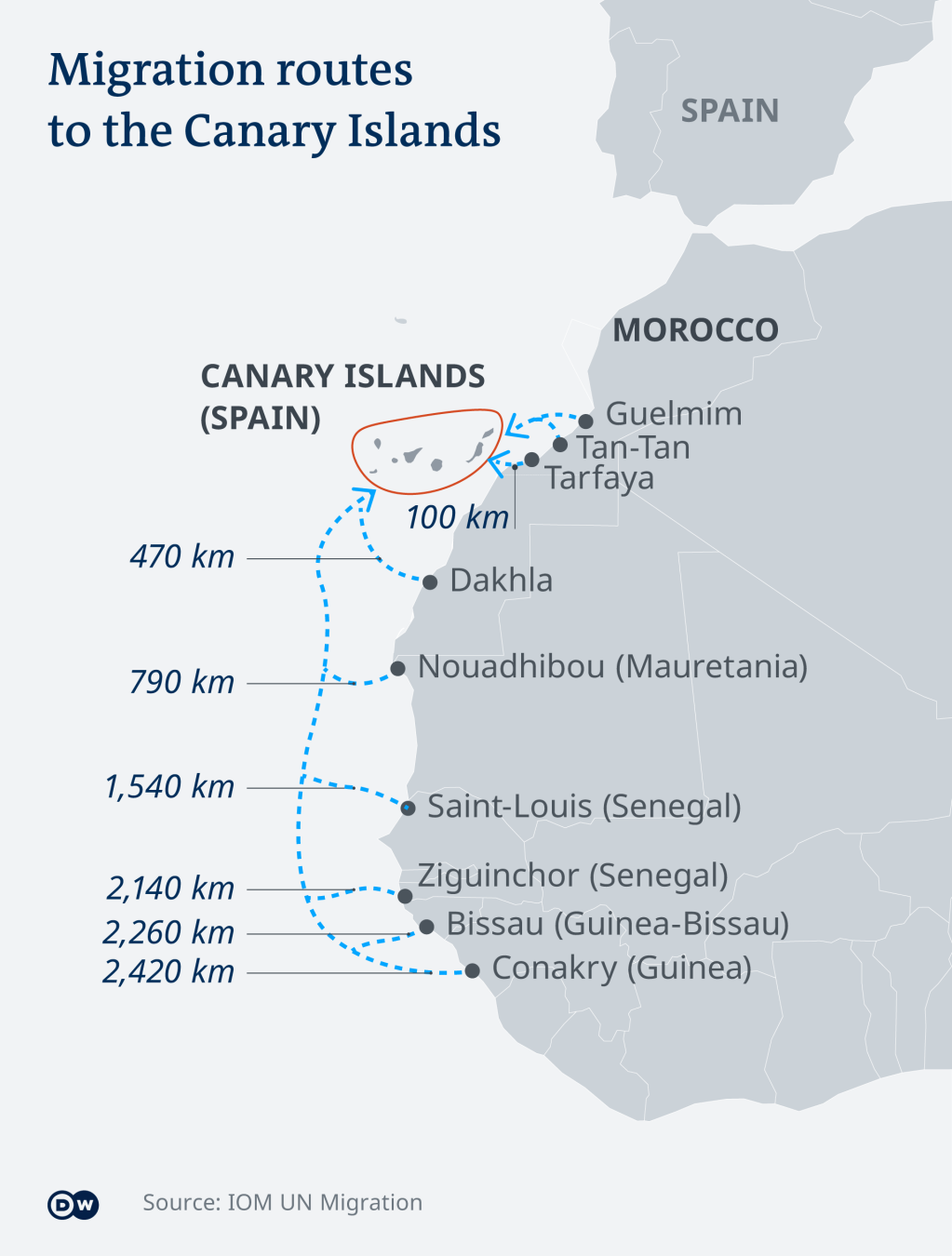
As a result, however, people seem to be willing to undertake increasingly longer and riskier journeys across the Atlantic Ocean to reach the island group, which is part of the European Union: some migrant boats are known to attempt journeys from as far south on the African continent as Guinea, located more than 2,400 kilometers away.
In 2025 alone, more than 1,176 people are known to have died or gone missing on this route, according to the IOM. The Spanish charity Caminando Fronteras (Walking Borders) estimates at least 1,482 people died en route to the Canaries in 2025.
According to the migrant charity Caminando Fronteras, the current tally of fatalities for 2026 has already surpassed the mark of 1,300 instances.
The majority of people embarking on this dangerous journey tend to be young, with a high proportion of accompanied minors among them. One of the recent people highlighted by Caminando Fronteras to have gone missing on that route this year is a 25-year-old named as Kissima Keita. According to the charity, his family lost contact with him in April this year when he was thought to be in Senegal. He is originally from Mali. His family, states the charity, "continue looking for him."
with AFP