
Spanish authorities have arrested two individuals suspected of exploiting migrants who arrived at the end of July in Ceuta. The suspects allegedly charged migrants approximately 30 euros per person to sleep on the floors of garages and storage units, facilities described by police as entirely unfit for human living conditions.
Two people suspected of exploiting migrants who had arrived during July’s mass arrivals into the Spanish autonomous city of Ceuta in North Africa have been arrested, police announced on Wednesday (September 16).
According to Spanish police, the two people charged migrants around 30 euros per person every day to sleep "on the floor, in spaces designated for vehicle parking and without adequate living conditions," including in storage spaces.
They only received mattresses and blankets if they paid the full amount upfront, and they also had to pay for charging their phones and received death threats to discourage them from reporting their situations to authorities, Agence France-Presse (AFP) reported, citing a police statement.
Police said that the suspects are believed to have "obtained large financial gains by exploiting the particularly vulnerable situation of the migrants who had recently arrived in the city."
The suspects also allegedly charged 6,000 euros for covert journeys from Ceuta to mainland Spain, though police didn't say if any took place.
Read AlsoEU to propose new emergency framework to tackle 'engineered and weaponized' migration
Smugglers target migrants stranded in Ceuta
The Spanish enclave of Ceuta, a small North African territory bordering Morocco, is grappling with unprecedented strain tens of thousands of migrants arrived in late July. Over the course of just two days, July 30 and 31, an estimated 70,000 migrants crossed into the city.
Spanish and Moroccan NGOs estimate that between 80 and more than 140 people lost their lives during the crossing. Most by drowning as they tried to swim around a breakwater. The majority of the migrants who made it safely were returned to Morocco within hours.
However, thousands of migrants remained behind, quickly overwhelming local infrastructure. Ceuta, which usually has a population of under 90,000, has seen its reception facilities and local authorities stretched for resources, leaving officials unable to properly accommodate or register many of the migrants.
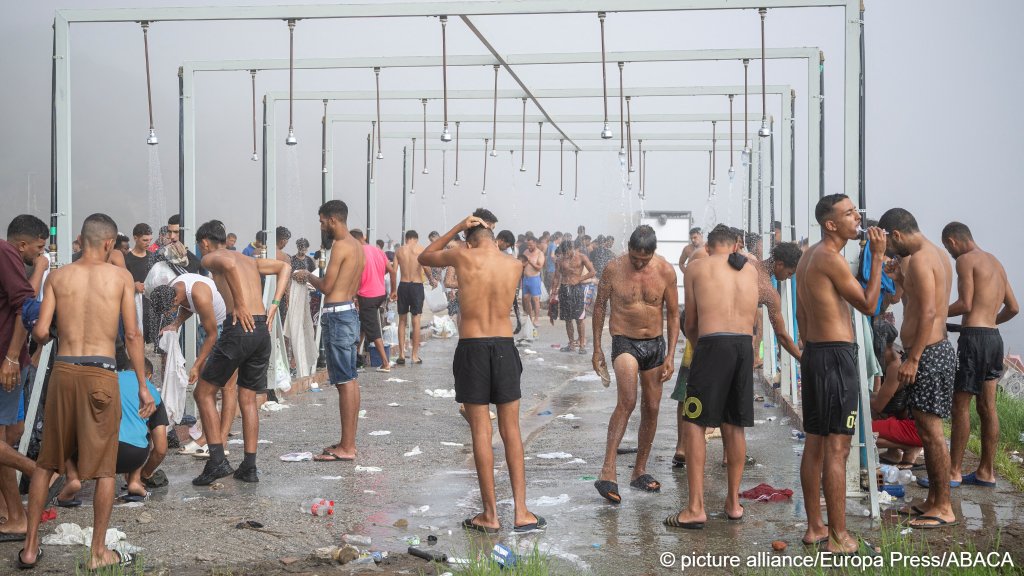
Consequently, makeshift camps have popped up across the territory, including a prominent settlement on a local beach. The sudden spike in rough sleeping and informal encampments has prompted concerns from humanitarian organizations, as well as from local residents.
The situation in Ceuta has also fueled illicit smuggling networks targeting the stranded migrant population. In August, police arrested five individuals accused of exploiting the situation by charging recently arrived migrants up to 9,000 euros for transport to mainland Spain.
Ceuta and Melilla, Spain’s other territory in North Africa, serve as the European Union’s only land borders with Africa. The territories operate under a strict legal exception within Europe’s Schengen free-travel area, with comprehensive border checks applying to all travelers making their way from the enclaves to the Spanish mainland, making unauthorized onward travel both difficult and precarious.
With AFP