
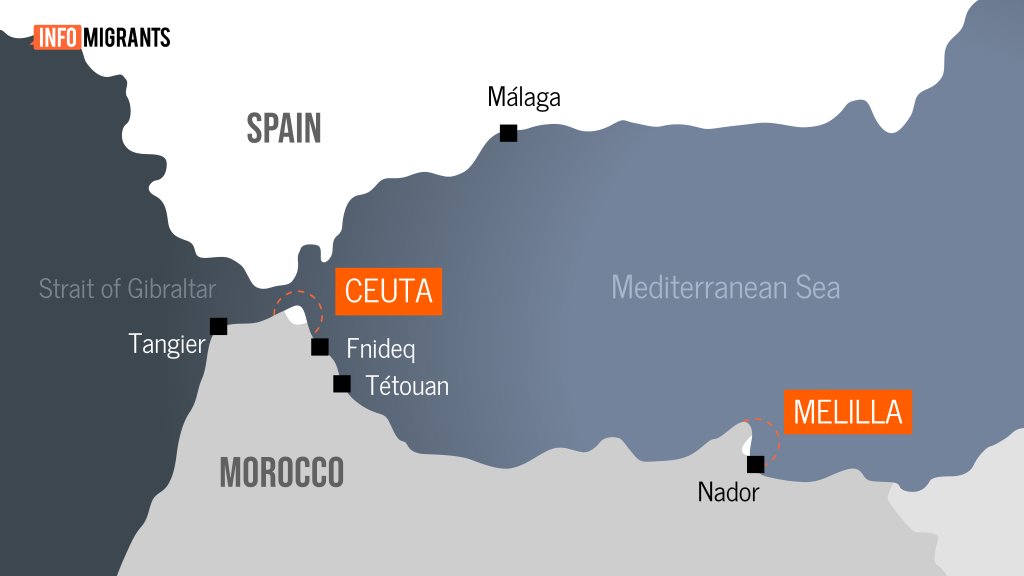
The sudden mass arrival of migrants in the Spanish territory of Ceuta triggered a political crisis in the European Union, with several European leaders calling for Spain’s exclusion or suspension from the Schengen open-border arrangement. InfoMigrants examines the legality of their proposal.
A political crisis has been brewing in Europe since the mass arrival of thousands of Moroccan and sub-Saharan African migrants into the Spanish enclave of Ceuta. The Italian Prime Minister Giorgia Meloni was the first leader to take a stand on the subject.
Meloni signaled her plans to suspend Spain from the Schengen area on July 31: "We are in the process of bringing together the competent bodies and, once these meetings are over, we are ready to act, including through exceptional measures… such as suspending the Schengen agreement with Spain." Denmark and Finland quickly adopted Italy’s position and called for Spain to be temporarily suspended from the Schengen area.
Read AlsoCeuta: Spain says most economic migrants won't qualify for asylum
Developed progressively since 1985, the Schengen Agreement ensures the free movement of people and goods across the European continent. It abolishes border controls and strengthens police and judicial cooperation among its members. Citizens and residents of the European Union (EU) can travel freely within this zone without undergoing border checks. The Schengen agreement consists of 29 states; 25 are EU members. Of the 27 EU member states, only two, Cyprus and Ireland, are not members of the Schengen area. Meanwhile, Iceland, Liechtenstein, Norway, and Switzerland are full members of the agreement even though they aren’t EU members.
Spain blasted Meloni’s declaration as "demagoguery", and out of line with European regulations. "Suspending a member state isn't foreseen in the Schengen texts," said Marie-Laure Basilien-Gainche, a law professor at the University of Lyon 3 in France.
Border controls
"The only possibility offered to other member states is to reintroduce internal border controls," said Basilien-Gainche. The Schengen Borders Code details the procedures for these controls, which are permitted "in the event of a serious threat to public policy or internal security". The circumstances include terrorist threats and organized crime, including human smuggling, and public health emergencies such as COVID-19.
The text also refers to “sudden, large-scale and unauthorized movements of third-country nationals between Member States", especially in cases where they could jeopardize the functioning of the "area without internal border controls".
For years, numerous countries have been reinstating internal border controls within the Schengen area. “France (for example) has continuously reintroduced and renewed controls at its borders for 11 years,” said Basilien-Gainche. Currently, 11 out of the 29 member states have carried out internal border checks. Germany did so, citing irregular immigration and smuggler networks. Poland took the measure while citing irregular migratory pressure on its borders with Germany and Lithuania. Denmark and Norway cited the risks of sabotage linked to Russia. Sweden for its part, has cited organized cross-border criminality and the Islamist threat.
Read AlsoCeuta: Four migrants arrested as Spain asks EU for help processing migrants
Italy is now part of the list, after it suspended the Schengen free-movement regime for maritime and air links with Spain for one month. The decision to suspend Schengen was “unavoidable” and “adopted to protect national security”, said the Italian Foreign Minister Antonio Tajani on August 28. Checks on passengers arriving from Italy by air and sea will be “targeted” and only apply to non-European nationals arriving from Spain, said the ministry.
Elsewhere in Europe, France stepped up controls at its southern border with Spain. The number of police at the Franco-Spanish border increased fivefold beginning on August 29, reaching a total of 334, said French Interior Minister Laurent Nuñez. The issue of Spain leaving the Schengen area is "not on the table", he added.
Portugal, the other country which shares a land border with Spain, has also reinforced its border controls. The Portuguese Prime Minister Luís Montenegro said on the public channel RTP that it was “justified to reinforce the presence of security forces at border checkpoints”.
A European evaluation of border controls
Besides the reinforcement of internal border controls, the Schengen Agreement uses an evaluation mechanism to monitor border management and control. States are thus regularly evaluated and if breaches are detected, the concerned country receives a list of binding recommendations accompanied by a timeline for remedial action. In 2016, the European Commission flagged Greece for "seriously neglecting" its external Schengen border controls, leading to increasing pressure along the Western Balkan migrant route.
Read AlsoFact checked: The Spanish regularization campaign did not drive the 60,000+ arrivals in Ceuta
Yet in the case of the migrant influx to Ceuta, "the Spanish government took all the necessary measures to control its external borders by preventing the migrants from reaching the Iberian Peninsula and contacting the Moroccan authorities to repatriate the Moroccan migrants to Morocco. I don’t see any serious negligence from Spain," said Basilien-Gainche.
Almost all the exiles – some 70,000 migrants – have returned from Ceuta to Morocco. The Schengen Area was "in no way" compromised during the Ceuta incursion, Spanish Interior Minister Fernando Grande-Marlaska said after a video conference with his EU colleagues. Brussels maintained a similar stance, saying there was never a migrant influx between Ceuta and the European continent.