
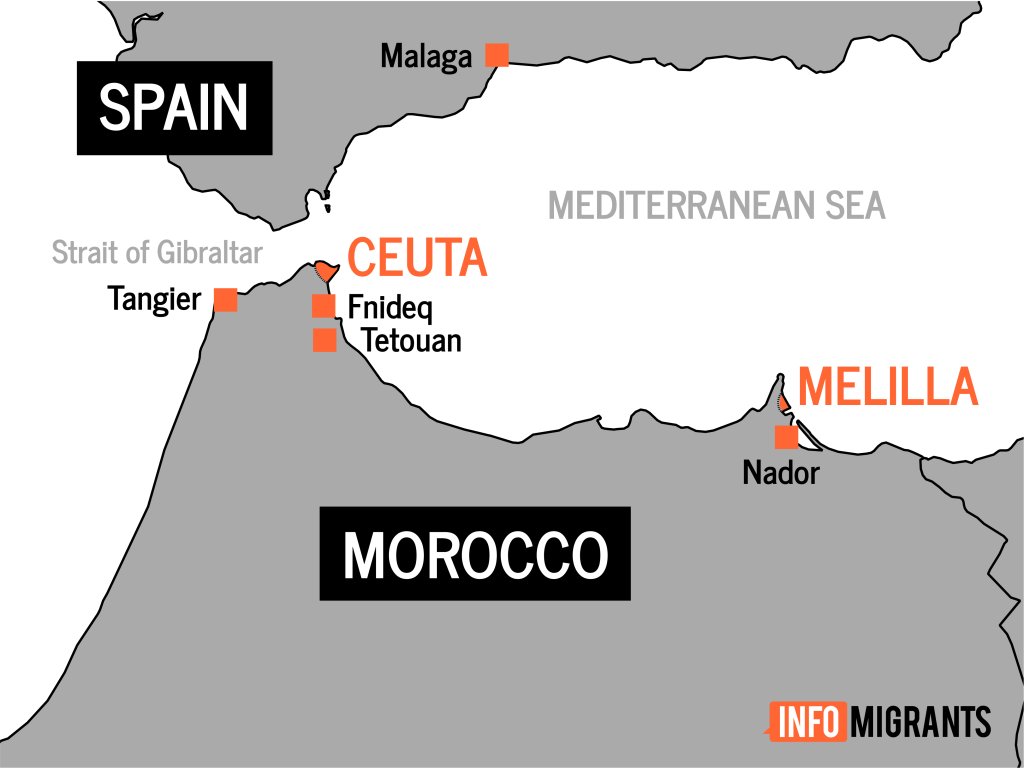
The Spanish government is preparing to return migrants remaining in the North African territory of Ceuta, while also working to expand accommodation and provide assistance and social services to those awaiting decisions on their cases. "Ceuta will return to normality, I am sure of it," Territorial Policy Minister Angel Víctor Torres has said.
The Spanish government has announced that authorities are working to expand temporary migrant accommodation and provide additional resources to manage the situation in Ceuta. The government, however, added that the majority of migrants who remain in Ceuta after the mass arrival from Morocco at the end of July will eventually be returned.
Miguel Angel Perez, the Spanish government's delegate in Ceuta, said on Tuesday (August 1) that most of the migrants still in the autonomous city do not qualify for international protection and are expected to be returned to Morocco.
Government says most migrants won’t qualify for asylum
Estimates of the number of migrants still in Ceuta range between 8,000 and 9,000, according to the Ceuta government. On August 4, the Interior Ministry said 72,000 people had entered Ceuta on July 30. However, the ministry also said that more than 70,000 had already left the city. Territorial Policy Minister Angel Víctor Torres said that 3,519 people had voluntarily returned to Morocco between August 10 and 31. The Interior Ministry also reported that 214 people had been expelled during the same period.
The government says many of those remaining in Ceuta are migrants who left their countries for economic reasons rather than people who would be eligible to apply for asylum. Some have been staying on beaches or in the streets while waiting for their situations to be resolved, hoping to reach mainland Europe following misinformation circulating on social media platforms and messaging services that European settlement would be a possibility.
The Interior Ministry has identified 1,129 minors since the mass arrival, while the government in Ceuta has counted 1,612 minors among those remaining, a figure it expects could rise as more are identified. However, under Spanish law, minors cannot be returned unless arrangements can be made to reunite them with their families.
Read AlsoCeuta: Four migrants arrested as Spain asks EU for help processing migrants
Ceuta scrambles to boost accommodation capacity and public services
To speed up administrative procedures, the Interior Ministry has sent additional personnel to Ceuta. The operation is to include 50 additional National Police officers and at least 11 more civil servants, aiming to shorten return procedures and speed up the processing of asylum applications. The Temporary Stay Center for Immigrants in Ceuta has also been revamped, while video-conference interviews have been introduced at the Temporary Foreigners' Assistance Center.
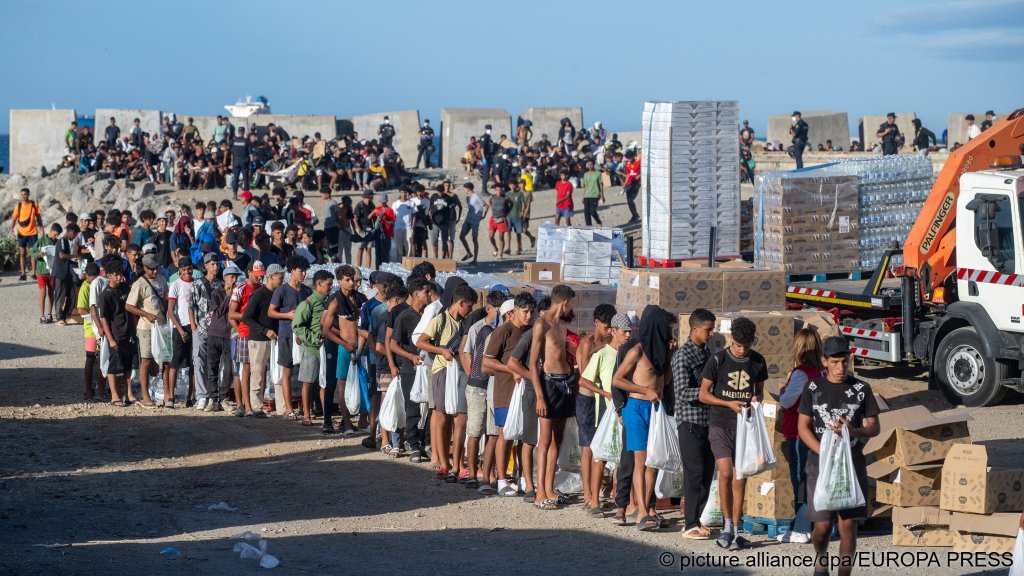
As part of attempts to increase accommodation capacity, a decree approved Tuesday establishes new sites for migrants, following an agreement with the Ceuta government that resulted in four municipal sports centers being removed from the list of proposed facilities. The military hospital, the city's former flour factory and another state-owned sports center were also excluded. The new decree instead includes several plots of land belonging to the Port of Ceuta, located away from urban areas, land belonging to the Ministry of Housing and the K-8 military barracks. Torres said materials would arrive during the week to prepare the sites. Once completed, the facilities are expected to provide 6,000 places, although no timeline was given for when they would become fully operational.
Existing accommodation includes around 300 people at the Hipica facilities and nearly 500 at the Embolsamiento site. The Ministry of Defence has also made infrastructure available and transported bunk beds, tents and other equipment to Ceuta, according to Spanish news agency EFE. Facilities used by the Armed Forces are additionally being made available to National Police officers involved in the response.
The government has said it has also provided food and hygiene supplies. According to figures released Tuesday, it has distributed 109,600 food kits, along with 1,396 female hygiene kits and 2,150 male hygiene kits. The Red Cross has provided 7,568 medical treatments and carried out 276 transfers to hospitals or health centers since the mass border crossing.
According to Torres, hospital bed occupancy in Ceuta is at 50 percent, with 104 beds occupied, including 15 by migrant patients. The Health Ministry has said it has begun a vaccination campaign using 300 doses and plans to continue with mass vaccinations, drawing on 45,000 doses donated by Spain's autonomous communities.
Read AlsoCeuta: What you need to know about migrant returns
‘Ceuta will return to normality’
The government is also looking to expand legal and judicial resources for the situation in Ceuta. The Ministry of the Presidency, Justice and Relations with the Courts has strengthened legal aid services, the Public Prosecutor's Office and the courts, including through the appointment of two new judges, one specializing in violence against women.
Alongside the measures directly related to migration, the government has approved a 309 million euros for a financial support package for Ceuta. The package is intended to provide additional resources for public services and security forces, improve facilities and support for migrants, and assist self-employed workers and small and medium-sized businesses. The government expects the funding to be distributed before the end of the year and estimates that it is equivalent to about 16 percent of Ceuta's gross domestic product.
Read AlsoMorocco: Migrants caught between Ceuta dreams and reality
A separate Royal Decree-Law approved by the government contains measures described as aimed at strengthening Ceuta's economy, including increased support for minors, an expansion of the Comprehensive Plan, tax measures and assistance for self-employed workers and small and medium-sized businesses.
The government says the combination of additional accommodation, personnel and administrative resources is intended to help authorities identify the migrants who remain in Ceuta and accelerate decisions on their cases.
Torres said the government would continue working with Ceuta's authorities and described the measures as having been approved with the "maximum possible consensus." A third meeting of the Situation Committee is scheduled for Wednesday.
"Ceuta will return to normality, I am sure of it," Torres said.
With EFE and dpa