
Spain has accused networks linked to Russia, Israel and the far right of spreading disinformation surrounding the migration rush into Ceuta this summer, while rejecting claims of Morocco's involvement. Both Russia and Israel have denied the allegations. The events in Ceuta have exposed the growing influence of social media and disinformation on migration movements.
Spanish Prime Minister Pedro Sanchez has accused networks linked to Russia, Israel and international far right of spreading and amplifying disinformation surrounding July's mass arrivals into Ceuta. Sanchez said the campaign was intended to exploit migration to attack Spain and divide Europe. On Monday (August 31), Sanchez said there were signs Russia and Israel had spread disinformation related to Ceuta, but added that there was no evidence of Morocco's involvement.
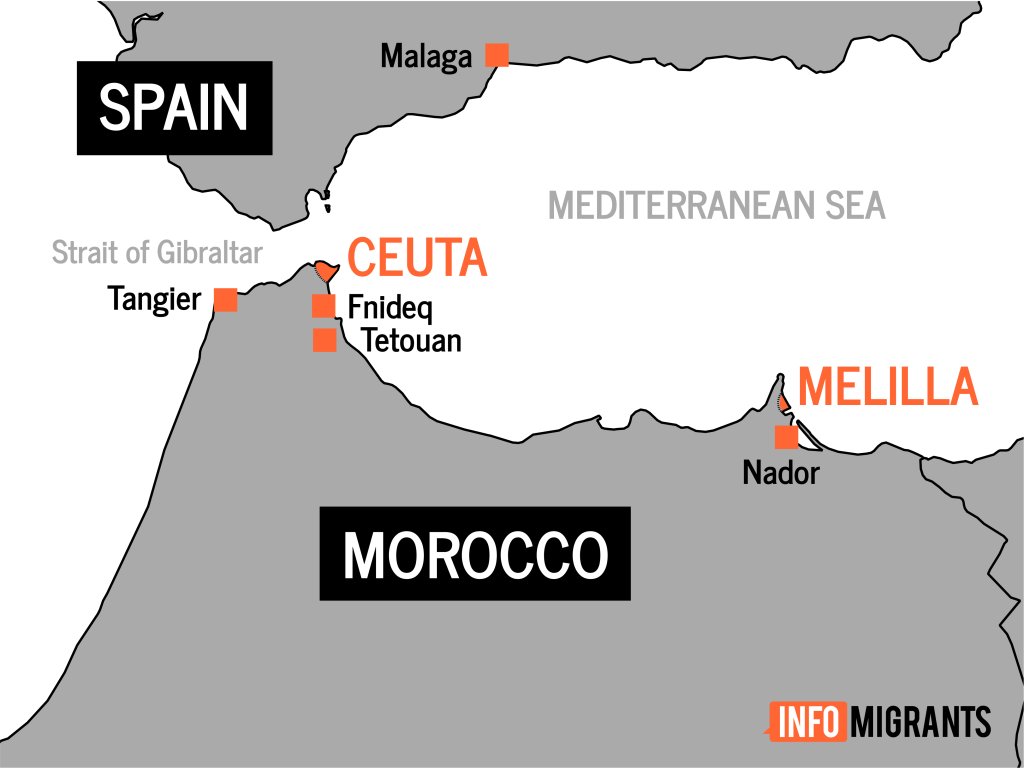
Over 70,000 migrants entered the Spanish North African enclave from Morocco on July 30 and 31, swimming or crossing on foot. At least 100 people died during the attempt, according to Ceuta’s local authorities.
Read Also'In Ceuta, they are eating the cats': Fake images and a persistent rumour
Exploiting migration 'not only to attack Spain, but also to attack Europe and divide it'
Spanish authorities said misleading claims on social media helped encourage the crossings, including a rumour that migrants arriving by sea would be allowed to remain in Spain. Sanchez said the origins and precise causes of the crisis were still under investigation, but mentioned the role of online disinformation.
"After July 30 and 31, there was a spread of rumours and disinformation, from social networks linked both to Russia and to Israel, and to an ultra-right international that always uses migration not only to attack Spain, but also to attack Europe and divide it," Sanchez told the local Cadena SER radio station.
He added that the alleged Russian and Israeli activity was tied to Spain’s foreign policy positions over the wars in Ukraine and Gaza.
Spain has officially supported Ukraine’s right to defend itself against Russia and has provided financial and military assistance. Sanchez has also condemned Russia’s invasion as a violation of international law and has called for stronger Europe-wide defence capabilities. Spain’s position on the war in Gaza has been critical of the Israeli government, with Madrid repeatedly criticizing Israel’s military operations in Gaza.
"It is evident that if Russia is engaged in disinformation on this issue, or if Israel is also spreading disinformation by criticizing the Spanish government, it is not because they are concerned about migration in Spain or Europe, but rather because of the political positions we are taking, which I believe are courageous, regarding the genocide in Gaza or Putin’s invasion of Ukraine," Sanchez said.
Spanish government spokesperson Elma Saiz said the government had "internal reports" from the Foreign Ministry supporting its assessment.
"We have evidence that the radical international, various digital forums from both Israel and Russia, amplified what happened [in Ceuta] with the intention of fracturing and polarizing Europe and Spanish society," Saiz said.
She also said the European Commission had identified Russia as a source of disinformation about the events on August 6.
Read AlsoMorocco: Migrants caught between Ceuta dreams and reality
Russia and Israel deny allegations
Russia rejected Spain’s allegations and demanded that Madrid provide evidence of its involvement. Russian Foreign Ministry spokesperson Maria Zakharova added that accusations needed to be supported by verifiable facts.
"When there are accusations, there need to be concrete facts, which must then be verified. Only after that can an accusation be taken seriously," Zakharova said, adding that there was no information confirming Russia’s alleged role and criticized the Spanish government for making accusations without supporting evidence.
"Any other country could be involved in this situation, since there is no information confirming [the allegations]. Therefore, as we always say, there first needs to be at least some information, not necessarily evidence, but some information to substantiate the concerns or apprehensions on the Spanish side. Then we would discuss all of this in detail," the spokesperson added.
Zakharova also said Russia had other channels for raising complaints, including its embassy in Madrid and the United Nations.
" Madrid did none of that…and immediately rushed to the microphones to make statements without any material to substantiate" the facts, she said, according to Russia’s RIA Novosti news agency.
Israel also rejected Sanchez’s claims, with Foreign Minister Gideon Sa’ar accusing the Spanish prime minister of lying and said the allegations were an attempt to distract from Spain's domestic problems.
"He lied again, astonishingly accusing Israel of spreading misleading information about the events in Ceuta," Sa’ar posted on the social media platform X.
"In his interview with Cadena SER today, he lied again, astonishingly accusing Israel of disseminating misleading information regarding the events in Ceuta. This is a brazen lie. Continuing to spread defamatory lies will not distract from Sanchez's disgraceful failure to manage his country's affairs," Sa’ar wrote.
Read AlsoUnaccompanied minors at risk of sexual assault in Ceuta
How disinformation has influenced migration
A rumour that "the Ceuta border is open" spread rapidly online, and a report by security and intelligence analyst Chema Gil of the University of Murcia found that an online campaign generated 11 million views from early July. Disinformation and digital forensic analysts have argued that social media played an important role in encouraging and motivating people to make the crossing from Morocco into Ceuta.
Social media and security expert Marcelino Madrigal said the messages and groups that contributed to the crisis appeared mainly on Facebook and WhatsApp.
"Rumours, messages and groups that caused this crisis" mainly appeared on Facebook and WhatsApp, Madrigal said, although it was impossible to determine "who or what ignited the flame".
An open-source investigation by technology company Golden Owl concluded "with a high degree of confidence" that the migrant rush "was a deliberately organised operation."
An important element of the online campaign was a distorted interpretation of a July Spanish Supreme Court ruling about migrants arriving by sea. An Instagram post appeared a day after the ruling claiming that migrants who come this way would not be immediately returned, which helped contribute to beliefs that the border had been opened, though legal experts have said that interpretation was incorrect.
The ruling established a different procedure for migrants "intercepted on the high seas", rather than granting unrestricted entry. In addition, even migrants who manage to stay in Ceuta cannot and will not automatically be able to continue onwards to mainland Spain or other European Union countries.
"The person may be returned all the same, it's just that this procedure requires basic guarantees," said human rights lawyer Laura Maria Medina Ferreras, adding that these must "always" be respected.
The events in Ceuta this summer have highlighted how misleading interpretations of legal developments can influence migration decisions when they spread rapidly through social media and messaging services, or when influencers with large followings encourage crossings or attempt the border crossing themselves.
Read AlsoMorocco and Spain bolster borders ahead of August 15 social media calls for renewed crossings
EU pressures big tech to respond to disinformation
Following the surge of irregular migrant arrivals in Ceuta, the EU has increased pressure on technology companies to respond more quickly to harmful disinformation during migration emergencies.
The European Commission said Meta and TikTok had agreed to voluntary measures to strengthen fact-checking, and the Commission, Europol and the platforms increased coordination. A new mechanism was established to help the companies work more closely with local fact-checkers able to identify misleading information as a crisis develops.
"The platforms confirmed that they activated their crisis protocols and... it was decided that an ad-hoc escalation and cooperation mechanism would be put in place," Commission spokesman Balazs Ujvari has said. "For now, we think that this is an effective tool. But of course, if needed, we are ready to go further," he added.
Operating under the EU’s Digital Services Act, the mechanism is intended to help "platforms get better information from the fact-checkers" who can flag "harmful disinformation related to, for example, a potential new mass crossing of the border."
EU tech sovereignty, security and democracy commissioner Henna Virkkunen also called on the platforms to "act decisively" during crises.
"Platforms must act decisively in keeping the integrity of the digital space, in particular during crisis situations," Virkkunen said. "Monitoring must increase, cooperation with fact-checkers to be strengthened," she added.
Meta has responded and said it was monitoring the situation and removing content that breached its policies. A Meta spokesperson said a team was "monitoring the situation in Ceuta in real time and removing content that violates our policies, including content that offers to provide, facilitate or seek human smuggling services."
TikTok said it had strict rules against content encouraging human smuggling or irregular border crossings and said it was working with Spanish fact-checking organization, Newtral, and Moroccan news agency, MapExpress, to monitor developing situations.
EU migration chief Magnus Brunner, meanwhile, described the Ceuta episode as a "test" of the bloc’s border security and "resilience to disinformation."
The crossings were "fueled by criminal smuggling networks and also disinformation," Brunner said, warning that it was "too early" to determine who was behind the online "instrumentalization" of the situation. He added that the EU "must strengthen our capacity to follow misinformation trends on social media, working hand in hand with Europol and all other EU agencies."
With EFE, Lusa, Reuters, AFP, and DPA