
Several thousand foreign seasonal workers swell the ranks of grape harvesters each year to pick the grapes used to make Burgundy wines. This essential workforce requires state officials to organize to welcome them under suitable conditions. Infomigrants went to meet Sudanese and Tunisian migrants working in a vineyard in eastern France.
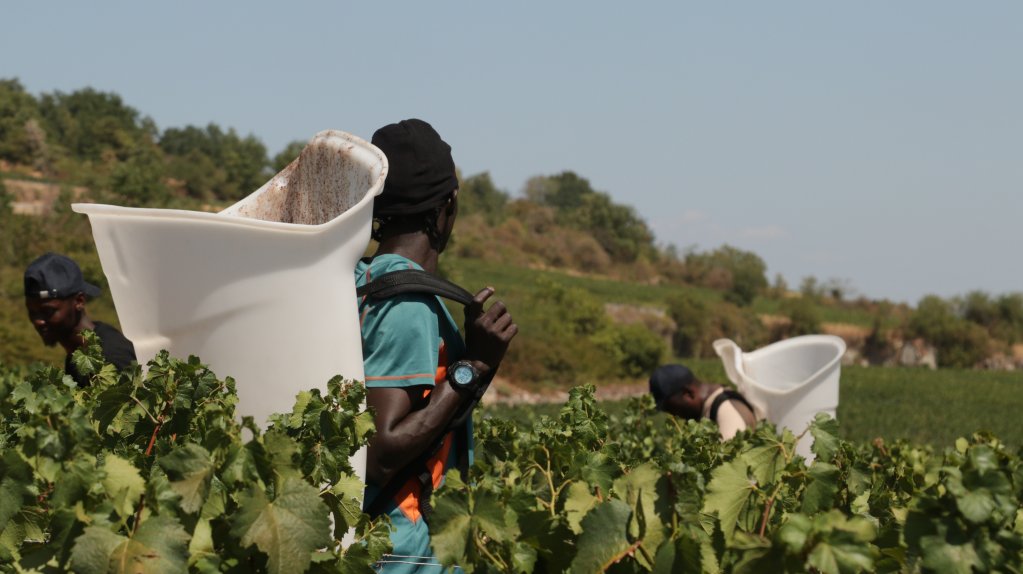
With white baskets on their backs, the grape carriers make trips back and make their way through the rows of vines to collect the bunches of grapes and carry them to the truck. The pickers, meanwhile, are crouching to harvest the bunches. The work is physically demanding, especially in 30°Celcius heat.
In these Burgundy vineyards near Puligny-Montrachet, in the Côte-d'Or region of eastern France, more than 50 people are working this August 19, for the first day of the grape harvest. The majority are Sudanese migrants, hired to pick the grapes between the end of August and the beginning of September.
This is the case for Hicham, 21. Bent over in a row of vines, pruning shears in hand, the Sudanese refugee carefully selects the grapes and discards any damaged fruit. He arrived in France three years ago, after passing through Turkey and then the Greek island of Samos. "I'm training to be an electrician, so I come here during my holidays. In Greece, I worked in agriculture for a year, harvesting tomatoes, potatoes… it feels good to work outdoors," the young man says.
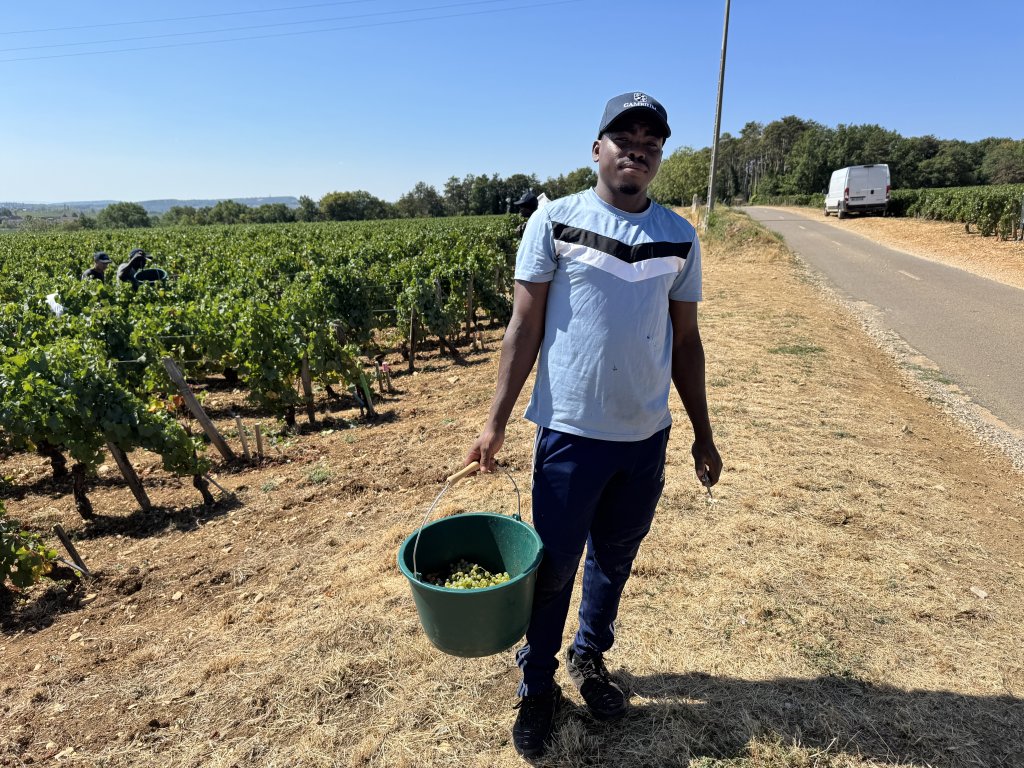
Like him, most of these Sudanese workers have other jobs throughout the year. Few of them see vineyards as an industry they can envision a future in. "During the grape harvest, we work for a maximum of one month, whereas in construction, I find longer contracts. I just finished a 22-week fixed-term contract in Tours on a construction site," Mohammed explains. He fled the war in Sudan before obtaining refugee status in France in 2025.
Read Also'I fell in love with the vineyards': An Afghan refugee who became a winegrower in Alsace
A solution to the labor shortage
More than 38,097 workers were employed during the grape harvest in 2025, according to figures from the social protection organization for agricultural workers (MSA). Among the newly registered workers, more than 9,300 were foreign nationals, representing at least 24 percent of the harvesters. While the majority come from Europe, workers from Morocco, Tunisia, and the Democratic Republic of Congo are also very numerous.
In these vineyards of Puligny-Montrachet, this team of Sudanese workers is employed by Cambium, a wine services company, to which the estate owner subcontracts the entire harvest management process, from recruiting and welcoming the grape pickers to working in the vineyards. This is a common practice in the region.
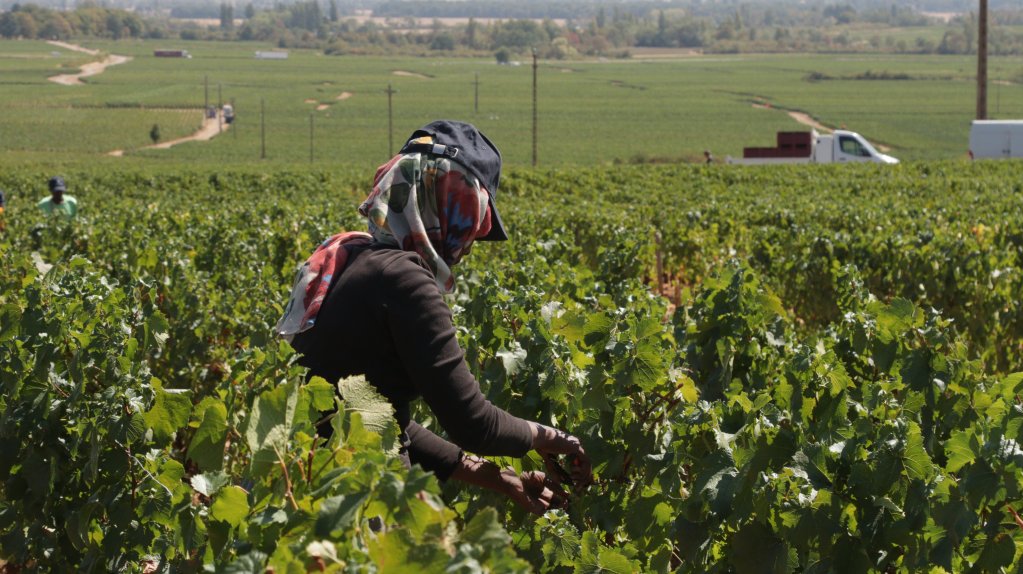
"Our vineyard has grown rapidly. However, finding and training skilled people takes time. Using a service provider allowed us to find a short-term solution to our labor shortage," one of the vineyard owners using Cambium's services explains. He wished to remain anonymous.
Many winegrowers in the region are seeing a local decline in job searches. Some find themselves understaffed when the harvest begins.
Read Also'The scars will remain': Boureima, a victim of human trafficking among champagne workers
A dual subcontracting arrangement
Julien Palys is the head of Cambium, a former vineyard manager himself. This August 19, he is supervising the first day of the harvest.
Seasonal workers of various nationalities work side-by-side in the Burgundy vineyards. Julien Palys also regularly employs Tunisian workers, notably through Walid, a Tunisian he hired as a seasonal worker in November 2025, and his brother, Abderrahmane. "Once you know someone, everyone spreads the word, and it's quite quick to find workers," he explains.
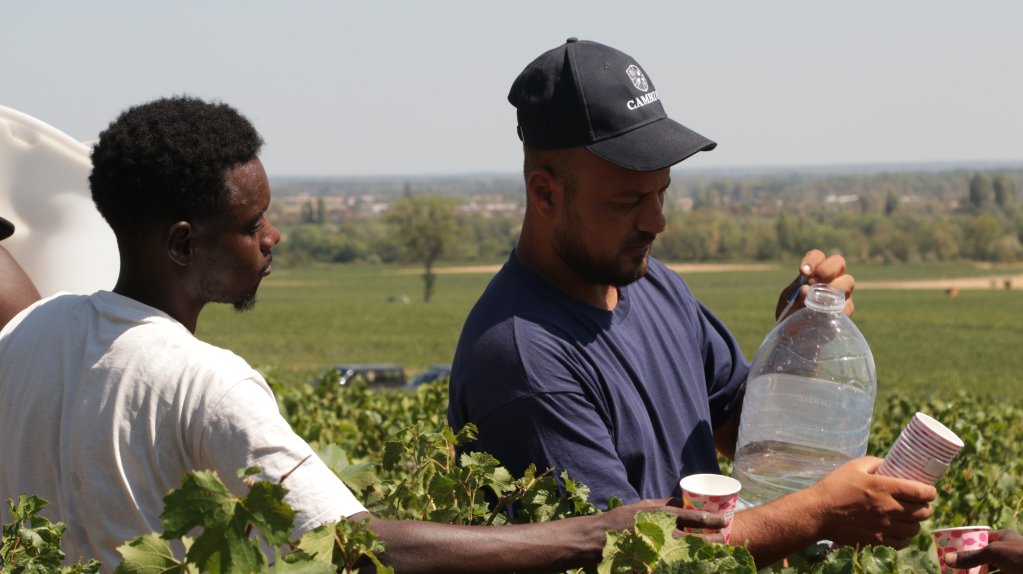
To recruit Sudanese migrants, however, Julien Palys used a subcontractor, who will also manage their pay. He told InfoMigrants that his Sudanese employees are paid the same as his direct employees, namely €14.50 gross per hour, with an €8.70 meal allowance. This is more than the minimum wage. "The contract clearly states that the subcontractor must strictly adhere to the pay offered to Cambium employees," he insists.
But this information has apparently not been communicated to the seasonal workers. One of the grape harvesters interviewed says he doesn't yet know how much he will be paid for this day's work.
The use of multiple subcontractors to recruit seasonal workers is viewed very unfavorably by unions. And for good reason: it "increases the risk of labor law violations, such as wage deductions," Frédéric Pissot, departmental delegate for the General Confederation of Labor (CGT) in Côte-d'Or stresses.
For seasonal workers employed for the grape harvest, the day begins around 7:00 am, to avoid the intense heat, and ends at 3:30 pm with a 30-minute lunch break and two 15-minute breaks during the day. Working conditions are sometimes demanding, but Mohammed considers them "less difficult than in construction."
Around 10:30 am, they are offered a snack of coffee, bread, and chocolate. A convivial moment, but one that Julien Palys also used to lay down a few "rules": "Water is precious, guys; we don't use it to splash water on our faces. I'd like to wash my face too! What's next, washing our clothes?" he called out.
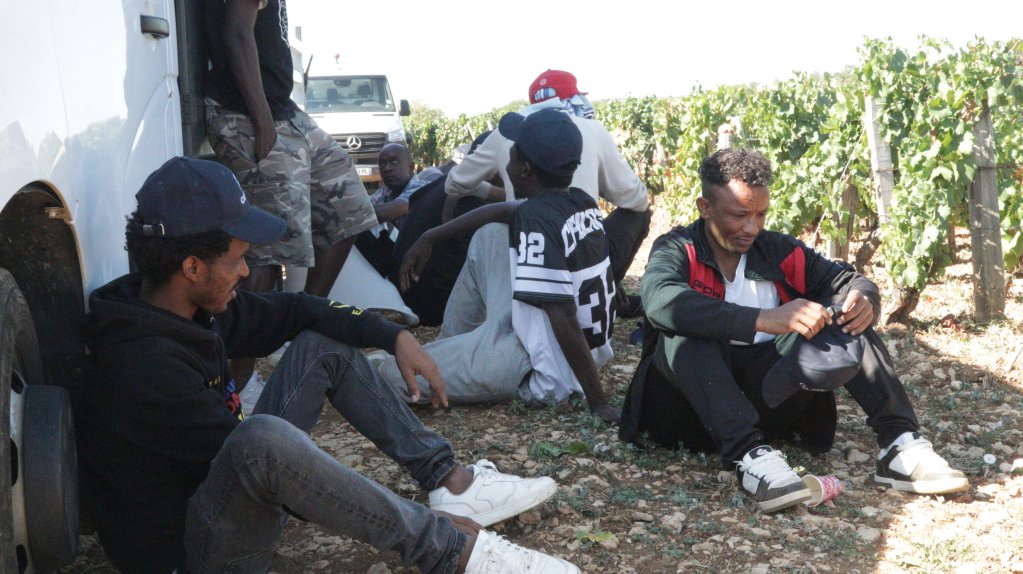
Given the heat, lunch was taken sitting on the ground, in the shade of the trucks. Cambium chose not to take care of cooking meals for health reasons, but instead offered a meal pay bonus. The seasonal workers therefore brought their own lunches.
Cases of substandard accommodation
Agricultural landowners have certain obligations regarding the housing, meals, and equipment of the grape harvesters.
This group of Sudanese seasonal workers is staying in Dijon, a city more than 50 kilometers away, during the harvest. They therefore make the commute every day. Four black minibuses were made available to them for this purpose.
Many of them live in Dijon year-round and therefore have apartments there. But some live in Paris. So, they have to figure out accommodation plans themselves. This is the case for Hicham, who lives in Grigny, in the Paris region, and is "staying with a friend."
Faced with these constraints, some landowners prefer to delegate the organization of accommodation and meals to service providers, even though they remain legally responsible for welcoming employees and ensuring compliance with labor laws on their properties.
This system is criticized by several labor unions because abuses abound. In September 2023, substandard accommodation for more than 70 Spanish grape harvesters was discovered in the Côte-d'Or region.
Walid experienced these poor working conditions with his previous employer. "Last year during the harvest, we lived in a campsite, sleeping in a mobile home on the floor without mattresses or blankets. When it rained, we worked without rain gear or boots," he describes, stressing the radically different situation now.
"These situations are rare," Ségolène Tritschler, Deputy Director of the Business and Occupational Health and Safety division at the MSA Bourgogne (the Burgundy branch of the French agricultural social security system) says.
Read AlsoFrance: Authorities accused of seizing phones of unaccompanied minors in north of country
Securing employment in the vineyards
To limit these situations, local stakeholders are organizing. The Burgundy winegrowers' professional association, the labor inspectorate, and the MSA established the "Qualiterritoires" label in 2025, which sets out specifications for wine service companies.
The labor inspection authorities and the MSA (Agricultural Social Security Fund) also say they have increased their vigilance during the grape harvest. Frédéric Pissot, of the CGT labor union in Côte-d'Or, regrets, however, that there aren't more labor inspectors to detect unacceptable working conditions, particularly regarding housing.
According to Ségolène Tritschler, Burgundy winegrowers are working towards better working conditions for seasonal vineyard workers. These conditions, she argues, guarantee "quality products.”
This quality is also the result of the seasonal workers' experience. Beyond the harvest season, the group of Tunisian workers employed by Cambium works for about 15 wineries for six months of the year.
This allows them to gain experience in all aspects of a sector facing a labor shortage. "I started at the end of December 2025 with pruning and shoot thinning, and until the harvest in August, I learned everything that goes into working in a vineyard," Walid explains.
And this expertise is also valued by winegrowers. "These pruning and bud-inducing stages are what structure the vine. It's essential to have trained and competent people to carry them out," the estate owner explains.
Walid now hopes that this experience and the length of his contracts will allow him to sign a permanent contract at the end of the year, as planned. He hopes to follow in his brother's footsteps and settle permanently in France.