
More and more families, single women, and women with children are staying at the France-UK border. This more vulnerable population is at greater risk of trafficking, exploitation, and sexual violence.
On July 30, at around 6:30 am, a French vessel deployed to monitor a migrant boat heading towards England discovered "three unconscious people on board." The victims were pronounced dead upon arrival at the port of Dunkirk, after their evacuation. They were three women, the Dunkirk prosecutor's office later confirmed, adding that an investigation had been opened.
A few days later, 173 migrants were rescued following a shipwreck on August 4. Among them, more than 50 were women and children.
These two tragedies illustrate the increasing number of women, children, and families among the migrant population staying along the northern coast of France.
This phenomenon has been observed by aid organizations working on the ground. "We've noticed that sometimes, around 50 percent of the people who remain after an attempted crossing are women and children," Angèle Vettorello, co-coordinator of the local branch of the Utopia 56 association in Calais, explained. According to her, "40 percent of the Loon-Plage camp" is made up of women and children, and the increase is affecting “the entire coastline.”
This increase is not "exceptional," but "it has been going on for over a year," Léa Biteau, project manager at Secours Catholique (Catholic Relief Services) in Calais, commented.
'People are staying longer on the coast'
The same sentiment is echoed by the Refugee Women’s Centre (RWC), an organization specializing in supporting displaced women and families living without shelter in northern France. According to Célia Prével, coordinator at RWC, this increase "has become increasingly visible" since 2024.
According to figures provided to InfoMigrants, the organization has already taken in more than 3,000 women since the beginning of the year. This number was projected to reach 5,200 in 2025, compared to 2,200 in 2024. Regarding children, 2,100 were taken in by the center in 2024, compared to 5,500 in 2025. Since the beginning of 2026, the number has already reached 3,100.
According to the associations, this increase is simply linked to the general rise in the migrant population on the coast. They argue that this is a direct consequence of last winter's poor weather, the tightening of European policy, and increased border controls. "There are fewer crossings, so people are staying longer on the coast," the project manager at Secours Catholique (Catholic Relief Services) noted. "Sometimes, people spend several days in the dunes waiting to board a boat," Angèle Vettorello added.
This increase in the overall population was confirmed by French state authorities to La Voix du Nord newspaper in early August. According to them, between 840 and 910 migrants were present in the Calais area. This figure is "up compared to the same period last year." As for arrivals in the United Kingdom, they are down sharply. Since the beginning of the year, 15,897 migrants have reached the English coast, compared to 27,997 over the same period in 2025, representing a 43 percent decrease. At the end of April, Interior Minister Laurent Nunez estimated that successful Channel crossings since the beginning of the year were down 56 percent compared to the same period in 2025.
'There are very few protection mechanisms for children and women'
The situation of these families, mostly from Eritrea, Afghanistan, Sudan, or Somalia, is worrying to local stakeholders. Upon arrival on the French coast, they are only entitled to one night in emergency accommodation before being forced to live in camps. "But this population is far more vulnerable," Angèle Vettorello stressed, citing in particular the increased risks of sexual violence, human trafficking, and sexual exploitation.
Locally, "there are very few protection mechanisms for children and women," Léa Biteau said. "We do the best we can with the resources available to us, but they are limited."
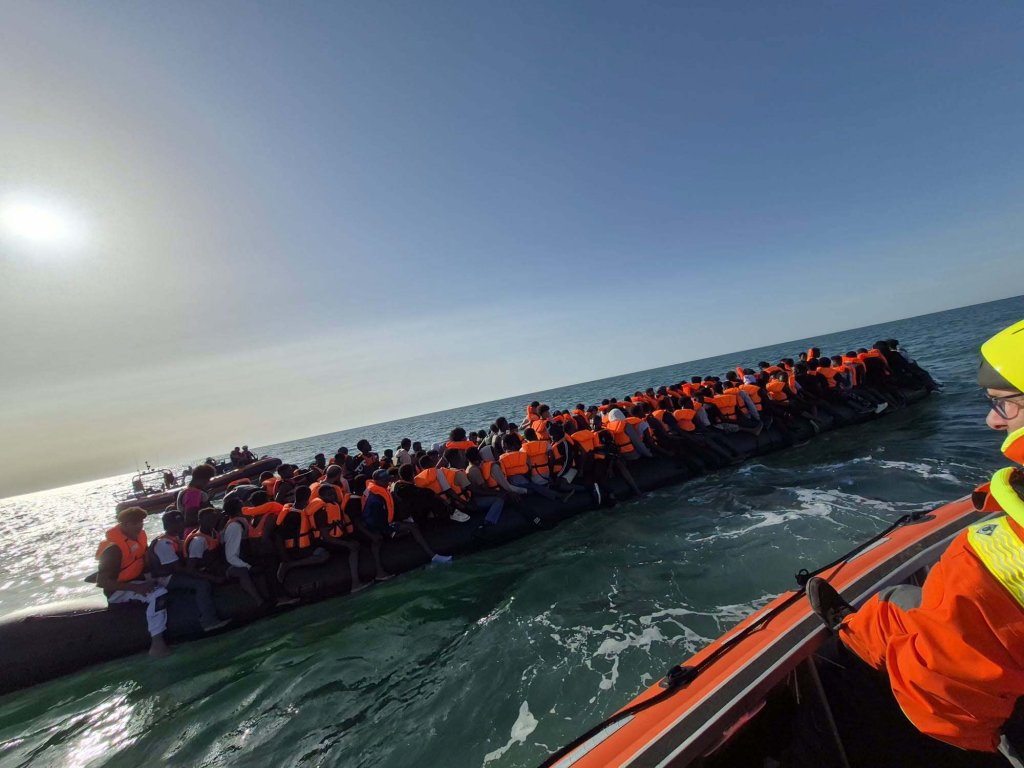
The presence of women and children at the time of boarding can also be a source of risk, especially considering the increasing size of the boats. On August 10, a boat carrying 230 migrants – including women and more than 20 children – reached England. Rescuers on the scene described a chaotic boarding from the French beach. "A veritable human tide surged towards the approximately 15-meter inflatable boat. Because it was overcrowded, several people were thrown from the vessel. About 30 of them found themselves in the water as the boat continued on its way. With the rising tide, part of the group quickly became isolated," the rescuers recounted. A particularly dangerous situation for women and children.
The larger the boats, the larger the crowd in the water and the greater the risks. "So many people trying to board a boat already in the water at the same time is a completely different situation. These are more complex boarding methods," the coordinator of Utopia 56 commented. "And potentially more fatal accidents."