
Rwandan authorities have announced that they've entered initial talks with certain EU governments on potentially hosting return hubs for migrants. Prior to the announcement, Italy had already confirmed having held discussions with Rwandan authorities on reaching a migration-related cooperation agreement.
Rwandan government spokesperson Yolande Makolo told the AFP news agency that the country had held "some initial discussions with some European countries" on a close migration-related cooperation deal, and announced later on local media that these talks were still ongoing.
"[B]ut nothing has been decided," she stressed in a radio interview.
Makolo emphasized that the discussions were chiefly based on Rwanda's "general approach and experience on the migration issue."
Makolo meanwhile also highlighted the fact that there was "no agreement yet" on any kind of deal and that at the current stage, the focus of the talks were mainly on establishing an "emergency transit mechanism" to serve as "a safe place for families who are stranded ... have nowhere else to go, or are in danger for various reasons."
She added that in this scenario, such families could spend time in Rwanda in preparation for returning to their countries of origin — or while waiting to be resettled in another country as refugees.
Read AlsoWhat the new EU migrant 'return hubs' deal means in practice
Divisive subject: EU 'return hubs'
The move comes after EU officials in June approved the principle of allowing certain failed migrants to be sent to third countries, where they would be placed in so-called "return hubs."
These facilities would not be run by the European Union directly; instead, individual EU member states will be allowed to operate such facilities in countries situated outside the bloc.
A number of member states, including Italy, Germany, Austria, Denmark and the Netherlands, have expressed interest in establishing such facilities jointly, and had previously announced that they have entered talks with a number of nations to this end.
The return hubs would exclusively be designed to house migrants who have no right to stay in the EU but cannot be sent back to their home countries.
However in many cases, they might exclude family units, which often benefit from special protections in the EU.
Read AlsoEU reported to be considering 12 possible countries to site migrant 'return hubs'
Italian push for outsourcing irregular immigration after Ceuta events
Two days earlier, Italy confirmed that it was already working on reaching an agreement with Rwanda to send some irregular migrants there.
At an emergency meeting of EU interior ministers, Rome implied that other member states should also urgently join their initiative on pushing for similar solutions following the sudden arrival of an estimated 70,000 people in the Spanish enclave of Ceuta in North Africa last month.
The irregular border crossings resulted in more than 70 deaths.
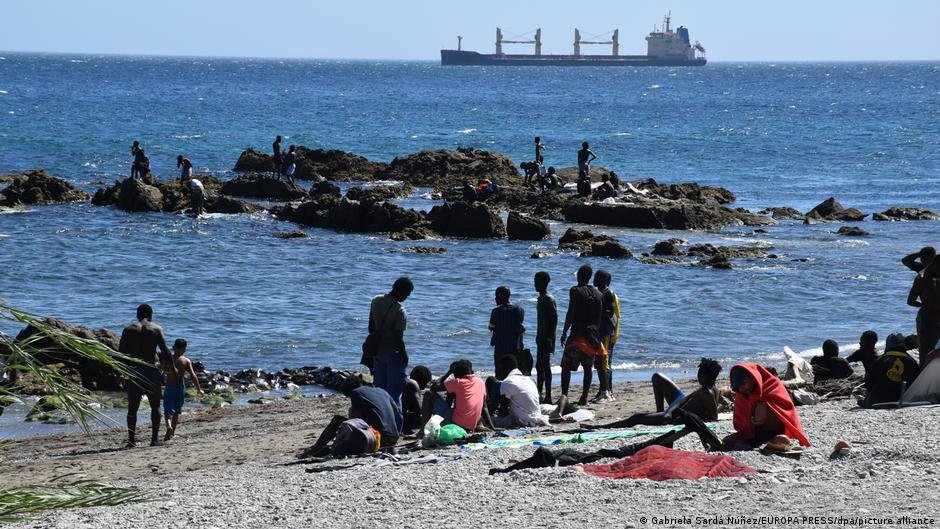
Italy suggested that return hubs outside the bloc could also serve the purpose of hosting such immigrants who arrive in the EU irregularly.
Italy already operates similar migrant detention centres in Albania, which were built to house people that its coast guard intercepts at sea; while applying for asylum, they are housed at two facilities in the non-EU nation until they are either accepted into Italy — or rejected.
The facilities in Albania only hold men; women, children, the elderly and infirm individuals are exempted from the regimen. However, the original function of the Albanian centers has had to be modified, after the majority of those picked up directly at sea became the subject of court orders and were sent back to Italy. Now, the few migrants and rejected asylum seekers who pass through Italy's Albanian centers tend to have already been in immigration detention in Italy and are transferred to Albania before being sent home.
Read AlsoEU Parliamentarians say they have been blocked from visiting migrant detention centers in Albania
Echoes of previous UK-Rwanda deal
The announcement of the discussions comes two years after the UK abandoned a similar deal with Rwanda, which had been reached under the former Conservative government.
Under that agreement, migrants who had no legal right to be in Britain but had demonstrably arrived in the country via "dangerous or illegal journeys" would have been sent to Rwanda to have their cases reassessed with a view to being settled there.
However, that deal was scrapped after the Labour government replaced the Conservative administration in 2024.
Rwanda meanwhile is also one of the African nations — alongside Uganda, Ghana and Eswatini among others —that have agreed to take in deported migrants from the United States, receiving an undisclosed amount of funds in return.
Read AlsoUK:The end of the Rwanda plan
with AFP