
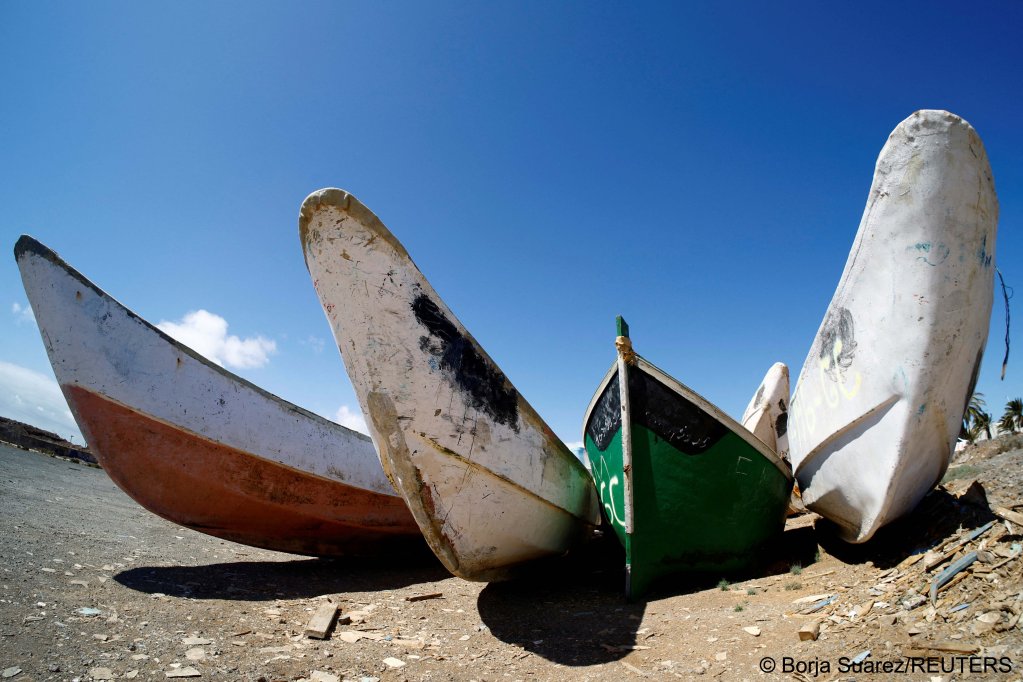
At least 133 people were saved during a maritime operation just off the Canary Island of El Hierro on August 4. Among those rescued were six minors and two women. The search-and-rescue effort for the migrants involved the deployment of multiple Spanish coast guard vessels for two days.
The canoe packed with dozens of irregular migrants had been missing in Atlantic waters for two days until a surveillance aircraft operated by the Spanish coast guard located it in the late morning hours of Tuesday, August 4.
The migrant boat was found drifting about 26 kilometers away from the island of El Hierro, which is the southernmost and westernmost island of the Canaries.
The local news outlet La Voz Canaria said that "[a]ccording to initial impressions," the rescuees appeared to be in sound health; however, a team of medical professionals — including the Red Cross — were nevertheless dispatched to El Hierro's main port of La Restinga to examine the migrants once they were safely brought ashore.
Only two people reportedly had to be taken to hospital for the treatment of minor injuries. Some news outlets meanwhile said the number of rescued migrants might have been as high as 140.
There has been no official statement on the number of people on the canoe nor about their nationalities though it is believed that they were mainly of sub-Saharan African origin.
One local news outlet said that the irregular migrants were nationals of The Gambia, Senegal, Mali, Burkina Faso, Nigeria and Ivory Coast.
Read AlsoMigrants from Africa brave deadly Canary Islands crossing
Intense search effort lasting 48 hours
The search operation, launched on August 1, was officially closed after the small migrant vessel was recognized as the missing canoe.
As proof, officials compared the migrant boat with photographs taken by a Portuguese military vessel on the day the canoe had gone missing, identifying it positively.
The two-day search effort was of a particularly severe intensity, involving three maritime vessels, a surveillance aircraft as well as a helicopter, and being coordinated by multiple maritime rescue centers — chiefly from the nearby island of Tenerife.
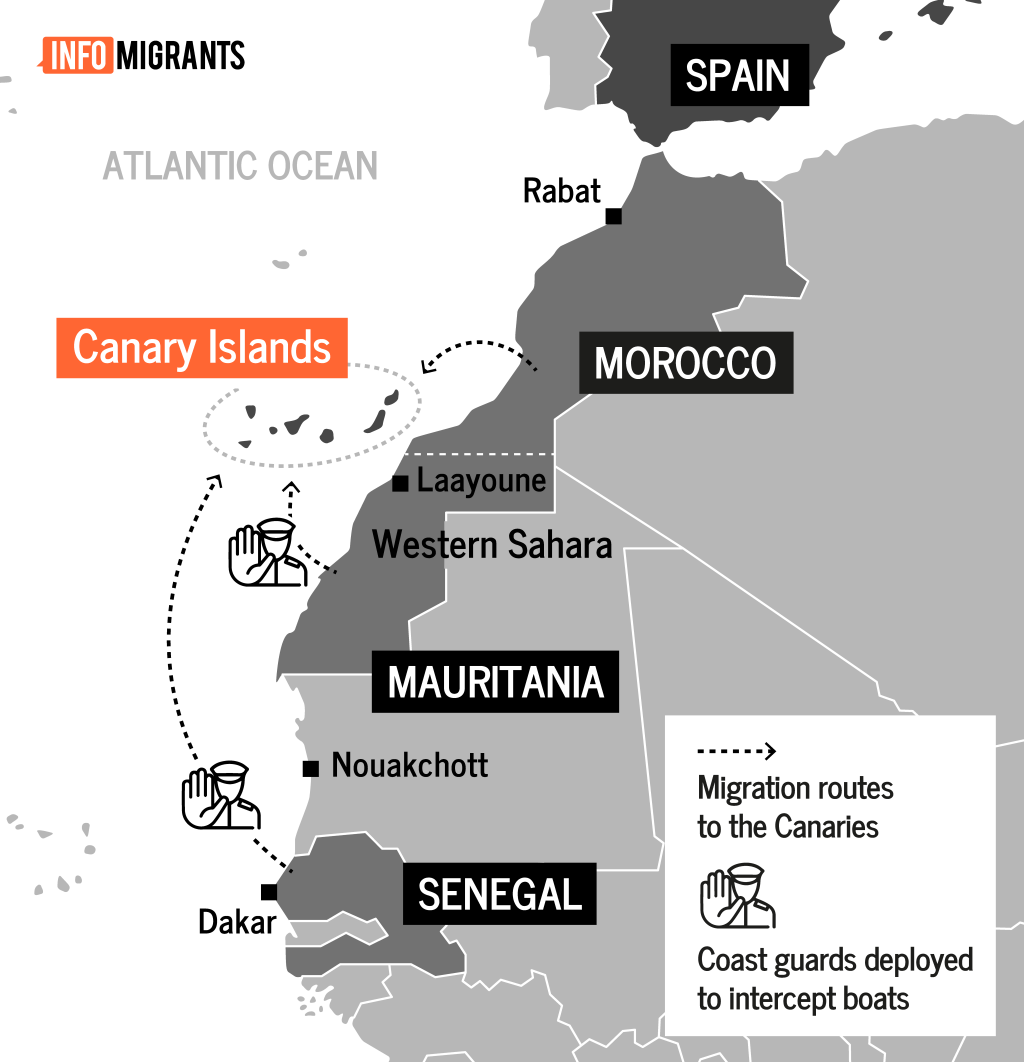
According to some reports recounting eyewitness accounts provided by the rescued migrants, the large group had departed from near Banjul, the capital of The Gambia, located about 1,600 kilometers south of the Canaries.
They said that the journey to the environs of the Spanish archipelago took 11 days in total.
Read AlsoSpain: Multiple arrests in connection with deaths in Atlantic waters last month
Migrants in police custody until imminent transfer to mainland Spain
It is expected that all adults will be transferred to other parts of Spain, as the Canary Islands continue to lack sufficient capacities to care for the numbers of irregular migrants that arrive on their shores.
In the case of the six minors, however, it is unclear at this point whether they are unaccompanied children; if it is established that they were traveling with either or both of their parents, they will be kept as a family unit and transferred together.
If they turn out to be unaccompanied minors, they could end up staying in one of the Canary Islands and being taken into care there; a transfer deal to the Spanish mainland for unaccompanied minors was only finalized last year following several legal hurdles, and involves individual applications rather than a blanket transfer.
Read AlsoSpain: Renewed disagreement over handling of unaccompanied minors in Canaries
The migrant canoe was the first to be rescued near El Hierro this month after several similar vessels had been intercepted in the same search-and-rescue area last month.
Also in July, one migrant vessel managed to actually land on El Hierro without help by maritime authorities; however, a woman and a baby died as part of that incident.
The Atlantic migrant route from Africa to the Canary Islands is considered to be the deadliest maritime migration journey in the world; in the first six months of this year, more than 1,300 people have died or remain missing on this route alone, according to the Spanish NGO Caminando Fronteras.
Read AlsoSpain: 165 migrants rescued off Spanish Canary Islands, one dead
Increasingly daring journeys to Spain's Canaries
Migrants hoping to reach the Canary Islands are increasingly resorting to more and more extreme measures, attempting to cross from West African nations with less maritime oversight than those closest to the Atlantic archipelago, which have a strong coast guard and navy presence off their coasts.
Nearby African nations including Morocco, Mauritania and Senegal have close cooperation deals with the Spanish government to stop migrant vessels and bring them ashore.
Despite a steep overall drop in arrival numbers, thousands of people continue to succeed in reaching the Spanish territory in the Atlantic Ocean, which is part of the European Union.
Read AlsoMauritania rescues 216 migrants as 144 reported dead or missing on Atlantic route