
Authorities in Ceuta estimate that more than 1,000 unaccompanied minors remain in the territory after around 72,000 entered from Morocco last week. Local authorities have asked that they be transferred to Spain amid alarms about overcrowding of suitable reception facilities for them.
Local authorities, in Spain's North African enclave Ceuta, have reported that around 1,100 unaccompanied minors remain in the territory, despite the majority of around 72,000 migrants having been returned to Morocco.
Speaking on public broadcaster RTVE, Ceuta Mayor Juan Jesus Vivas, said that the city is scrambling to manage the needs of an estimated 1,100 juvenile migrants amidst government facilities that were made to house less than 100. "We are crying out for help and assistance," he reportedly said.
Local media reports describe the minors as crammed into warehouses at the Tarajal border, while others sleep out in the open on beaches, streets and alleyways. Some have bandaged arms, injuries they reportedly sustained while attempting to swim across the border. Some were allegedly inflicted by the police.
A 17-year-old boy named Youssef told local media outlet El Faro de Ceuta, that he had traveled alone. His mother, who is a single parent, is sick. He said he made the journey to find work so he could take care of her, even if it meant being away from home.
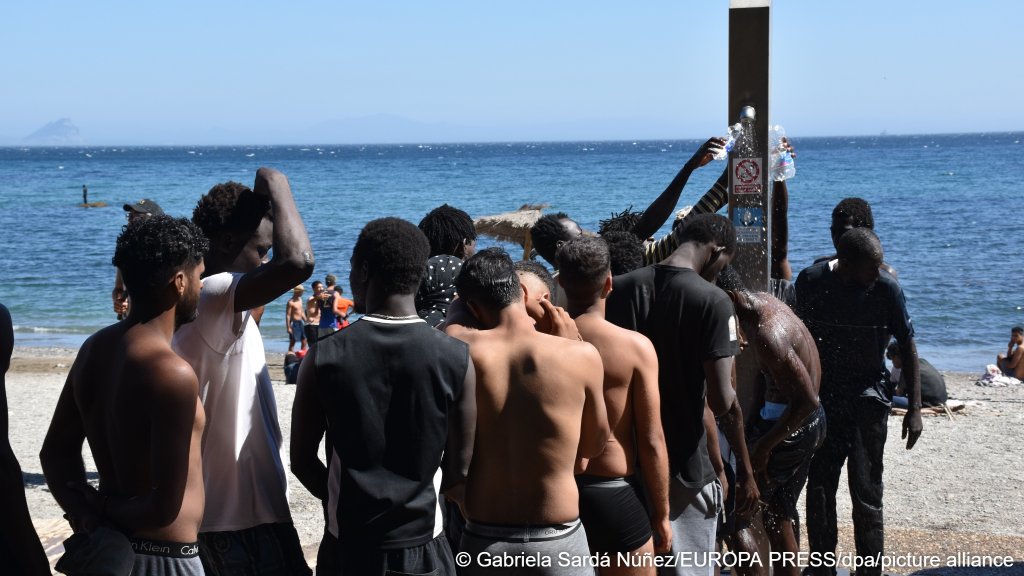
Local organizations report distributing thousands of meals a day while authorities rush to establish makeshift sanitation and accommodation facilities.
El Faro also reported a mixed reaction from the residents of Ceuta.
“It’s been very painful. It’s a catastrophe, and honestly, both they and we are victims. They are victims because they are being used as a weapon of war, and we are the ones who are left to deal with the consequences," said one resident.
Meanwhile, another resident said, "this is unsustainable, you can see it for yourself…thank goodness they’re not aggressive after all, because otherwise there would have been a civil war."
Others reported to feeling abandoned by state authorities, and said that they hope those who had arrived will eventually leave.
Read AlsoWho is responsible for the Ceuta border surge?
Particular risks for young girls
Spain is now struggling to quickly identify minors in the group and distribute responsibility for their care across the country.
Spain’s immigration policies assign the city responsible for children found within its territory but provides for redistributing unaccompanied minors from territories experiencing an emergency situation.
These transfers require identification, confirmation of age, individual files and the cooperation of receiving regions.
The Ministry of Youth and Childhood announced it would approve funds of 25 million euros to Ceuta to strengthen care for unaccompanied migrant children. Two educational centers will be designated for shelter specifically for young girls.
Humanitarian organization, Save the Children has called on the authorities to expedite the distribution of unaccompanied children and teens to the different autonomous cities of the country to "alleviate the pressure on the city's protection system and guarantee adequate care for all minors."
In a statement, Save the Children warned that unidentified children could remain on the streets or in unsuitable facilities, exposed to trafficking, violence and other exploitation. The organization specifically warned of the risks faced by young girls.
One local resident, named as Hamza Sitouni Moreno, told the news agency Reuters that he had taken some of the children he found to local authorities but been turned away. He told the news agency he had one young girl sleeping in his car for safety, and had built makeshift shelters for other children and provided them with food and blankets.
"So many people arrived ... the authorities cannot handle this," he said.

Invisible and at risk
"In a crisis of this magnitude, girls and adolescents can become especially invisible. It’s not enough to count how many children and adolescents have arrived: we need to know who they are, where they are, and what their needs are. A teenage girl who is alone and outside the system can be extremely vulnerable to violence, exploitation, or trafficking," Jennifer Zuppiroli, migration specialist at Save the Children in Spain said.
The Spanish government allocated 2.3 million euros to Ceuta to combat gender violence in 2026.
In a letter addressed to the Ceuta health and social services councilor, Minister of Equality María Guijarro warned of the "extreme risk" of sexual and physical violence, trafficking and sexual exploitation faced by girls and offered to collaborate on safeguards for migrant women. Furthermore, the minister said that Ceuta could access the State Pact against Gender Violence funding to help with its response.
While, it is is difficult to assess the number of young females and children who made their way to Ceuta, latest Eurostat figures as of July 2026 indicates that overall, unaccompanied minors seeking asylum in Spain are mostly male. However, the numbers indicated a major increase in the number of female asylum seekers from 2024 to 2025.
In 2024, 75 of the total 910 juvenile migrants seeking asylum were female, translating to about 8 percent. In 2025, there were a total 3,210 recorded minors of which 1,185 or about 37 percent were female.
Read AlsoEU agrees to send border aid to Spain after Ceuta talks
Internal opposition from some regions to transfers
While regional governments are obliged to assist overstretched territories in emergencies, it remains unclear if Spain's conservative People's Party and far-right Vox – which jointly run four regions – would accept migrant minors, reported the news agency Reuters.
On Wednesday (August 5), all four of their regional coalition governments indicated they would challenge any such order, with Vox's leader saying "not one euro" of Spanish money should go to the migrant minors in Ceuta.
Even if regions accept them, experts warn that the process of identification and relocation could take months, requiring individual interviews, reports and contact with countries of origin to rule out returning them to their families, explained Reuters.
A lawyer representing humanitarian charities in Ceuta, who declined to be named because they were not authorised to speak to media, said the authorities and police were currently focused on registering minors under 15, but that there could be thousands more young people still to be identified in the city.
Since a legal reform passed in 2024, allowing for the transfer of minors to different regions in the case of emergency, reported Reuters, a total of 719 minors have been transferred from the Canary Islands to the Spanish mainland and more than 400 minors have been relocated from Ceuta, according to government data to April 2026.
Inter-territorial solidarity is necessary so these minors end up in other locations where they will be better off," said Miguel Angel Perez, a government representative in Ceuta, on Wednesday (August 5). "The law must be upheld.
Meanwhile though, a representative for the conservative PP party, and the Madrid regional government's president Isabel Diaz Ayuso said the young migrants should be sent home. "I can't see Spain abandoning its children to their fate in another country," she posted on X. "It's inhuman, every country should take responsibility for its own children and citizens."