
An Afghan father of two, who says he fought alongside Western allies against the Taliban, has been returned to France under the UK and France’s controversial "one in, one out" migrant returns deal, just weeks after crossing the English Channel. The former soldier says he wanted to try his luck in the UK after his asylum applications were rejected in Austria.
A 28-year-old Afghan soldier who was flown back to France from the UK just weeks after crossing the English Channel said he had decided to make the journey and "try his luck" in Britain, outside the European Union, after his asylum applications were rejected twice in Austria.
"I fought with your armies," Haidary Hamedullah told French news agency AFP in Paris, referring to the Western-led coalition that fought the Taliban alongside thousands of Afghan soldiers before US and allied NATO forces withdrew in 2021. The withdrawal left many of those who had supported the coalition behind, exposing them to the risk of Taliban reprisals.
"People like me have nowhere in the world to live in safety…Where should we go?" Hamedullah asks.
Read AlsoUK: Prime Minister Burnham promises to be 'relentless' on migrant Channel crossings
Afghanistan to Greece to Bulgaria to Austria
Hamedullah is among the 1,087 people the UK has expelled to France under the two countries' so-called "one in, one out" migrant returns agreement, AFP reported on Wednesday (August 5). His wife and two children, who turn eight and 10 this year, are still waiting in Pakistan. Hamedullah said he had to flee Afghanistan to Pakistan with his family after the Taliban regained control of the country in 2021.
Traveling alone from Pakistan, he made around a dozen attempts to enter Europe through Greece and later Bulgaria before finally succeeding.
After being stopped by police in Austria in June 2022, his asylum application was rejected twice. He said that after he had tried all the pathways for international protection in the European Union in February, he decided to try his luck outside the bloc by crossing the English Channel from France to the UK.
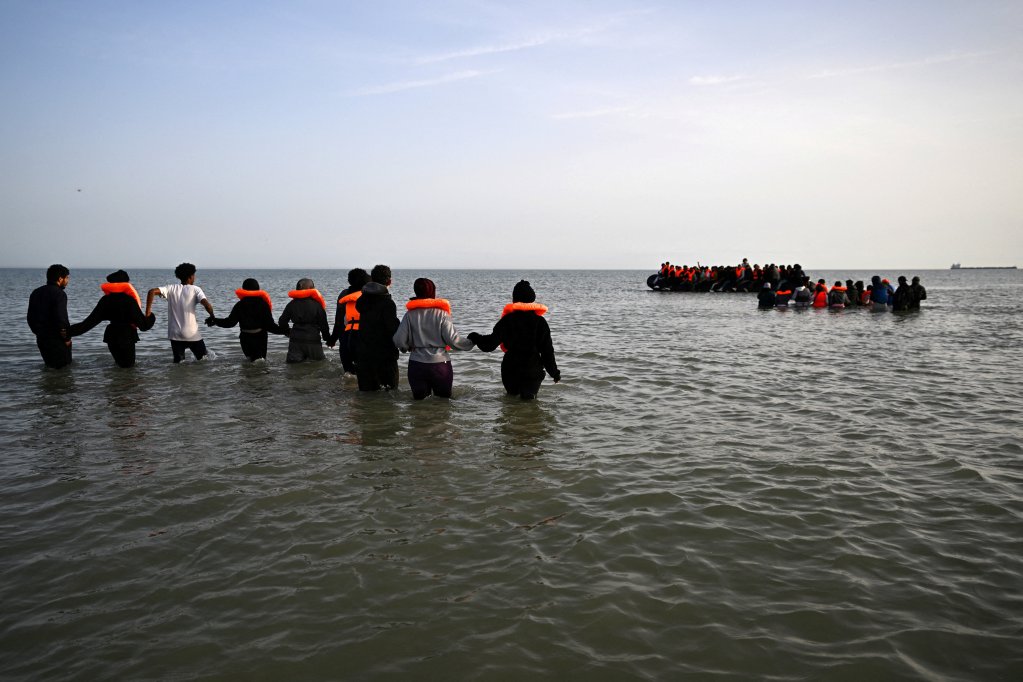
In the French port city of Dunkirk, he said he paid 1,500 euros to people smugglers for a place on a dinghy bound for England, but was stopped by French police on his first attempt. On a second try in April, he spent eight hours hiding on the beach before wading into the water with other migrants to board a small boat undetected. The vessel made it across the Channel to the English coastal town of Dover.
After arriving, women and children were taken to hotels, while men traveling alone, including Hamedullah, were detained. "Authorities who interviewed me told me that I 'shouldn't be here'," he said. He was transferred to a detention center near London's Heathrow Airport, where he was held with about 350 other people.
"We were all depressed…We ate, waited, doing nothing," he said.
Hamedullah said he was assigned a lawyer, with whom he could speak to for about 30 minutes. Fifty-one days later, he said he was flown back to France, where he now fears he could eventually be returned to Austria.
Read AlsoChannel crossing: French coast departures claim more lives as migrants attempt to reach UK
What is the 'one-in, one-out' agreement?
Under the 'one-in, one-out' deal, which entered into force on August 6 in 2025 and has since been extended until the end of September 2026, the UK can return migrants to France if they crossed the Channel irregularly and are considered ineligible for asylum. In exchange, the UK agrees to accept an equivalent number of migrants in France who have not tried crossing the Channel via a small boat, and who are eligible for asylum by other routes. By the end of June, the UK recorded 1,117 migrants through the scheme in return for the forced returns carried out to France.
Both France and the UK claim that the arrangement helps tackle people smuggling networks and discourages migrants from attempting the often deadly journey to England’s southern coast, but dozens of human rights defenders have condemned the deal, saying it causes even more harm to people who have already suffered persecution, war, exploitation, or torture, as well as a high-risk journey across the Channel.
More than 41,000 migrants arrived in the UK by small boat last year, the second-highest annual figure since records began in 2018.
This was based on a feature from the French news agency Agence France Presse (AFP).