
Following more than 60,000 arrivals in Ceuta by swimming or land in 24 hours, theories and political opportunism abound. One of them often resurfaces: the mass arrivals are supposedly due to the regularization plan implemented by Spain. However, that theory is not bourne out by the facts. The regularization campaign ended more than a month ago, and those granted legal status were workers already present in the country, meeting specific criteria. Several other reasons exist, given the absence, at this stage, of an official statement from Rabat.
Nearly 60,000 people entered Ceuta in 24 hours (between the morning of July 30, and the night into July 31), according to Spanish authorities on July 31. These migrants arrived by swimming or by land from Moroccan territory.
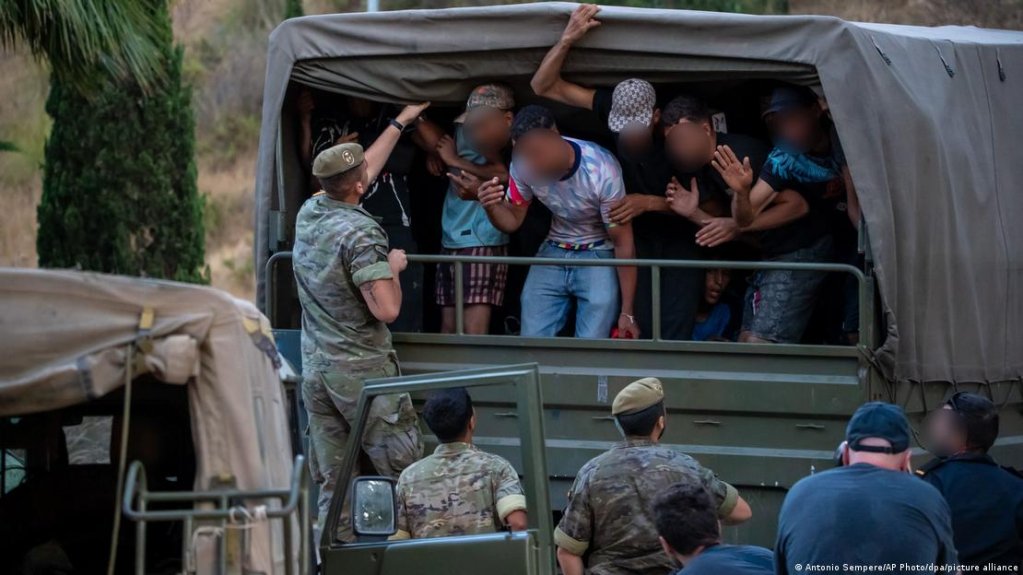
At least 43 migrants died during these attempts, according to the Spanish newspaper El Mundo. The Spanish Ministry of the Interior also reported on July 31 that 37,500 people had already been returned to Morocco from the enclave.
As early as the evening of July 30, reactions from some European political leaders and citizens linked these unprecedented arrivals to the exceptional regularization campaign conducted by Spain.
The strongest reactions in this regard came from Italy. The far-right Prime Minister, Giorgia Meloni, stated that Spain's regularization policy had encouraged "human trafficking." In response, she indicated her intention to take "exceptional measures," such as "suspending the Schengen Agreement with Spain."
"The images coming out of Ceuta demonstrate how the Madrid government's decision to grant Spanish, and therefore European, citizenship to more than 500,000 undocumented immigrants is profoundly flawed and encourages human trafficking," her Foreign Minister, Antonio Tajani added. Tajani is also Vice-President of the EPP (European People's Party, a right-wing group), the largest party in the European Parliament.
Spain responded through its own Foreign Minister, José Manuel Albares. Demanding "European solidarity, not partisan demagoguery," he dismissed a statement that, according to him, "has nothing to do" with the facts.
On the French side, François-Xavier Bellamy, a Member of the European Parliament and also Vice-President of the EPP group, also referred to these mass arrivals in Ceuta as the "logical consequence" of the regularization plan. "While it has already received more than a million applications, thousands of foreigners are now forcing their way across its border in Ceuta," the politician wrote on X, referring to this as "a problem for France and for all of Europe."
A regularization campaign closed for a month
However, this causal link between the regularization campaign and the situation in Ceuta is not correct. First, it must be remembered that this campaign, launched by the Spanish government in mid-April, closed at the end of June. That is to say, a month ago.
Furthermore, what Italian Foreign Minister Antonio Tajani claims is false: it is not about "granting Spanish, and therefore European, citizenship." The regularization campaign only allows people to obtain a one-year, renewable residency permit, most often for those already working as undocumented laborers in the Spanish economy. A large proportion have been in Spain for years.
Finally, Colombians represent the largest nationality of applicants, at nearly 26 percent. In total, two out of three applicants come from Central and South America. Moroccans account for only 13 percent of the cases.
The figures released in early July by the Spanish authorities show that this regularization campaign, which ran from mid-April to the end of June, did indeed exceed the government's projections. The ministry anticipated 500,000 applications to be processed. However, it received twice that number. In less than two months, no fewer than 1.2 million people submitted applications for regularization.
But today, on the Ministry of Migration's website, a red banner clearly indicates that the application period is closed. Authorities are giving themselves three more months to review all the applications received. So far, only 11,000 people have received the coveted one-year residency permit. And nearly 600,000 others have received temporary authorizations while their applications are being finalized.
Rumors of a border opening
The media outlet El Faro de Ceuta, whose teams are on the ground, reported on July 30 that "Moroccan soldiers were seen encouraging minors to cross the border. Everyone sees it; they can't deny it." Enrique Santiago, a Spanish communist member of parliament, denounced this as a "provocation" by Morocco on Friday.
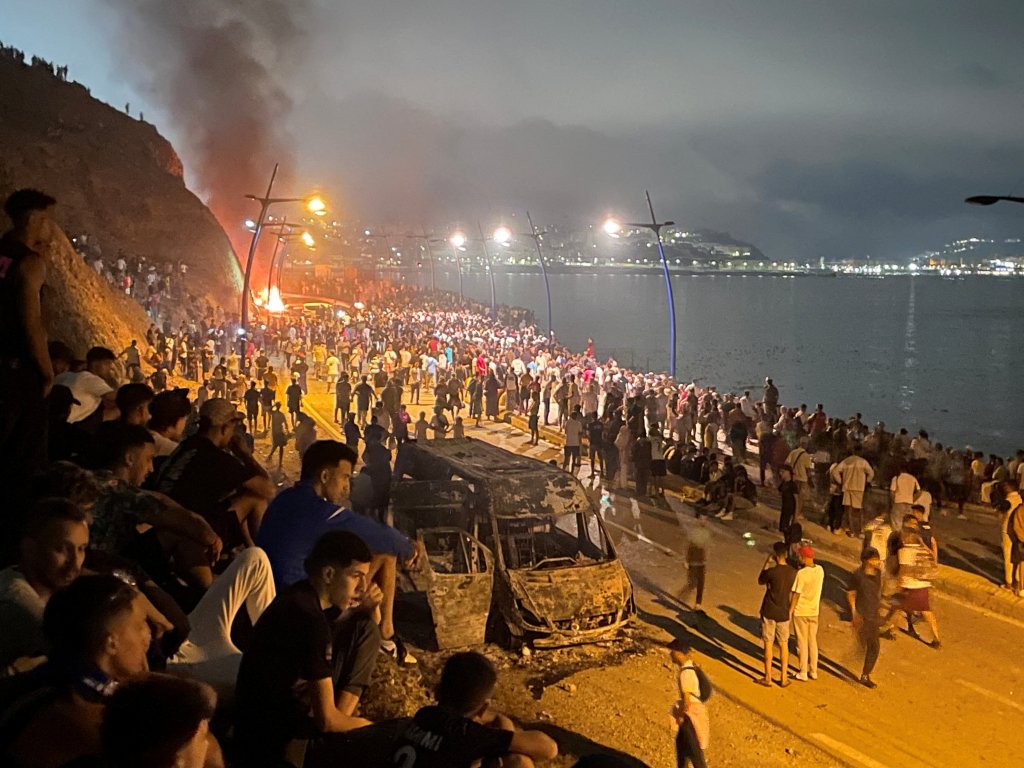
Rumors of a border opening quickly spread on social media. "I was in Tangier, where I was working. I woke up in the morning and heard that the Ceuta border crossing had opened at 10 pm [on the evening of July 29]," said Fatima Zahra, a Moroccan woman, who added that she had been warned by friends. "We thought, 'Let’s try our luck too,'" she told AFP.
However, the situation on the ground evolved very quickly. As early as Thursday evening, AFP witnessed scenes of Moroccan police officers attempting to push back migrants who were getting too close to the border with Ceuta. And according to Reuters, on the morning of July 31, Moroccan authorities deployed water cannons and repeatedly pushed back migrants trying to approach the border. Fatima Zahra also indicated that she was ultimately turned back.
Even though there are signs that the border is closing, why have the Moroccan authorities seemed to turn a blind eye, even if only sporadically? Without official communication from the Moroccan government at this stage, several explanations are possible.
The Spanish government points to Supreme Court decision.
In response to the tweet from Italian Minister Antonio Tajani, José Manuel Albares asserted that "today's events are related to a ruling." This "ruling" refers to a Supreme Court decision at the end of June over the pushbacks carried out by the Spanish authorities in Ceuta and Melilla, ruling them illegal. The ruling describes the act of intercepting migrants on the high seas and returning them to Morocco without prior legal proceedings as an "abuse of power."
The Spanish city of Ceuta, for its part, is demanding a "modification" of this Supreme Court ruling, "in order to expressly specify that the special border refoulement regime applies to any person attempting to illegally enter the national territory via Ceuta and Melilla through any unauthorized point of entry, whether by land or sea."
In any case, the central government in Madrid has been pointing to this court decision in its communications as one of the factors behind the easing of controls at this normally heavily guarded border.
According to Pedro Sánchez, "human trafficking mafias" are responsible for widely disseminating information about this court decision on social media. Social media plays a crucial role in influencing Moroccans seeking to reach the enclave of Ceuta. "What emerged from our discussions with the Moroccan authorities is a self-serving interpretation by human trafficking mafias of a ruling by the Spanish Supreme Court," the Spanish Prime Minister declared during his visit to Ceuta on July 31.
From the 2021 incident to today: the possible repetition of the tension over the Western Sahara issue.
Another reason cited by several observers is Pedro Sánchez's official visit to Algeria on July 20. This was the first visit by a Spanish Prime Minister in four years, following several years of diplomatic strain between Algiers and Madrid, AFP noted.
The Western Sahara, a territory largely controlled by Morocco and disputed by Rabat and the Polisario Front separatists, supported by Algeria, is a key issue.
The current images in Ceuta are reminiscent of those from May 2021, when more than 10,000 migrants arrived in Ceuta in just two days. At the time, the root of the crisis was undeniably geopolitical: Rabat opposed allowing the leader of the Sahrawi independence movement, the Polisario Front, to enter Spain for medical treatment. The diplomatic crisis only ended in 2022, when Spain finally lent its support to the Moroccan plan for Western Sahara.
This support then led to a diplomatic rift between Madrid and Algiers. Pedro Sánchez's visit to Algeria on July 20 now represents a warming of relations between Spain and Algeria. But some interpret it as the trigger for the Moroccan authorities' current anger.
In the absence of official Moroccan statements, it is difficult to know to what extent this explanation carries weight. Relations between Madrid and Rabat "were not affected" by this visit, a source at the Spanish Foreign Ministry told AFP.
Nevertheless, everyone remembers the events of 2021. "In 2021, Morocco pressured Spain to change its position on Western Sahara, allowing thousands of people to enter Ceuta in search of a future and decent living conditions they couldn't find in Morocco. After Spain changed its position on Western Sahara in favor of Morocco's, the two states coordinated their border policies. It was in this context that the massacre of June 24, 2022, took place, in which at least 27 asylum seekers were killed and more than 60 are still missing to this day," the Border Resistance collective, active in both Spain and Morocco, claims.
"Today, relations between the two countries are strained again, and Morocco is once again allowing its citizens to attempt to reach Ceuta, knowing that, like in 2021, a new agreement will likely be reached with Spain to coordinate returns," the organization continued.
In fact, more than 37,500 migrants have already been returned to Morocco from the Spanish enclave, according to the Spanish Interior Ministry. Departures from Ceuta are taking place "at a rate of 150 people per minute," according to information provided by the Interior Ministry to AFP.
An official Moroccan source had already confirmed to the news agency, on condition of anonymity, that the authorities of the two countries had indeed exchanged information on coordinated actions to "implement measures for the repatriation, as quickly as possible, of all those who have entered Ceuta illegally."
Other countries are also regularizing migrants’ status, without triggering an influx
Other contextual factors must be kept in mind. The Throne Day celebrations in Morocco — marking King Mohammed VI's accession to the throne in 1999—took place on July 30, coinciding with the day of mass arrivals in Ceuta. King Mohammed VI presided over a reception that day in the city of M'diq, located about twenty kilometers from Fnideq. Numerous Moroccan security forces were deployed in the city, according to observers and an AFP photographer.
Here again, neither the police forces present nor King Mohammed VI commented on the situation in Ceuta.
Finally, it should be noted that not every regularization campaign automatically leads to an increase in the arrival of migrants. According to several studies, the reality is far more complex: everything depends on the regularization criteria, particularly regarding residency; the perception by family and friends of the rules in force in the destination country; the community's integration in that country, and so on.
Italy itself, under Meloni, so quick to accuse Madrid, has already regularized nearly 500,000 undocumented migrants. Between 2023 and 2025, 450,000 residence permits were granted to foreign workers to address labor shortages in various sectors in Italy, with entry quotas set by decrees from the Ministry of the Interior in sectors experiencing labor shortages, such as agriculture, hospitality, healthcare, and home care.
For the year 2025 alone, a quota of 181,450 entries has been planned in Italy, Vues d'Europe, the website of France Terre d'Asile, recalled, highlighting that "this recruitment policy outside the EU reveals the Italian paradox".
This article was initially published on July 31 in French, that's why the figures quoted were correct at that time, and have since been revised up, we have reflected that in information boxes where relevant.