
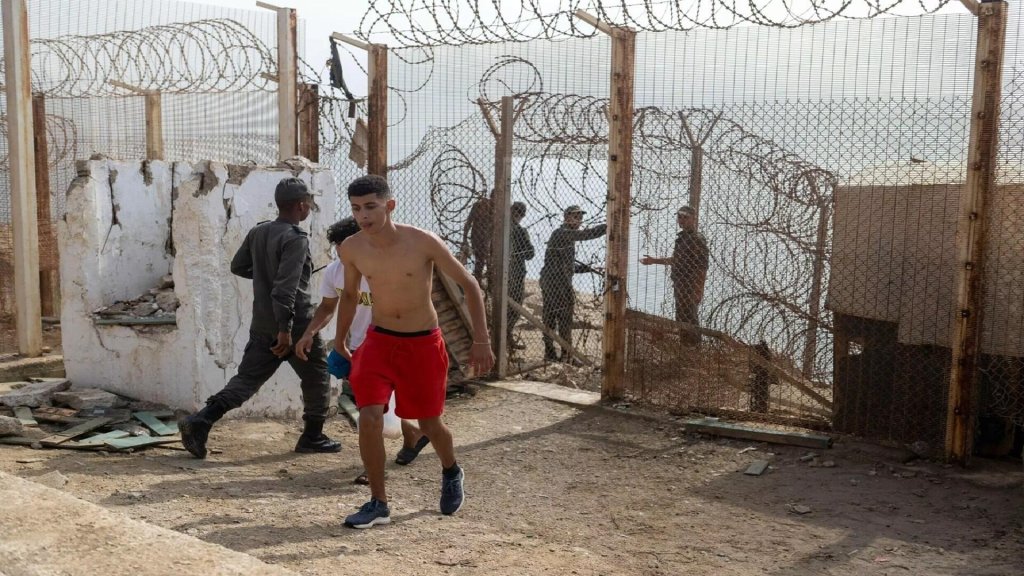
Last week’s sudden migrant arrivals in Spain’s North African territory of Ceuta have deepened tensions between Spain and Morocco, while also exposing divisions within the European Union over migration policy. As authorities respond to the crisis, political actors across Europe are using the situation to push competing agendas.
The aftermath of last week’s sudden migrant arrivals into the Spanish territory of Ceuta in North Africa has intensified already existing tensions between Spain and Morocco, as well as broader tensions between Spain and its European Union partners.
Ceuta officials have criticized Morocco’s handling of the border, while Spanish authorities have sought greater support from EU partners. Meanwhile, some EU countries have criticized Spanish leadership and the country’s migration policies, and far-right, anti-migration politicians from several different countries have sought to exploit the situation in Ceuta to gain momentum in voter support.
Read AlsoCeuta: EU calls borders a 'shared European responsibility'
Morocco reacts to Ceuta crossings
A senior Moroccan official has said that authorities warned Spain after social media networks started circulating interpretations of a recent Spanish Supreme Court ruling that migrants who enter Spain by sea cannot be immediately returned without following legal procedures, unlike those who cross by land.
"We started engaging with the Spanish side around July 22-23, when the networks began talking about this," the Moroccan senior official, speaking on condition of anonymity, said on Monday (August 3), the French press agency Agence French Presse (AFP) reported.

"We discussed this ruling and its impact. We explained that this ruling was going to create a problem. And it did create a problem," he added.
Spanish government spokeswoman Elma Saiz, however, has disputed the claim.
"At no point was there any evidence, any report that alerted us to the magnitude of this unprecedented event," she told reporters in Madrid. The Moroccan official maintained that the arrivals in Ceuta did not reflect a failure of Morocco's security forces.
"It's simplistic to say that Morocco should just have used force to stop them. That is to completely misunderstand this phenomenon," he said. "Could Spain, seeing them coming, have done something to stop them simply using weapons and security forces? That's not possible."
"At a certain point, the Moroccan law enforcement forces could no longer confront the migrants because the numbers were very large," and because "the pull effect was very strong," he said.
"It is not Morocco's sole responsibility" to manage migration, he said, adding that the kingdom spends around 500 million euros each year on migration management.
Foreign Minister Jose Manuel Albares said Spain expected solidarity from other EU countries after previously assisting them during migration increases such in 2015. On Tuesday (August 4), EU interior ministers are holding an emergency meeting to discuss Ceuta and broader migration policy.
Read AlsoUnderstanding Ceuta: A contested borderland in Europe’s African enclave
In U-turn, Denmark praises Spain's handling of Ceuta
After previously suggesting that the EU should considering suspending Spain from the Schengen area, Denmark said on Tuesday (August 4) that it was "very satisfied" with Madrid's handling of Ceuta.
“I am very satisfied that Spain acted quickly by deploying, among others, police and military forces, and that many migrants have already returned to Morocco,” Danish Immigration and Integration Minister Morten Bodskov said in a statement.
"But these events show that it is absolutely crucial that we have control over the EU's borders," he said following an extraordinary meeting of EU ministers on the subject, called at the request of Italy and Denmark and backed by 20 other countries.
The situation in Ceuta has also raised questions over whether Spanish intelligence agencies had sufficient warning of the mass movement and whether the Madrid government was informed. Reports in Spanish media suggested intelligence services concluded that Morocco did not organize the crossing but allowed border controls to weaken as crowds gathered. Spain’s government has denied reports of internal tensions between security agencies.
Spanish Interior Minister Fernando Grande-Marlaska said on Tuesday that last week's arrivals into Ceuta "did not compromise" Europe's visa-free Schengen zone. He explained that there was no easy way to get from Ceuta to the Spanish mainland and on through other European borders anyway, and added that the majority of arrivals had been returned.
With AP, Reuters and AFP