
Both Morocco and Spain are deploying forces after overwhelmed authorities in Ceuta called for extra assistance. Meanwhile, Italy has threatened to suspend Schengen arrangements with Spain, as debate continues over what may have fueled the dramatic increase in arrivals, including the role of social media and a recent court ruling on sea arrivals.
The Spanish government declared it will deploy military units on Friday (July 31) to assist police in the North African enclave of Ceuta, an autonomous city of Spain, which borders Morocco.
Numerous media reports have stated that as many as 49,000 migrants crossed into Ceuta in the past 24 hours. However, in response to a request for clarification on that figure, the press office of Spain’s Interior Ministry told InfoMigrants that "the figure of 49,000 currently being circulated is not official and has not been provided at any point by the Ministry of the Interior," adding that it would begin releasing "verified figures" later in the day.
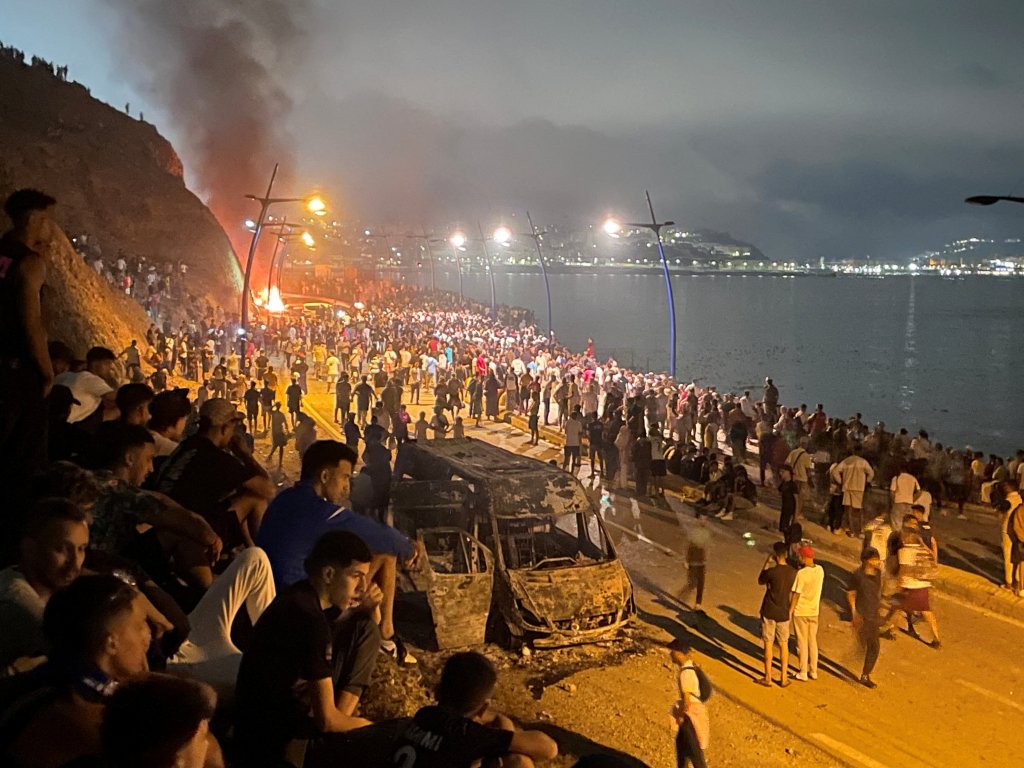
Overnight, there were reports of fires in the streets of the enclave, whose entire population numbers around 83,000 according to the most up to date local figures.
'Complete chaos'
A spokesperson from the Guardia Civil, Spain's national gendarmerie force, has said however that people were "massively entering from the sea" through the Tarajal breakwater, stressing that police were overwhelmed. However, the spokesperson could not give any estimates for the exact numbers of arrivals.
Rachid Sbihi, head of the association that represents Spain's Civil Guard officers who patrol the border, called the situation at Ceuta "complete chaos" saying the border had "totally collapsed. It's not possible to give precise numbers, but there are thousands of migrants crossing," he added.
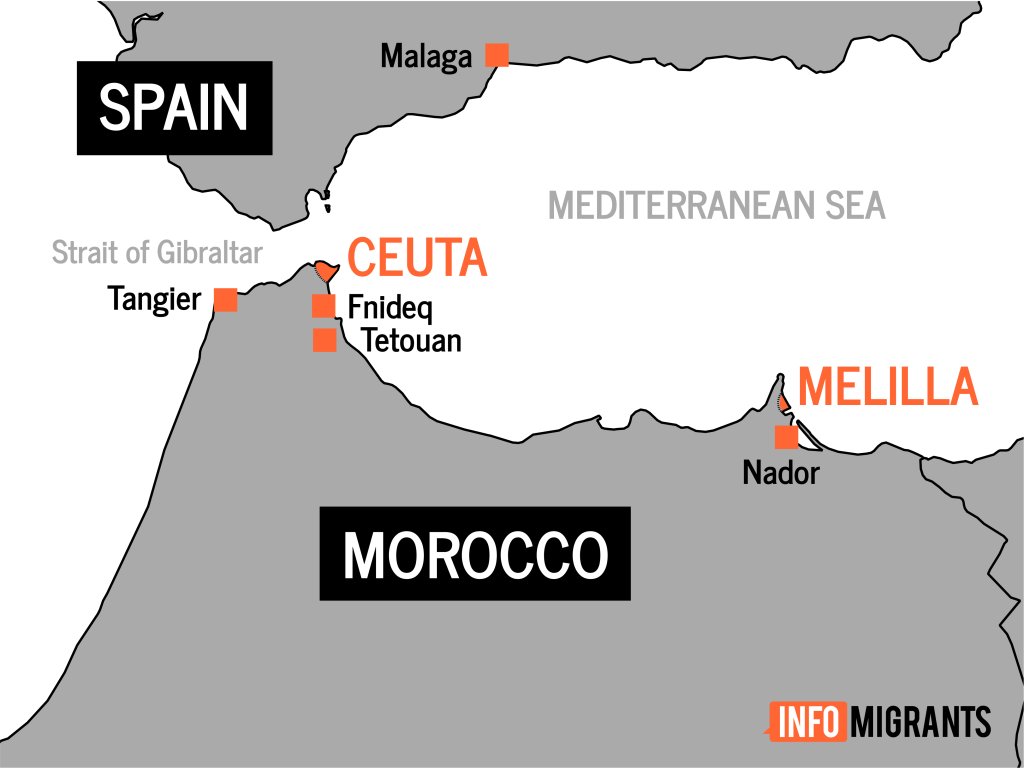
The pressure on Ceuta has also shifted to Melilla, another Spanish enclave in North Africa, around 400 kilometers away, where the border with Morocco has been closed to prevent any potential similar arrival of irregular migrants.
19 people die during attempted crossing
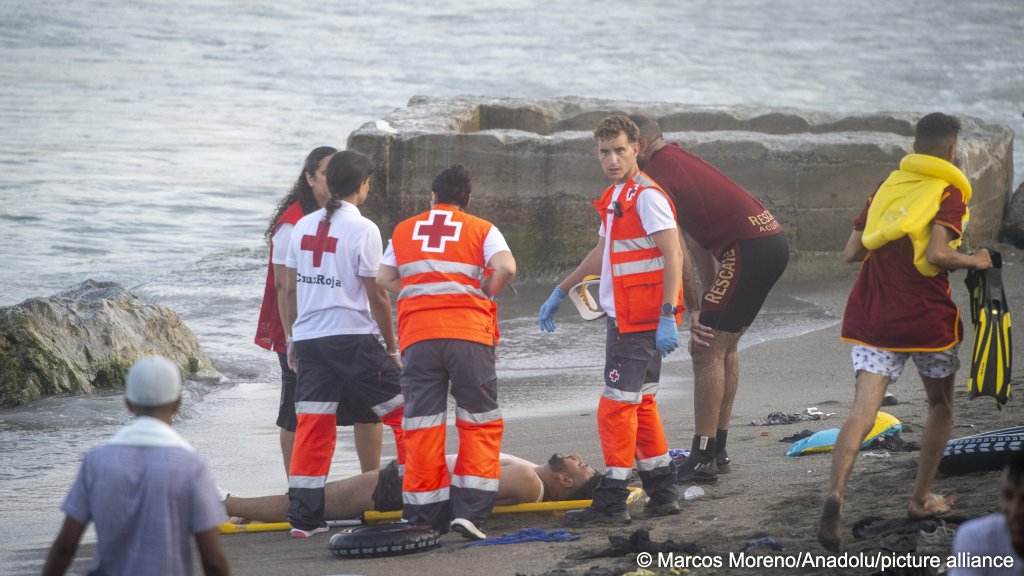
At least 19 migrants are reported to have died trying to reach Ceuta in recent days. Spain's government delegation did not provide information on the circumstances of the deaths, but bodies were reported to be seen floating in the water. Other bodies have been found on the coast of mainland Spain, near the city of Malaga.
Spanish authorities reported on Friday that they believed they had found a fourth body near Malaga, all of whom they suspect had been trying to reach Ceuta too. Some of the bodies, reported Spanish media on Thursday, were in a state of "severe decomposition." Initial investigations by authorities in Malaga suggest that those found had been attempting to swim to Ceuta and must have been overwhelmed and disorientated by sea currents, and ended up drifting towards Malaga.
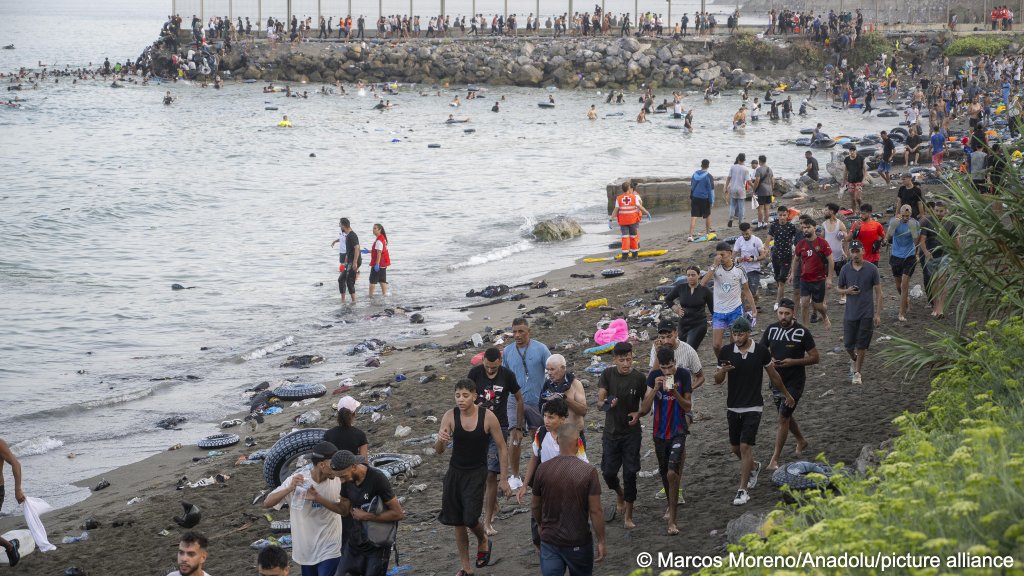
Many of the migrants, including children, had to swim to reach Ceuta.
Local media reports describe groups of young people walking with floats, ready to plunge into the water to make the crossing.
Dozens of migrants have died this year trying to reach Ceuta, according to local authorities. Before the latest round of arrivals in the last 24 hours, reports suggested that at least 27 people had died trying to reach Ceuta since the beginning of the year. The IOM's Missing Migrants project doesn't break down deaths and missing for Ceuta, but across the whole of the Western Mediterranean on various routes towards Spain, they estimate that 247 people died this year. That figure was last updated on July 22 and so does not include the latest reported deaths.
A local workers association representing Civil Guard officers has described the situation in Ceuta as a "serious humanitarian crisis."
Spanish Prime Minister Pedro Sanchez will join Interior Minister Fernando Grande-Marlaska in a visit to Ceuta on Friday.
Morocco and Spain boost security forces and military
Three platoons of 20 soldiers each, a diving unit, and a military vessel are also scheduled to be deployed to Ceuta on Friday, the Interior Ministry announced, adding that "special police intervention units" were also being reinforced to a total of 200 personnel. The regional government had earlier urged Madrid to send army assistance and close the border with Morocco as large crowds of people tried to cross the border fence.
Spain's government has said its Armed Forces would help the Civil Guard "maintain security in the city of Ceuta."
Morocco's security forces are bolstering night time patrols at the Castillejos border, but are "tolerating the continued flow of irregular migrants" along the coast towards the Spanish autonomous city, Spanish newspaper El Pais reported on Friday.
Moroccan authorities have not yet publicly commented on the crossings but Spain's interior ministry said authorities in Rabat were "closely cooperating" with Spain to handle the situation and that Moroccan police are putting in measures to "stop people" trying to cross the border. Both Rabat and Madrid have agreed to collaborate "for the return, as soon as possible, of all people who entered Ceuta illegally."
The Moroccan Association for Human Rights in northern Morocco, meanwhile, has described the situation in Ceuta as "exceptional."
"The Tarajal border was opened under unusual circumstances this morning and people crossed," said Achraf Maimouni from the association.
The arrival of thousands of people from Morocco in Ceuta has once again strained relations between Spain and Morocco, which had appeared to be on a more stable footing since a similar situation erupted in the Spanish enclave in May 2021.
'No one without papers will be able to cross'
Non-commissioned officers of the auxiliary forces, the paramilitary corps, have said that they were waiting for a "crucial moment" to disperse the crowds gathered in the hills of Castillejos with the aim of what they have described as "storming the border fence," and to end the "flow of Moroccans, groups of Moroccans, and some sub-Saharan Africans" into Spain.
The Castillejos district, the closest to the Tarajal border crossing, has seen women with children to sleeping in the town, hoping to cross. Dozens of people were spending the night in parks and camping with bonfires on vacant lots, waiting to try to reach Spain.
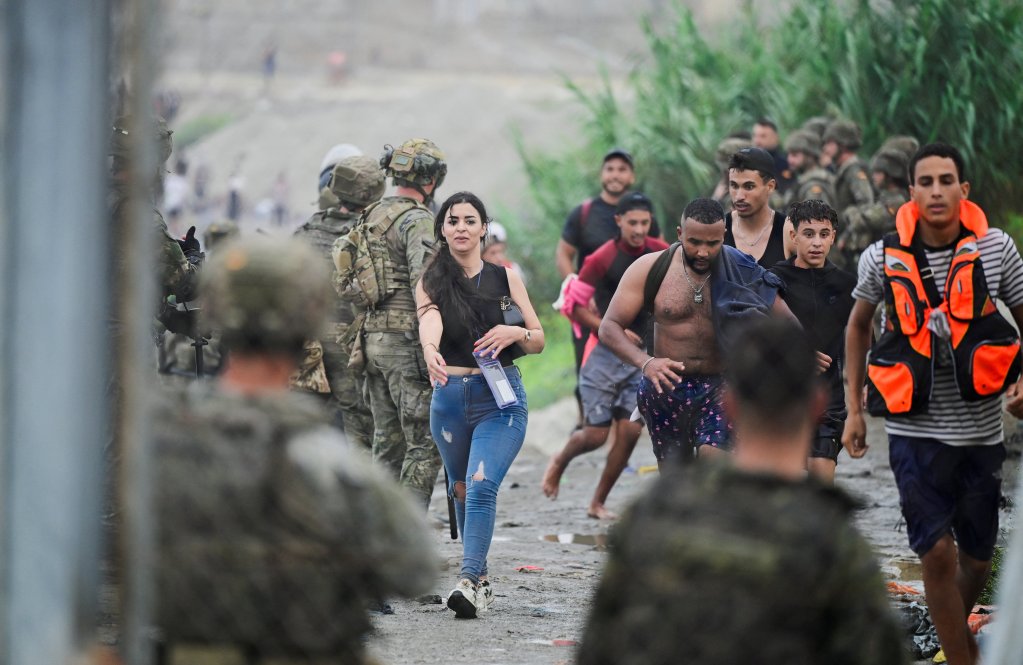
"No one without papers will be able to cross up here," El Pais reported an officer from Castillejos district as saying. "Those who go down along the beach will continue to cross. That is a problem for Spain. It's a matter of diplomacy," he added, without further elaboration.
Read AlsoCanary Islands: Migrant arrivals down over 80 percent in first quarter of 2026
An 'emergency' or not?
Ceutan authorities have asked the government in Madrid to declare an emergency for reasons of national security. Regional government head, Juan Jesus Vivas, also requested more police officers and for the army to be deployed at the border "to guarantee the inviolability of the frontier and citizen safety."
Already on Wednesday (July 29), he had warned that the migrant reception centers in Ceuta were "overwhelmed" with scores of people sleeping on the streets.
The Spanish government, however, has said that Spanish legislation covering declaration of national emergencies does not consider migrant arrivals a risk to national security, adding that government bodies are cooperating with each other to boost speed and competence in Ceuta.
Italy threatens to suspend Schengen agreement with Spain
In reaction to the situation in Ceuta, Italian Prime Minister Giorgia Meloni declared that Spain should be suspended from the Schengen zone, a free travel zone Europe, that should be without immigration stops. Meloni threatened to end Italy's open-border Schengen agreement with Spain "to defend our borders and ensure the safety of our citizens."
Italy does not share a border with Spain, but, like some other European countries following Spain's move to regularize hundreds of thousands of migrants earlier this year, has expressed concerns over a so-called "pull factor" effect of encouraging irregular migration, though many migration experts have debunked this claim.
Meloni's comments echo remarks made earlier by Italy's Foreign Minister Antonio Tajani, who said Italy is "ready to act, including through exceptional measures…such as suspending the Schengen agreement with Spain."
In response to Tajani, his Spanish counterpart Jose Luis Albares accused him of weaponizing migrants for political motives. Italy's far right prime minister meanwhile, Matteo Salvini, has called for the entire Schengen zone to be dismantled.
Read AlsoHow Spain's 2026 regularization works
Ceuta: A longstanding source of Spain-Morocco tensions and migration
Ceuta is a small autonomous Spanish city on the northern coast of Africa, bordering Morocco, and marks one of the European Union's only land borders with the continent. Along with the Spanish enclave of Melilla, around 400 kilometers away, it has long been a focal point for migration into Europe, as Spain serves as a major gateway for people seeking better economic opportunities or fleeing conflict and instability. Migrants attempting to reach Ceuta often make the dangerous journey by sea. Others seek to climb the border fence.
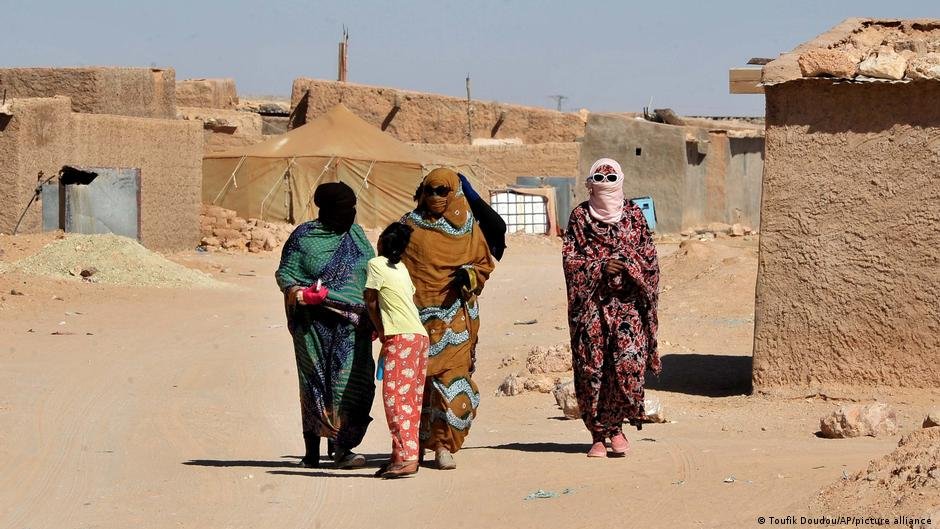
The territory is also a longstanding source of tension between Spain and Morocco, with Rabat claiming Ceuta and Melilla as its own. Migration pressures at the border have at times become linked to wider diplomatic disputes, most notably in 2021, when more than 8,000 migrants entered Ceuta in two days after Morocco was accused of relaxing border controls allegedly over the issue of Western Sahara. The move came amid a dispute over Spain's decision to allow Brahim Ghali, leader of the Polisario Front, to receive medical treatment in Spain. The Polisario Front has for decades claimed to represent the Sahrawi people of Western Sahara, a territory contested between Morocco and the independence movement.
Why now?
It was not immediately clear what prompted the sudden increase in migrants attempting to reach Ceuta this week. Authorities had recorded a rise in arrivals in recent days, with many migrants making the crossing by swimming from Morocco to the Spanish territory.
Some Spanish officials had suggested that the increase may have been linked to a recent Spanish Supreme Court ruling stipulating that migrants who enter Spain by sea cannot be immediately returned without following legal procedures, unlike those who cross by land, such as by climbing border fences. However, some migrant rights experts questioned whether the ruling was a significant factor, arguing that many people attempting the crossing were unlikely to have known about the legal decision.
According to an El Pais report, social media may have fueled the increase in arrivals in Ceuta this week.
"Like many others waiting at midnight in Castillejos, they trusted that the following morning they could cross the border without problems, as in a dream, an unfounded piece of information from social media that many believed…" wrote one report. "Thousands of people, mostly young, have flocked to both Spanish cities in recent days, a phenomenon amplified by digital media and social networks," it added.
Social media platforms such as TikTok have also been used by people smugglers to portray dangerous migration journeys through irregular routes such as the Central Mediterranean and the Balkans in a more glamorous, simplified or idealized way. By downplaying the risks and highlighting the prospect of reaching Europe, they can be used to attract and exploit vulnerable people.
'A better life awaits us in Spain'
Entire families with children and scores of young people now await their future, on both sides of the border.
"We come from Tangier. We have passports, but no visas. I have jobs, but no future. We believe a better life awaits us in Spain," El Pais cited a 47-year-old painter as saying. He, like many Tangier residents, speaks fluent Spanish. He is accompanied by his wife, Nesma, 36; his daughter, Romaisa, 12; and his son, Tarik, who is only two. "With the children, we can't cross the beach and rocks like all those other people…We hope the border opens tomorrow and they let us cross freely."