
One of the 31 Afghan men Germany has just deported to Kabul holds no criminal conviction, more are likely to follow. The Interior Minister is now saying that deportations will not be limited to convicted criminals but could be extended to those who, show "no signs they have integrated in Germany."
"This morning, 31 Afghan men subject to enforceable deportation were flown to Kabul on a charter flight," Germany's Interior Minister announced on its website via the social media site Mastodon on Tuesday (July 28).
Interior Minister Alexander Dobrindt stated on the site: "Deportations to Afghanistan will continue consistently. Anyone who threatens our security has no prospect of remaining in Germany. It is clearly in our society’s interest that criminals leave our country."
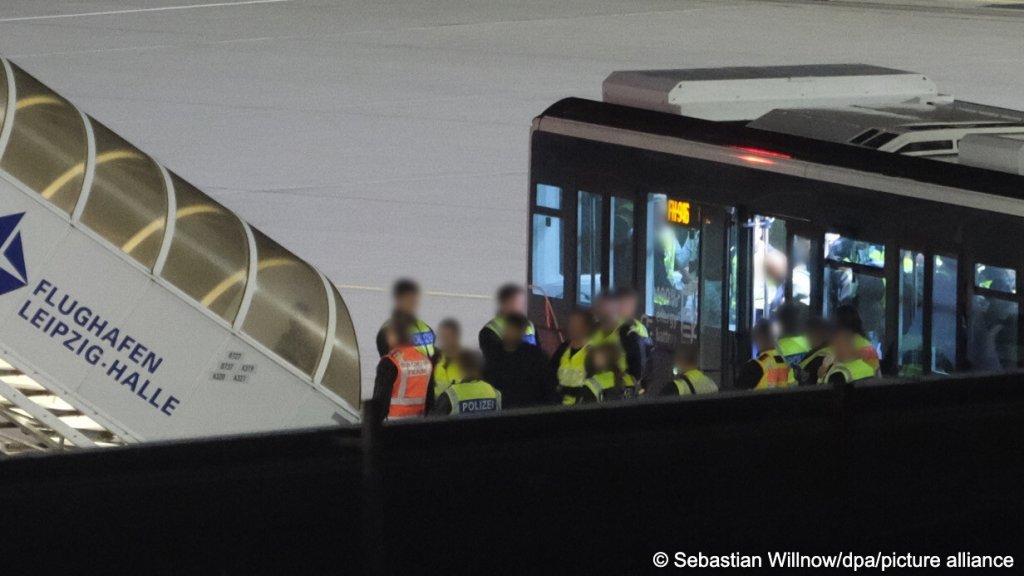
However, although he mentions "criminals" in that statement, it has emerged that one of the 31 Afghan men deported to Kabul on Tuesday actually has no criminal conviction. The aircraft departed from Leipzig/Halle Airport in the early hours of the morning.
Interior Minister confirms one passenger did not have criminal record
Interior Minister Alexander Dobrindt said the majority of those on the flight were "serious offenders" convicted of crimes including homicide, rape and violent offenses. However, he confirmed that one passenger did not have a criminal record.

According to Dobrindt, the man was ordered to leave Germany after his asylum claim was finally rejected. He had attempted to seek protection in another European country but was later found to be living there irregularly. After being transferred back to Germany, he was deported to Afghanistan. Dobrindt argued that deportations were not limited exclusively to convicted criminals.
"People who have no right to stay in the country can also be subject to deportation if there are no signs they have integrated in Germany," he said. The reference to integration lacks a clear legal definition and could leave room for inconsistent interpretation, discriminatory application, and how and to whom such criteria are applied in practice, point out pro-migrant organizations.
The government had previously stated that its priority was to return people convicted of serious crimes or considered a security threat. A spokeswoman for the Interior Ministry said on Wednesday that though the focus remained on convicted offenders and individuals deemed dangerous, she argued it was legally possible to include people without criminal records on deportation flights.
Earlier this week, IOM chief in Afghanistan Mihyung Park told the German press that based on the current security situation in the country, they could envisage the possibility of returning Afghan men to Afghanistan, but not women and girls. "The security situation in Afghanistan has got much better, and that is a fact," explained Park.
The inclusion of the non-criminal deportee prompted criticism from refugee rights organizations which argued that the government was broadening its scope of returns to Afghanistan beyond those convicted of serious offenses.
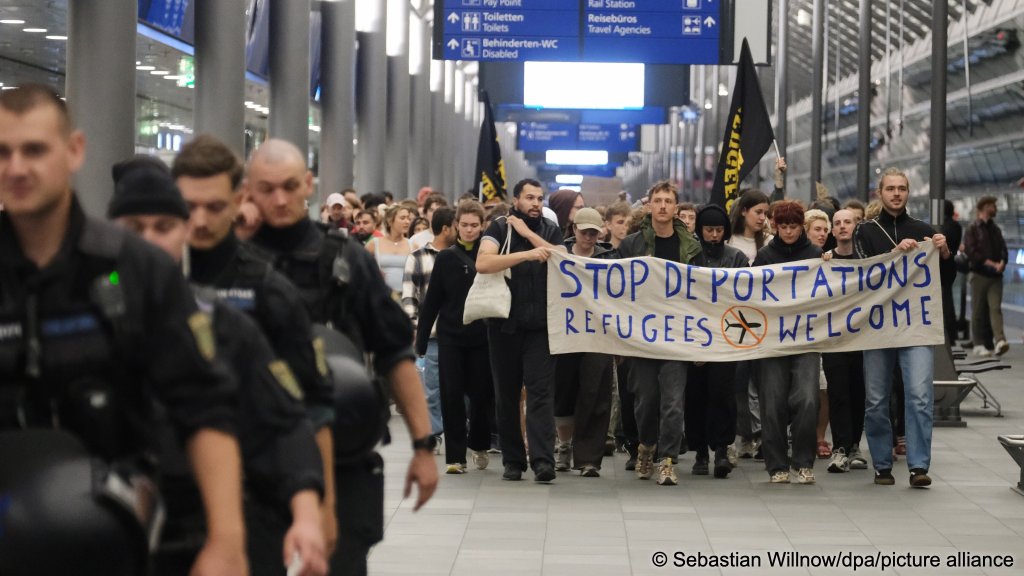
Dobrindt acknowledged protests took place at Leipzig/Halle Airport before the flight departed but said the government would maintain its "firm stance" on migration policy.
Read AlsoRefugees and migrants should not be exploited as political tools in campaigns, warns UN
Germany 'not limiting ourselves only' to deporting criminal convicted migrants
An Interior Ministry spokesperson confirmed to InfoMigrants recently that Germany’s deportation policy does not only target convicted criminals.
"Our stated policy for this government, signed by all coalition parties, CDU, CSU and SPD, underlines that we will start up deportations to Afghanistan and begin with those who hold criminal convictions, but not limiting ourselves to that," the ministry statement read, adding that individual states can decide who they might deport and who not.
"According to the Residence Act, foreign nationals must be deported if they are legally obligated to leave the country and a departure deadline has not been granted or has expired. Furthermore, no prohibitions on deportation may exist in an individual case. Besides this, Federal States are responsible for enforcing residence law and are free to decide on returns on a case-by-case basis. Afghan women and girls are generally granted protection in Germany."
Germany collaborates with Taliban on deportations
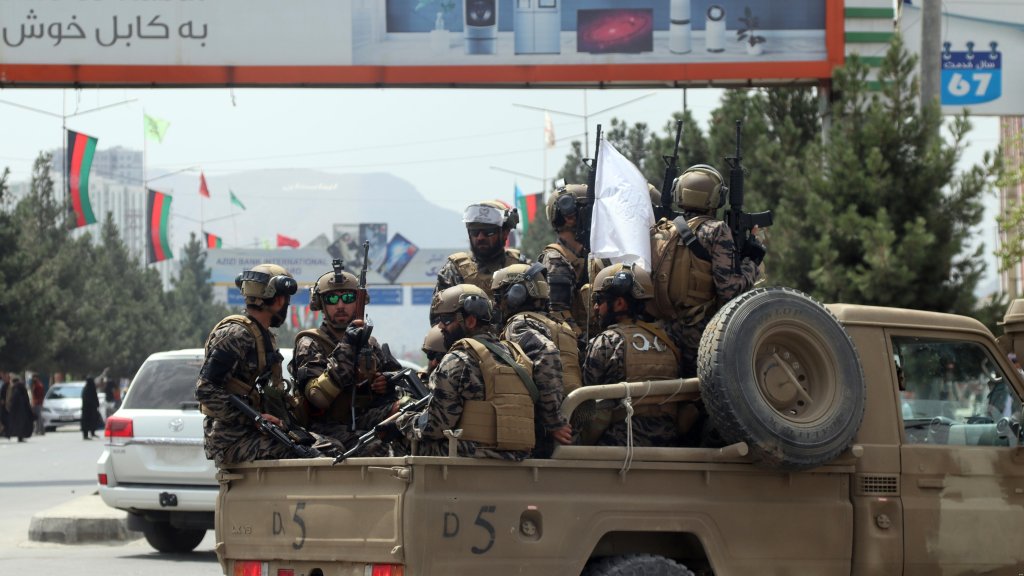
Tuesday's deportation was made possible through a direct agreement between the German government and the Taliban authorities, allowing Germany to organize returns to Afghanistan without relying on intermediary countries. Deportations to Afghanistan resumed in 2024 after being suspended following the Taliban’s takeover of Kabul in 2021. Since then, Germany has returned more than 200 people to the country.
Human rights groups have raised concerns about the safety of deportees, with Amnesty International reporting that at least one person returned to Afghanistan was later killed. Human rights advocates have also criticized European Union countries for engaging with the Taliban, whose authorities have been accused of widespread human rights violations, particularly against women and girls, with girls being barred from education beyond the age of 12, among numerous other restrictions.
A planned deportation flight in early June was cancelled after Taliban authorities refused to cooperate, highlighting the challenges involved in arranging returns to a country where Germany does not officially recognise the ruling Taliban.
The latest flight follows talks between Taliban representatives and the European Union in Brussels last month on increasing the return of rejected Afghan asylum seekers.
Although Germany does not recognise the Taliban government because of its record on human rights, some support Berlin's "practical" decision to engage with them over this issue to enable deportations, while others slam the government for further compromising human rights principles to enable the unjust deportation of vulnerable migrants.
Afghanistan in midst of severe humanitarian crisis
Upon arrival in Kabul, deportees were expected to be processed and questioned by Taliban officials, according to eyewitnesses at the airport. Families of some returnees were seen waiting for them, and officials reportedly told relatives that detainees could potentially be released after receiving assurances from their families.
Afghanistan remains in the midst of a severe humanitarian crisis. Millions of children and mothers are suffering from acute malnutrition, and aid workers have warned of critical hunger levels across much of the country.
The deportation comes as Chancellor Friedrich Merz’s government seeks to pursue tougher migration policies as Germany's far-right Alternative for Germany (AfD) gains ground in opinion polls, ahead of state elections in several German states in September, (Mecklenburg Western Pomerania, Saxony-Anhalt and Berlin).
Read AlsoAid to Afghanistan drops to record low, as more people are forced to return
Five Afghans with no convictions awaiting deportation
The Bavarian Refugee Council and the Jesuit Refugee Service (JRS) told InfoMigrants this month that there are at least five Afghans with no actual convictions sitting in deportation detention. One is reportedly in Munich, three are in Eichstätt and one in Hof.
In Eichstätt and Hof, the detainees are said to be all men in their twenties. They left Afghanistan after the Taliban took power and traveled to Germany.
The men had travelled to Austria and were stopped by German authorities while trying to return, in violation of the conditions pinned to their status. All of them held what is called a Duldung, a temporary tolerated stay given to people who have not been granted asylum but whose deportation cannot currently be carried out. Holders of a Duldung are generally prohibited from traveling outside Germany without permission. It is believed that this breach brought them to the attention of police, resulting in their detention and subsequent deportation proceedings.
Lawyer and migration law expert Heiko Habbe at the University of Hamburg told InfoMigrants that Afghan men too could be at risk of being abused or persecuted if they weren’t seen to abide by strict morality laws in Afghanistan (for example if they didn’t wear regulation traditional clothes or a beard, or abide by social norms of the Taliban sufficiently). Habbe stressed that some men had even been "killed for wearing Western clothing," and therefore some Afghan men are also in need of protection.
With dpa, AFP, Reuters, and EDP