
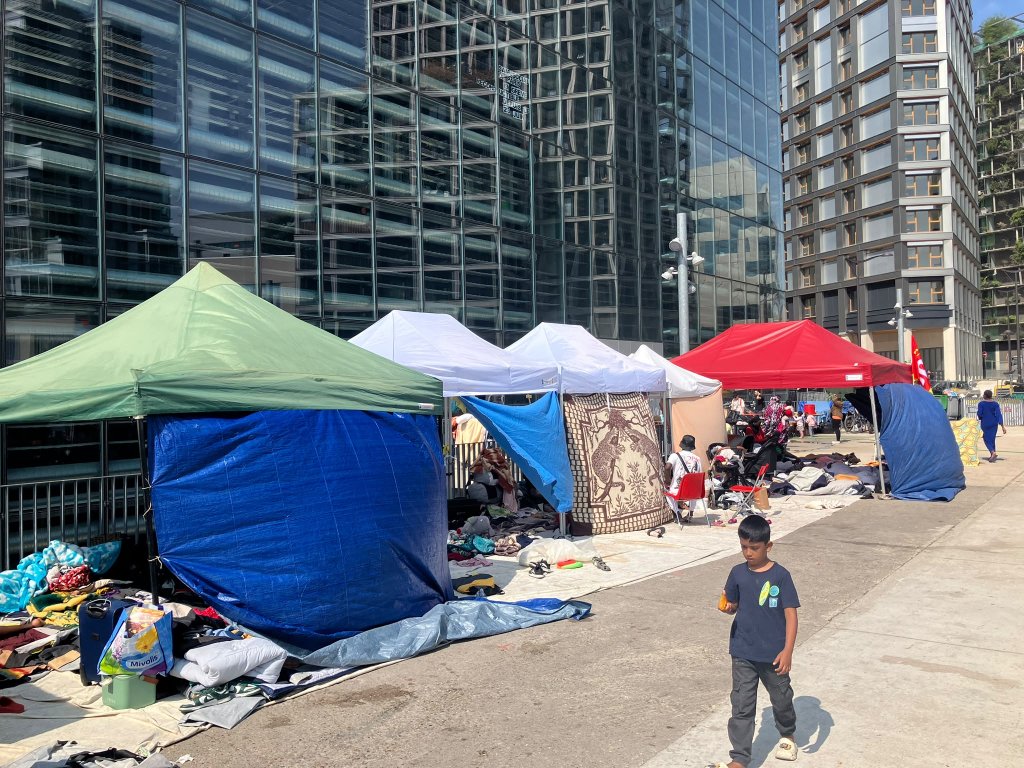
More than 200 migrants, mostly from sub-Saharan Africa, have been occupying the steps of the Samu Social headquarters in Paris's 13th arrondissement for over a week. Almost half of them are children. The protest is being led by the Utopia 56 association and follows restrictions imposed by the regional authorities on hotel stays. The families say they can't get an answer from the emergency shelter hotline and don't know how to cope.
"Who votes to go to the pool?" Five little arms shoot up, as high as possible, fingers pointing to the sky. Brijino, 11 years old, with braids tied on top of his head and a bright smile, spontaneously becomes the group's charismatic leader. "We're hot, we want to go to the pool!" he insists in a plaintive voice, burying his face in his hands, addressing anyone who will listen.
When he arrived at this encampment, set up on July 15 in front of the Samu social headquarters in Paris's 13th arrondissement, Brijino immediately wanted to make friends. He's the one the other children followed to make a ball "out of paper and tape" as soon as they arrived, 11-year-old Mohamed recounts. He stays glued to his friend Brijino between somersaults on the asphalt. After an adult gave them a real ball, Brijino has still been the one initiating the soccer games—although, on this Wednesday morning in July, the game was interrupted by a slightly too powerful shot that sent the ball flying over the fence of a construction site.
And when 9-year-old Tidiane* says that he prefers the ice rink to the swimming pool and swears that he has "never fallen" on the ice, Brijino, like a big brother, gently rebukes his boasting. Brijino even tries to snatch the purple and blue Scoubidou adorned with two beads that Tidiane had just made.
"Look over there, on the building's balcony! A motorcycle!" Brijino shouts, himself sitting on a pink plastic two-wheeler, half his size and with a Minnie Mouse figure under the handlebars. The boy squints to get a better look at the beige Vespa parked on the upper floor of one of the enormous glass buildings surrounding the encampment. "I need glasses. Every morning when I wake up, my vision is blurry." The boy doesn't get much sleep: at 6 a.m. this morning, the noise from the construction site woke him. And it's like this every day, the other children around him explain, playing with their superhero figurines.
The families of Brijino, Tidiane, Mohamed, and the others have been participating for several days in the occupation led by the Utopia 56 association and the striking emergency social services workers against shelter evictions and the lack of emergency shelter spaces. The majority are from West Africa and are undocumented.
On June 10, the management of Samusocial in Paris announced the eviction of those who had been taken in under the Cold Weather Plan, while also cutting back on overnight stays due to state budget cuts.
Facing the heat by day, the cold by night
During the winter, with nighttime temperatures below freezing, Samusocial exceeded its budget, providing 350 additional overnight stays. Now, with the arrival of a new regional prefect, the state has demanded that this budget overspending be made up, in addition to the closure of the Cold Weather Plan. "So they had to balance the 861 overnight stays allocated as planned by the Cold Weather Plan, plus the additional 350: that's more than 1,200 overnight stays to cancel," Nathan Lequeux, coordinator of the Paris branch of Utopia 56, explained.
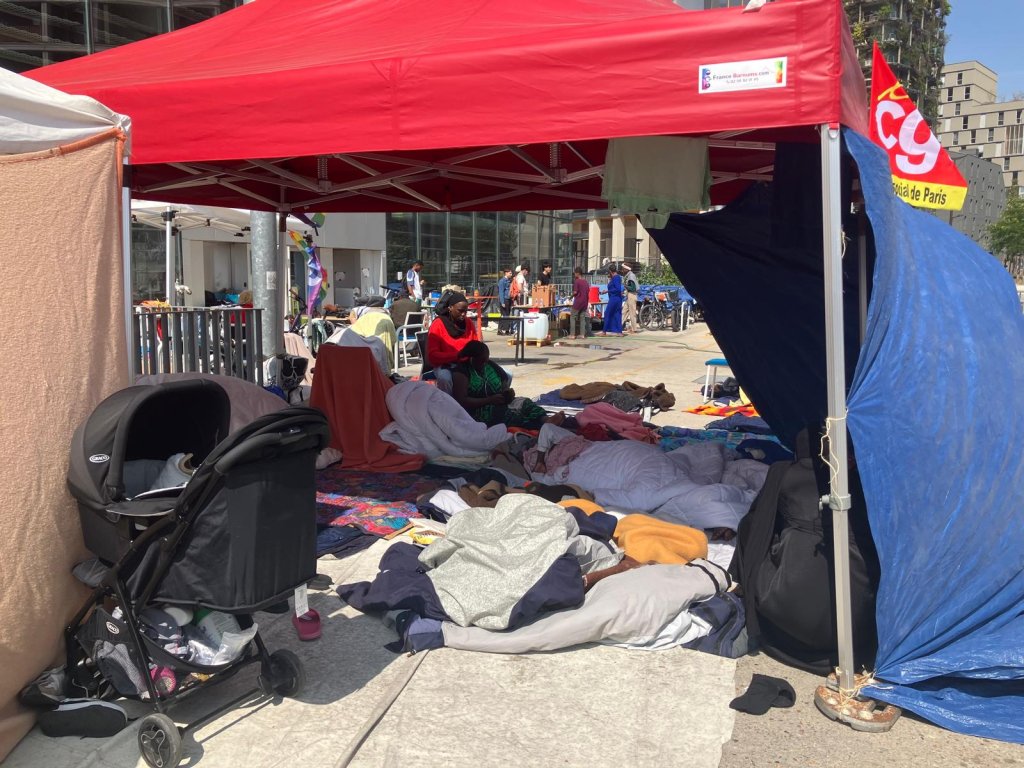
During the day, when the heat beats down like it does this Wednesday under the midday sun, children dream of swimming pools or ice rinks. Or "at least some ice cream," Mohamed whispers, with an exaggeratedly pleading pout. Behind them, a woman lies stroking the head of one of her three children, huddled against her on blankets in the shade of a truck. On the other side of the truck, a solitary woman stands in silence, her forehead pressed against the vehicle, her eyes closed.
At night, the heat disappears, but "the cold and the wind" become the challenge, Kone Kariatou, 28, and Massandje Dosso, 23, explain. These two young women, one wearing a yellow polo shirt, the other a red fleece, sit beside their babies. Isaac and Mohamed are only three months old. "We can handle it, but the children can't. They often cry at night, they can't sleep. We wrap them up in the sheets as best we can."
They’ve been here for a week. These two Ivorian women became friends after meeting during this occupation. "Yesterday and the day before, it all collapsed because of the wind," they explain, pointing to the tents set up by the NGOs. The steel bars holding them up have since been tied together as a precaution. "My baby was underneath when it fell… I was so scared, I screamed: 'My child, my child!'" Kone Kariatou says, laughing at herself now that she’s relieved nothing serious happened.
Back to homelessness when the child turned three months old
Kone Kariatou arrived in France in January from Ivory Coast. Her first refuge was a Doctors of the World clinic. She was taken to the hospital for the last two months of her pregnancy, where she stayed until she gave birth. Then, she had to leave. The emergency hotline (115) found her a place in a social hotel, but only until Isaac was three months old.
After those three months: a terse text message said it was over. "You don't go fighting with the people at the hotel, and even if some try and tell them, 'There's no way I'm going back out there, I have children.' It's pointless," Kone Kariatou sighs. "The day I left, we had no water, no food, nothing. My son cried all day. I went from Juvisy (in Essonne) to Paris to find a day center."
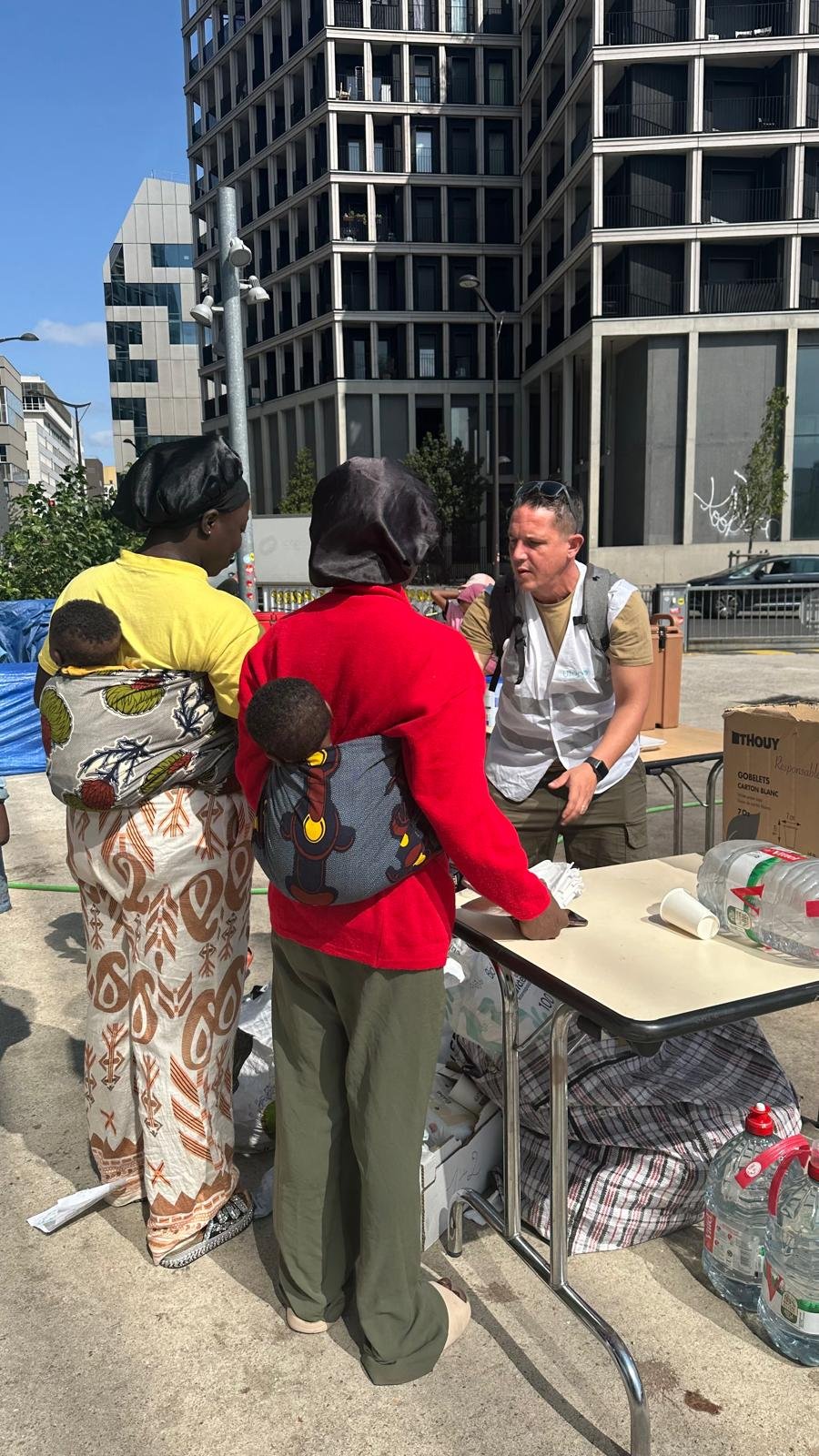
Massandje Dosso experienced the exact same situation: after Mohamed's first three months, everyone turned away. She has been in France for three years. "Until I was seven months pregnant, they wouldn't take me in. At seven months, the emergency medical service (SAMU) gave me one week, then another week, then another week, each time changing hotels. It's very difficult," she says, all of this being during her last trimester of pregnancy. Three months after giving birth, there was "no message, nothing," just the end of support and the emergency hotline (115) no longer answering the phone.
This three-month-old criterion for the child "has been in place for some time. It's the priority 1 criterion, which applies to the Île-de-France region. Just three years ago, we were still able to find housing solutions for people in priority 2 [priority 2 includes other criteria considered less urgent, editor's note], but today, no one outside of priority 1 gets access," Nathan Lequeux, coordinator of Utopia 56 Paris, explains. As a reminder, unconditional housing is a fundamental right in France, enshrined in its law (Article L. 345-2-2 of the Social Action and Families Code).
The priority 1 criteria have even been tightened recently. Pregnant women meet the criteria after seven months of pregnancy like Dosso Massandge, earlier, they were given additional support at the six month. Several medical conditions are also excluded. Women may also qualify if they are experiencing violence, but only in certain categories. If they are survivors of domestic violence, they should be able to acces help, but if they have experienced sexual violence on the street, which used to also qualify them as a priority 1 candidate, they will no longer be considered. Yet, the latter is a daily threat, as Kone Kariatou explains: "A young girl, who was here with us, told us that someone tried to rape her. Her and her sister. It's serious. It can stay with her for the rest of her life."
'When you're vulnerable, you're destroyed even more.'
"The longer you suffer the less normal you become," 33-year-old Mesieur sighs, her emotions raw. The young woman's gentle face and long eyelashes are framed by a pale pink headband. Her bright eyes speak volumes about what life on the streets is like. "When you're vulnerable, you're destroyed even more."
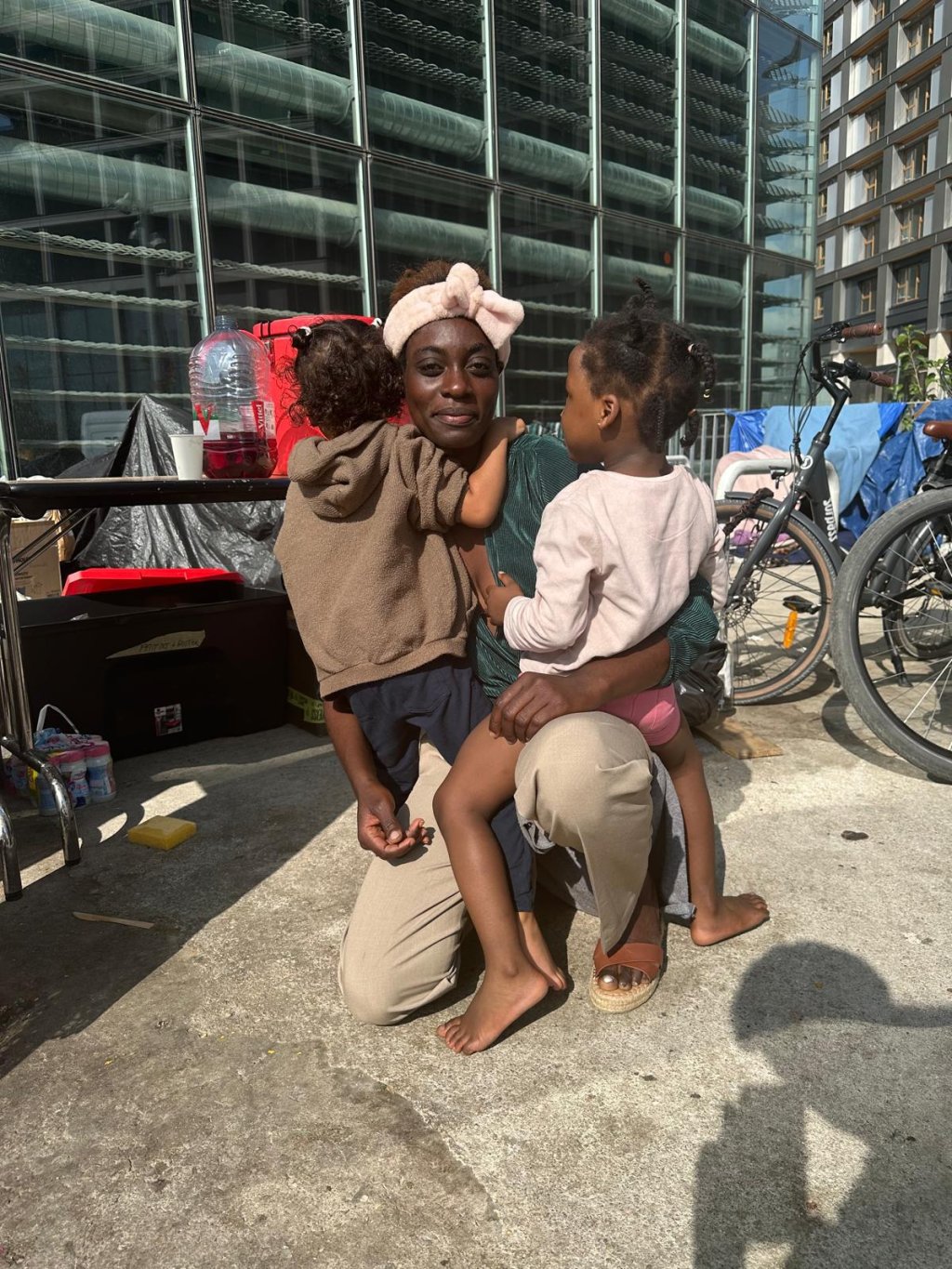
Since she arrived at the occupation on July 18, this Togolese woman has been helping others in any way she can. This morning, she's handing out refreshing pomegranate juice to the children who are passing by and hugging her leg repeatedly.
"I didn't know it was possible to live like this. To come to a country, to France, and wait for hours on the phone. Or wait for hours in the hospital emergency room. What does 'emergency' even mean anymore?"
246 people, including 107 children
According to the latest statistics received by Utopia 56, only 8 percent of calls to Samusocial are answered. And when a 115 hotline operator finally picks up, "75 percent of the calls don't result in a spot being offered," Nathan Lequeux says. "We are forced to turn away people with very high priority, such as pregnant women, because the places have been occupied by other people since January. The government has asked us to re-evaluate these situations," Vanessa Benoît, director of Samusocial Paris, explained to AFP at the end of June.
The prefecture conducted an initial social assessment on the morning of July 22, through workers from the association France Terre d'Asile. They counted 246 people, including 107 children. Most are very young, including about ten infants. Arrivals have been gradual.
"It's the bonds between us that give us strength. That helps us," Barry says, sitting in the shade with his wife and their child. The little one, lying on his back, his right cheek against the thick blankets, sleeps soundly next to him, in a pretty blue sweater. Without thinking, his mother places a sheet over his stomach. She puts away a plastic bag containing painkillers and other medication for her baby. "We need housing to protect our child. This has been going on for a month. He's only four months old; he can't protect himself like we can," Barry says sadly.
Barry and his wife left Guinea-Conakry six years ago. Yet, in all this time in France, they have not been able to regularize their status. Their asylum application was rejected. They have exhausted all appeals.
"The regularization process is so long that it traps people in temporary accommodation," Jordan Bernard, general secretary of the CGT union at Samusocial explains. This man, his hair tied in a bun, his features tired but his voice calm, is one of the spokespeople for the strike that has now lasted two months.
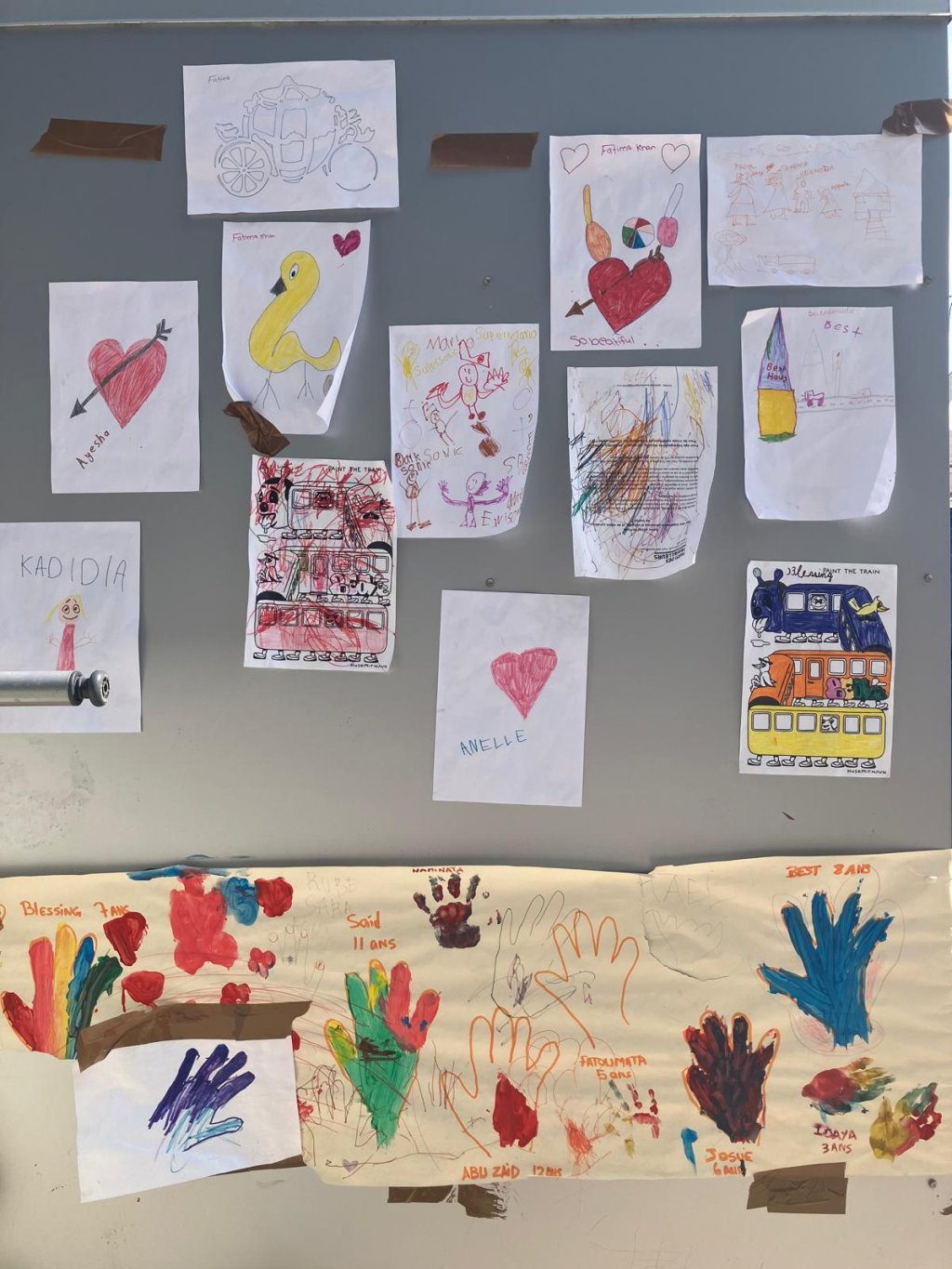
Behind him, a boy unfurls a long banner on which children have colored trees, wolves, and flowers. "The lengths of stay are getting longer and longer, which creates less fluidity. We also have elderly people, isolated and with chronic illnesses, stuck in our care facilities. They could access nursing homes if they had legal status!" the Samusocial striker says.
The mobilization of migrant families is changing their demands to the Samusocial management and the regional prefecture. "Building more housing is a first emergency response, but we need a fundamental reflection so that people don't remain in precarious situations indefinitely. More and more families are living for years in social hotels: the majority of them are people stuck in the process of regularizing their immigration status."
'Maybe we could sleep in the offices up there?'
The occupation of the Samu plaza with Utopia 56 and these displaced families "has reignited the momentum" of their strike, Bernard says, cigarette in hand. While only "15 to 30 colleagues" from the Samu have been holding out like him for two months, some days, more do, and especially in the past week, "the majority of colleagues support what's happening here on the plaza. Doctors from the Samu have joined the strike, as well as the Housing Department," he asserts. He himself says that "the discussions with the families" in the past few days "have given him renewed energy."
"We shouted, we wrote on banners," young Brijino says, all smiles. He participated in demonstrations with all these adults. To escape the heat, the construction noise, and the cold at night, "maybe we could sleep in the offices up there, is that okay?" his friend Mohamed asks, his gaze fixed on the multi-story glass building. According to French national statistics (INSEE), one in five homes in Paris is unoccupied (nearly 260,000 units).
When Mohamed is told that this building, however, houses the headquarters of Samusocial, he knows exactly what that is. He knows what 115 is, the people his mother "calls for two hours every morning when we wake up at 6 a.m." Then she starts again. To no end. "I'm going to take the elevator," Brijino declares thoughtfully. "To ask them."
*The name has been changed.