
Greek police authorities have made more than a dozen arrests related to the smuggling of people in vehicles over the last week, according to announcements made on the Hellenic Police website.
Police authorities have made more than a dozen arrests related to the smuggling of people in vehicles, according to announcements made on the Hellenic Police website.
Today (July 28), a 22-year-old suspect was arrested for the illegal transport of migrants within the country. "The suspect reported to have been driving a private car in the Old National Road Kavala, Thessaloniki and did not comply to police signals for a vehicle check," read a statement on the website. The latest arrest was also reported in Greek newspaper Ekathimerini.
A search of the vehicle, found three people who lacked travel documents. Two were in the luggage compartment. They are suspected to have entered irregularly through a point in the Greek-Turkish border and were headed for Greece's second city Thessaloniki, in the north of the country.
On Saturday (July 25), the police arrested three people, one Greek national and two foreigners for allegedly transporting about 17 people in private cars.
All in all, the police reported 16 cases of arrests for the illegal transport of people. Only one used a truck, all the others used a passenger vehicle, they said.
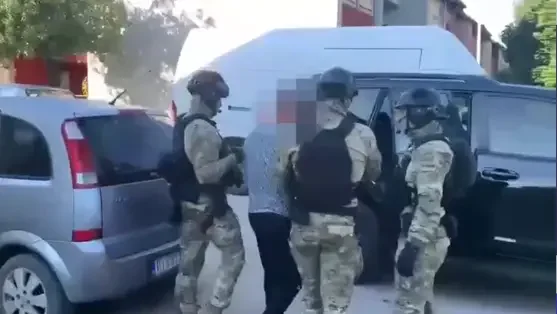
Last week, Europol announced the arrest of seven people across three countries in a coordinated police operation to crack down on migrant smuggling. In a statement, Europol said that five suspects were arrested in Greece, one in Bulgaria and one in the Netherlands on Thursday (July 16). The suspected criminal network allegedly smuggled migrants through the Balkans using rented, stolen, and fraudulently registered vehicles.
Read AlsoEuropol dismantles major smuggling ring
Smuggling routes
According to Frontex, the European Union's border control agency, most irregular migration into the EU passes through several established routes.
- The Eastern Mediterranean route covers land and sea crossings from Turkey
- The Western Mediterranean route links Morocco and Algeria with Spain
- The Central Mediterranean route carries migrants from North Africa, Turkey and Greece towards Italy and Malta
- The Western Balkan route connects Greece with Central and Western Europe through countries including North Macedonia, Serbia, Bosnia and Herzegovina, Montenegro and Albania
Frontex data indicate that the Western Balkans is the most frequently used land route, with movements originating from Serbia accounting for 74 percent of detected irregular land-border crossings.
Other major pathways include the Western African route to the Canary Islands, the circular route between Albania and Greece, and crossings through the EU’s eastern borders from Russia, Belarus, Ukraine and Moldova.
Read AlsoBalkans: Europol arrests five suspected migrant smugglers
A shifting and growing threat
The latest Europol report describes criminal networks as decentralized but also structured, scalable and increasingly global.
"Criminal networks are now more agile and better connected than ever, exploiting both vulnerable people and systemic vulnerabilities," the report noted, describing criminal activity across Europe as a "shifting and growing threat".
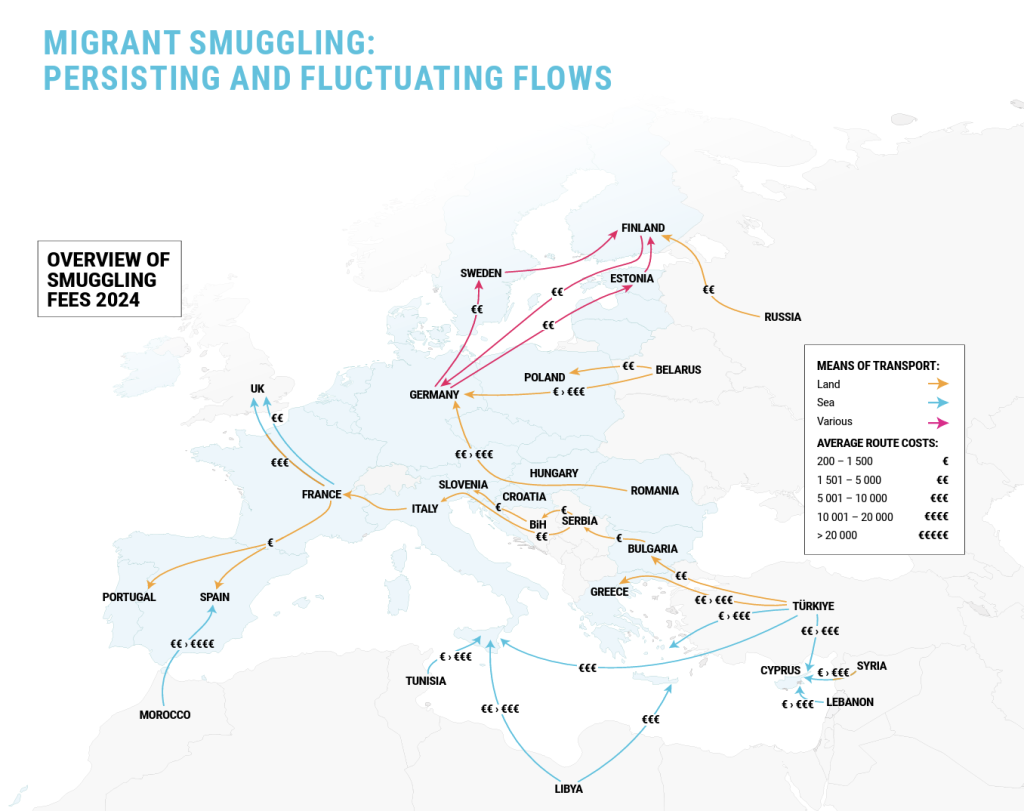
The smuggling networks reportedly employ an organizational structure where each part of the smuggling route is managed by different field actors. Key figures are said to be based outside of the EU to avoid detection and arrest. This important 'business feature' allows the networks to maintain their operations despite police crackdowns and arrests.
Decentralization of operations is evident in how criminal groups recruit people and move illicit profits across borders, turning the digital domain into a borderless space for crime and money laundering that remains difficult for law enforcement to police.
Read AlsoJumping onto trucks in Calais, the last resort for migrants without money