
The University of Strasbourg has implemented differentiated registration fees for non-European foreign students since 2024. Over the past year, several students have been threatened with deregistration if they did not pay the requested amounts.
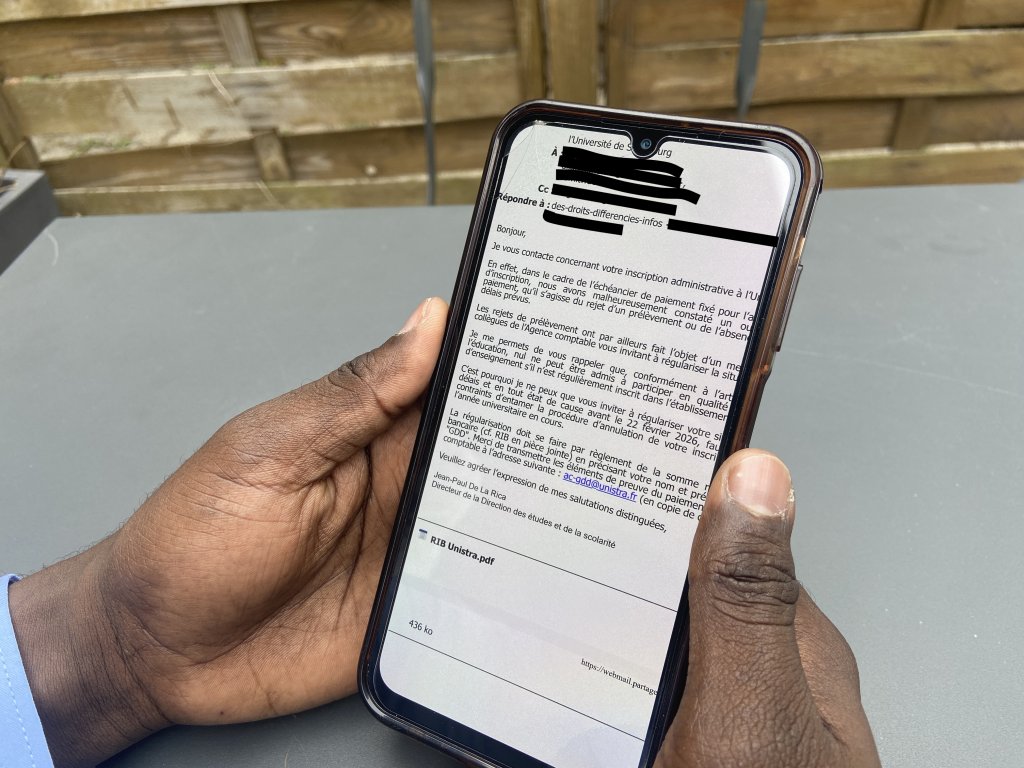
Brahima* almost gave up everything when he received, last November, an email from the University of Strasbourg threatening to expel him if he did not pay more than 3,900 euros demanded from him in international tuition fees.
This 28-year-old Senegalese had enrolled in a master of Public Administration at the University of Strasbourg to continue his studies and was preparing to take his final exams at the end of the first semester. "I told myself that I was studying for nothing," he remembers, sitting on a low wall not far from Strasbourg station.
When he got to France in 2023, Brahima studied geography in Paris before continuing his studies in Strasbourg. "I enrolled at university in May 2025; at that time, I had not seen anywhere that I had to pay almost 4,000 euros for my Master's degree. I found out a few days before the start of the school year," the young man in a striped polo shirt and sports pants says. "I was stunned. I filed for an exemption, but it was refused. If I had had the information, I would not have taken the risk of coming to study in Strasbourg."

Introduction of 'differentiated rights'
In November 2018, the government's plan for higher education, called "Bienvenue en France" (Welcome to France), introduced differentiated fees for university registrations for so-called extra-community (non-European) students, going up to more than 10 times the price paid by European students.
At the University of Strasbourg, for these students, the price of a bachelor's degree now amounts to 2,902 euros (compared to 178 euros for Europeans) and the price of a Master's degree is 3,950 euros (compared to 255 euros for European students).
But the 2019 text left universities free to exempt up to 10 percent of all registered students from these fees. Thus, in reality, very few universities have charged differentiated fees to their non-European students. The University of Strasbourg had already stood out by applying these differentiated rights to non-EU students right from December 2024.

But, in April 2026, the current Minister of Higher Education, Philippe Baptiste, launched a new plan for higher education called Choose France for Higher Education. A first version of this plan required universities to respect a limit of 10 percent of non-EU students exempt from differentiated fees (a way more restrictive limit than 10 percent of all students). A few weeks later, the limit was raised, with a target of 20 percent of non-EU students exempt in two years. Until then, universities will be able to exempt 30 percent of non-EU students in 2026-2027 and 25 percent in 2027-2028.
In Strasbourg, for the 2025-2026 academic year, the university welcomed 10,380 non-EU students and was able to exempt a good number of them from fees -- notably all undergraduate students. But 310 Master's students remained without a solution. Some had to pay the requested fees, some were deregistered, while others remained in a gray area without knowing if their year would be validated.
Of these 310 students, several dozen received letters threatening them with deregistration if they did not pay the differentiated fees within a few days.
'I was able to put money aside'
This is the case of Brahima, but also of Hamit Wachi Allatchi, 32. This elegant Chadian man, who arrived in France for his law studies in 2023, also had the unpleasant surprise of discovering at the start of the 2025 school year that he was going to have to pay much higher registration fees than he expected.

"As I had already been studying in France for several years, I thought that the differentiated fees would only apply to students who had just arrived in France," he explains, in a blue shirt and polished moccasins, from the terrace of a small café in the north of Strasbourg.
A few weeks after the start of courses, the student negotiated with the university the possibility of paying the fees in two installments and made a first payment in October. He planned to make the second payment a few months later. Nonetheless, at the beginning of February, he received a letter from the university inviting him to "regularize his situation before February 22", otherwise his registration would be canceled.
"I was able to pay because I have been working in France for several years so I had put a little money aside," explains the law student. But he points out that paying fees can be more problematic for students who have just arrived in France.
'For some students, 4,000 euros is a colossal sum'
To denounce this situation and support foreign students in difficulty, Hamit Wachi Allatchi decided to create a collective of extra-community students. Among its main demands: to recognize the differences in the financial situation of foreign students depending on their income.
"We ask the French state to take into account the income of students from the Third World," Hamit Wachi Allatchi says. The young man, who is now studying financial law, believes that it would be "fairer" to assess students' situations on a case-by-case basis before making them pay. "A Cameroonian student cannot pay the same as a Saudi or a Canadian. For some students, 4,000 euros is a colossal sum," he argued.
Elsa Rambaud, political sociologist and member of the Snesup union in Strasbourg, also slammed "a sacrifice of the poor countries of the French-speaking world". For her, the registration fee increases aim to "reorient French areas of influence." "If we want to be credible with emerging countries, we must send a price signal that shows the value of our training." The tuition hike is a "short-sighted calculation," according to her.
Because nothing says that wealthier Asian or American students will choose to study in France because of these differentiated rights. On the other hand, as early as 2019, the president of the communications committee of the Conference of University Presidents (CPU), François Germinet, estimated the general "30 to 50 percent" drop in applications from African students to French universities.
Working too many hours, a 'huge risk'
In Strasbourg, as in other cities in France, faced with sums that they could not pay, some students "have taken out debts with their families or their classmates, stopped paying their rent, or increased the number of precarious jobs while they are subject to very reduced working hours", Elsa Rambaud explained.
For already precarious students, the increase in university registration fees is one of too many expenses. Especially since it coincides with the end of personalized housing assistance (APL) for non-European and non-grant students.
From the Agorae grocery store, adjacent to the Crous de Strasbourg, Maroussia Dhume, president of the Afges student association, notes the impact of this measure on the standard of living of non-EU students. "It's very stressful for students. And, very often, the easiest expense to reduce is food," she says.

Brahima and Hamit did not want to take the risk of increasing working hours. They deemed it too dangerous for their administrative situation as well as for their studies. “It's a huge risk because if we work too much, we risk receiving a deportation notice [OQTF] by the prefecture, which verifies the number of hours worked," Brahima says.
"I only work 10 hours a week because, in law, there is a lot of homework and my studies are a real priority for me," Hamit Wachi Allatchi says. His professional project is to set up a financial investigation consultancy in Chad to fight against corruption.
With his collective, the Chadian student also wants to point out the obvious: "Extra-community students are not only beneficiaries of the French system”. “Some will stay working in France and contribute to its wealth. Others will return to their country and contribute to France’s image internationally.”
*First name has been changed