
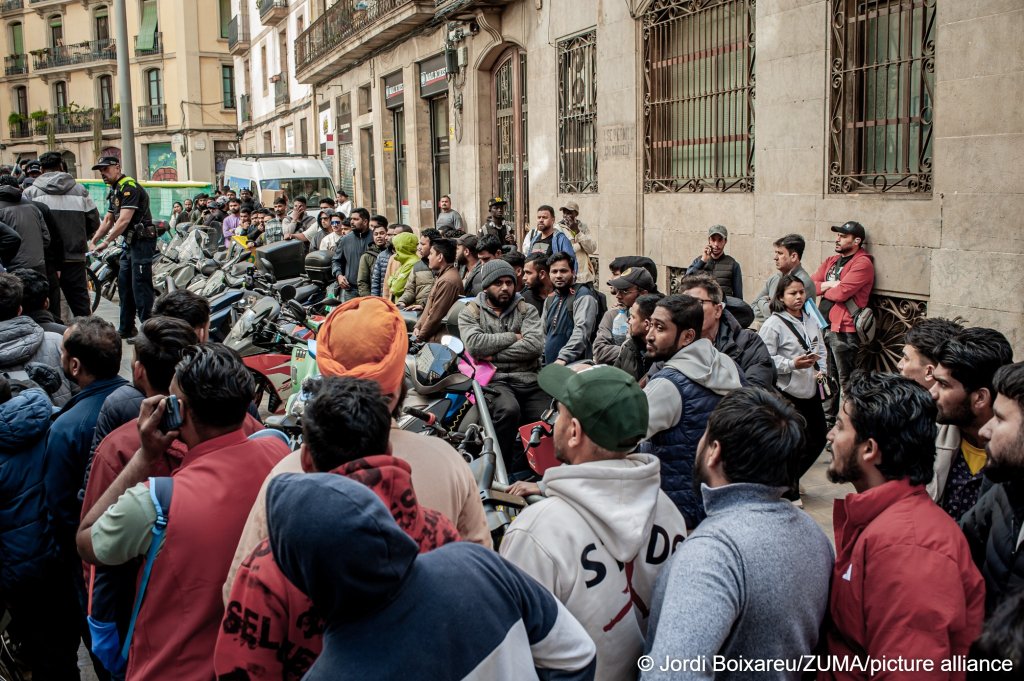
Spain's extraordinary regularization decree has come under fire after the number of applications exceeded 1.2 million — more than twice the forecast number. Spain's migration minister has now responded to public concern and misinformation about the regularization drive, calling for an end to prejudice against migrants and emphasizing the important role they will play in the country's economy.
Spain's Minister of Inclusion, Social Security, and Migration Elma Saiz has come out in defence of the extraordinary regularization process for immigrants in Spain, saying that the government's immigration policy was enabling Spain "to grow and progress more than neighboring countries."
"The demographic, economic, and social reality is very clear, and we need immigration to remain a prosperous country and to maintain our welfare state," the minister stressed.
Amid an aging population and falling birth rates, the government hopes that migrants will help make up for a major shortfall in tax and social security revenue, which is expected to hit Spain in coming years.
Read AlsoSpain’s extraordinary regularization: Who benefits and who is left out?
Saiz: 'Spain's economy needs migrants'
Saiz explained that there are 3.4 million foreign workers contributing to Spain's social security, adding that more than 10 percent of that figure had joined the system in the last year.
Foreign workers now account for over 15 percent of all social security contributors, with the extraordinary regularization decree expected to push that percentage over the 20-percent mark.
Saiz emphasized that "the immigrant population supports strategic sectors such as caregiving, agriculture, construction, hospitality, transportation, and healthcare, and fills vacancies that often cannot be met by the domestic labor market."
Read AlsoSpain: Study finds that immigration is not the solution to ageing population and falling birth rates
"Thanks in large part to them, employment in Spain is growing faster than in neighboring countries; since 2018, it has grown by 13.8 percent, compared to the European Union average of 5.2 percent," she emphasized.
Of the nearly 1.2 million applicants for the extraordinary regularization drive, 81 percent are under the age of 45, which would allow them to contribute to social security through employment for at least 20 years.
Saiz doubled down on her message on X, stressing that "[w]hoever works, contributes, and pays into the system is part of Spain's progress, regardless of where they were born."
Read AlsoSpain: Over 1 million applications submitted as deadline for regularization drive closes
Calls to stop hate speech against migrants
The minister also responded to growing negative sentiments on migration among many Spanish people, highlighting that "misinformation spreads with particular intensity" when it comes to migration-related concerns, while warning that "false rumors and prejudices do great harm to society."
"There can be no coexistence when prejudices are fueled, falsehoods are spread, or entire groups are singled out because of their origin."
This comes as Spain's Observatory Against Racism and Xenophobia has published recent findings suggesting that migrants are increasingly becoming targets of hate speech on social media — Muslim and African women in particular.

Saiz urged people not to normalize hate speech and to report it wherever it occurs before it can escalate into acts of physical violence.
Saiz also implied that any negative reaction to cultural differences was disproportionate, since two thirds of applicants to the regularization scheme come from Latin American nations — countries with which Spain shares centuries of history.
Read AlsoInside Spain's extraordinary regularization drive
Spain's humanitarian responsibility
The minister also stressed that the extraordinary regularization process was important on humanitarian grounds, highlighting the "irregular status creates vulnerability, fuels the underground economy, and limits the economic and social potential of thousands of people who are already part of our communities."
"Unlike those who offer simple answers to a complex phenomenon, Spain is committed to policies based on institutional responsibility without losing sight of the humanitarian perspective," she continued.

Saiz also responded to claims saying that the policy would only serve as an incentive for more migrants to attempt to reach Spain, explaining that the process only applied to people who were already in Spain at the beginning of the year.
"They did not come because we initiated this process, but rather because they had already been in Spain for at least five months," she said, emphasizing that "this has been a well-planned and appropriately scaled process, [with] more than 620,000 applications already being processed."
Read AlsoSpain: Regularization 'not only an administrative process'
with EFE