
Latvia is experiencing an increase in irregular border crossings from Belarus, the country's border guard chief has said. The Belarus route first emerged almost five years ago.
Latvia has recorded an increase in undocumented migrants attempting to cross the border from neighboring Belarus, State Border Guard head Guntis Pujāts said on Thursday (July 9) according to Latvian public broadcaster LSM.
"The situation [at the border] has been quite tense and complicated since April," Pujāts said in an interview on Latvian radio. "This year we have already stopped 7,634 people, which exceeds last year’s figures by 800 [people]."
"Latvia is currently the main destination" of irregular migrants coming from Belarus, he said, pointing to lower arrival figures in fellow Belarussian neighbors Poland and Lithuania. According to the border guard chief, Lithuania has so far stopped 900 undocumented migrants this year, while Poland recorded only a few attempts.
Read Also80,000 migrants pushed back at EU borders in 2025, fewer than in 2024
Increased aggression?
The border guard commander also claimed his force was witnessing increased aggression on the part of migrants and their smugglers. "We have to use special equipment, weapons and warning shots to prevent illegal border crossings," he said.
Pujāts highlighted the rising frequency of migrant smuggling operations and cited an incident where a border patrol vehicle was allegedly intentionally struck.
He admitted that border guards are unable to intercept every crossing attempt, noting that approximately ten percent of individuals manage to bypass patrols. He also reportedly requested increased military assistance to help secure the border.
As of March 2025, entry at checkpoints at Latvia’s border with Belarus and Russia has been restricted to motor vehicles only. Authorities had previously strengthened border controls several times citing security concerns.
At the beginning of the year, Latvian authorities presented evidence of organized migrant transfers through Belarus and into the EU, saying that photos and documents found on migrants' phones indicate Belarusian military involvement, but details about when the evidence was discovered remain unclear.
Read AlsoGerman national arrested in Latvia on suspicion of migrant smuggling
Belarus route: active since 2021
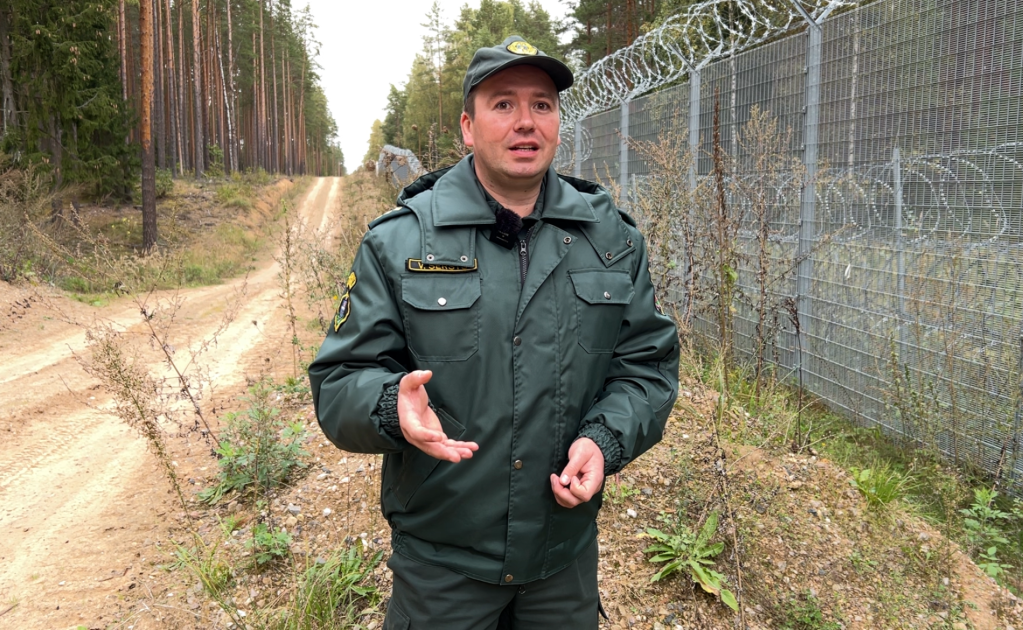
Latvia's border with Russia's close ally Belarus is around 172 kilometers long and forms part of the EU's external border. A double mesh fence topped with barbed wire stretches along the whole distance.
Under a 2021 law, Latvian authorities returned thousands of migrants from Latvian territory. This policy has been repeatedly criticized by NGOs and UN agencies, who point out that pushing people back to a territory where they might face danger is against EU and international law.
Western countries have long accused the Belarusian leadership of trying to destabilize the EU by helping migrants across the EU external border, and using them as a kind of hybrid kind of warfare. Belarusian ruler Lukashenko has repeatedly rejected the accusations.
EU member states Latvia, Lithuania and Poland authorized pushbacks and fortified their borders with Belarus following the emergence of the Belarus route in August 2021. The large numbers of mainly Middle Eastern migrants crossing irregularly into the EU from Belarus resulted in thousands becoming stranded in border regions for months.
As of 2024, more than 115 people are known to have died on the EU-Belarusian border. The real number estimate migrant rights organizations could be a lot higher.
Over the past few years, Latvia also built a fence on its 283-kilometer border with Russia. Unlike the frontier with Belarus, however, the principal reason for the fortification is not to stop irregular border crossings but potential Russian aggression.
with dpa