
Since July 1, a new facility in the German state of Saxony is to house asylum seekers obliged to leave Germany due to another EU country being responsible for them.
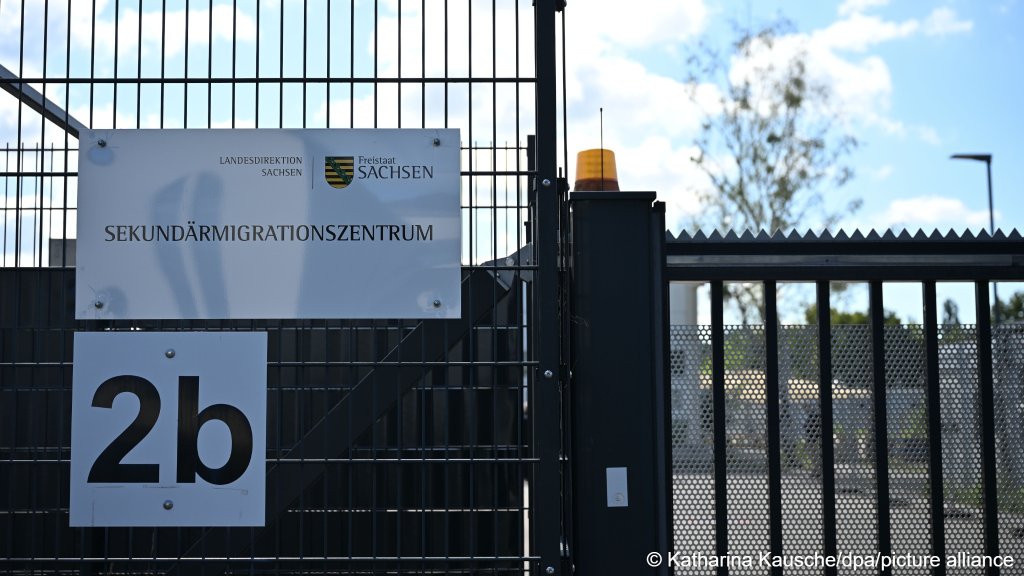
At the beginning of this month, a so-called secondary migration center for asylum seekers who are to be transferred to other EU countries opened in Dresden, the capital of the state of Saxony in eastern Germany.
Since June, German states have been able to use the secondary migration centers to centrally house people whose asylum cases fall under the jurisdiction of another EU country or who have already been granted protection there. Migrants are housed in these centers, with a view to sending them back to those countries as soon as the correct procedures are in place.
According to the Saxon state government, the facility in Dresden is the country's largest with 400 spots in single, double and family rooms.
Saxony's Interior Minister Armin Schuster said the goal is to implement the new Common European Asylum System (CEAS) as quickly as possible. "And secondary migration centers are a key instrument of the CEAS," which took effect on June 12.
Read AlsoGermany: Multiple raids carried out against Syrians suspected of smuggling and misuse of passports
What are the conditions on site?
Under the new rules, residents are required to register and remain on the premises. What's more, anyone wishing to leave the fenced-in grounds must obtain permission and state a reason, such as a doctor's appointment or a walk.
According to Schuster, this should also be possible on short notice.
The facility has been operational since July 1, at the site of the former State Departure Center in Dresden, though no one has yet been housed there under the new regulations.
Residents of the center are reportedly to be transferred to the relevant EU member states as soon as possible. The duration of their stay is not to exceed 24 months; for families with minor children, the maximum is 12 months.
'Deportation prison' or 'housing option with certain conditions'?
Migrant advocacy and aid organizations have criticized the facility. Speaking to regional public broadcaster MDR, Saxon Refugee Council and NGO Mission Lifeline called the center a "deportation prison" with prison-like conditions.
The Refugee Council's Angela Müller said that there's no reason not to make asylum procedures more efficient; she also, however, called on the state government not to curtail human rights and dignity in favor of faster procedures.
Müller argued that decentralized accommodation is better suited to uphold rights to privacy, freedom of movement and, where appropriate, health and education.
Müller also criticized that her colleagues were not allowed to conduct monitoring visits of the facility, although as yet there is no one resident there. The Saxon Ministry of the Interior has so far declined to confirm whether and potentially why Saxony might be denying access, MDR reported.
Ronny Wähner from the conservative CDU faction in the state Parliament denied the allegations, calling the facility a "housing option subject to certain conditions." He added that "too much freedom of movement" would "undermine" its purpose, and that "people going underground again" must be prevented.
Read AlsoGermany: Interior Minister wants more deportations, especially of criminals
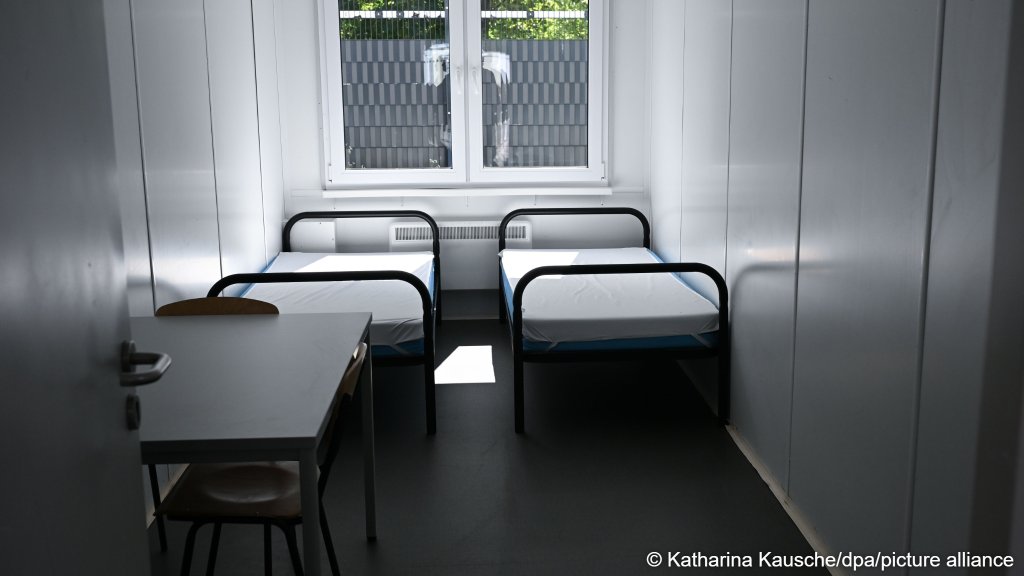
'Bunk beds, tables, lockers, chairs, that's it'
In the city of Halberstadt in neighboring Saxony-Anhalt, meanwhile, another secondary migration center is being set up for 150 people.
The mostly young men expected to be housed there will have access to the bare essentials, Philipp Eysel, director of Saxony's central point of contact for asylum seekers told MDR: "We have bunk beds, a table, a locker, a chair -- and that's it."
The principle, Eysel explained, is to make staying in Germany as unattractive as possible. The stated goal is not to grant those affected too many benefits -- "except for a bed, bread and soap -- and to motivate them to leave the country voluntarily, because they simply aren't allowed to stay here."
Saxony-Anhalt will hold state elections in September where the far-right anti-immigration party AfD is expected, according to current polling trends, to gain the most votes.
Thuringia, another eastern German state, is taking a different approach. There are currently no plans to establish a so-called secondary migration center, the government told MDR. Instead, Thuringia is relying on its existing structures and the new EU-wide screening procedures for identifying asylum seekers.
Dublin Centers in Hamburg and Brandenburg
According to the Saxon Interior Minister Schuster, Saxony was the first federal state to open a secondary migration center. Two other states -- Hamburg and Brandenburg -- had already established so-called Dublin centers prior to the CEAS reform.
These generally function similarly but differ, for example, with regard to possible restrictions on residence.
In Hamburg, according to a spokesperson for the Interior Ministry, the Dublin Center has been converted into a secondary migration center.
In Brandenburg, the Interior Ministry is still considering whether to convert its Dublin center.
Classrooms, childcare and common areas
Unlike other facilities, the secondary migration center in Dresden is not intended solely for men traveling alone, but also for women and families. That is why there are now also rooms for school classes, childcare, and a women's café.
In addition to their living quarters, all residents have access to common areas, a laundry facility, and areas for play and sports. German language classes and advice on returning home are also offered on site.
CEAS, short for Common European Asylum System, has been in effect since June 12. Its main objectives are to introduce uniform procedures across EU member states to streamline and speed up asylum matters.
Another integral part of the new guidelines is the introduction of a solidarity mechanism designed to alleviate some of the burden of countries at the forefront of receiving people presenting for asylum, such as Greece, Italy and Spain.
with dpa