
Even while arrivals to European countries keep decreasing, the number of people who have died trying to reach Europe has been on the rise this year, new data by the International Organization for Migration (IOM) shows. Another trend is an uptick in so-called invisible deaths.
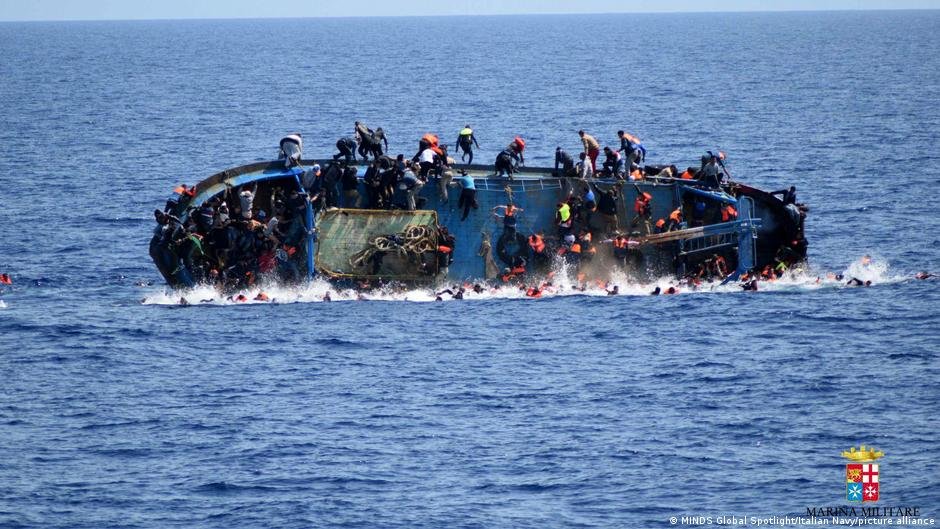
During the first six months of the year, 1,570 people have died on sea routes trying to reach European shores. That's a 27 percent increase over last year, when 1,232 perished during the same period, according to new data released by UN migration agency IOM on Wednesday (July 8).
The increase comes as the number of irregular arrivals to EU countries continues to decline: Last year, EU border agency Frontex recorded the lowest annual total since 2021 with just under 178,000 irregular entries at the EU's external borders.
This year, the trend continued: Frontex data published in mid-May showed a 40 percent year-on-year drop for the first four months of 2026.
In other words: less migration is not translating into safer journeys.
"The fact that fewer arrivals coincide with more deaths is a reminder that deterrence does not make migration safer," said the IOM's Andrea Garcia Borja, referring to the sweeping trend among member states and the European Union of tightening (im)migration policies. "We need better data to fully understand what happens along entire routes and create accessible regular pathways to reduce the need for people to undertake such dangerous journeys in the first place," she urged.
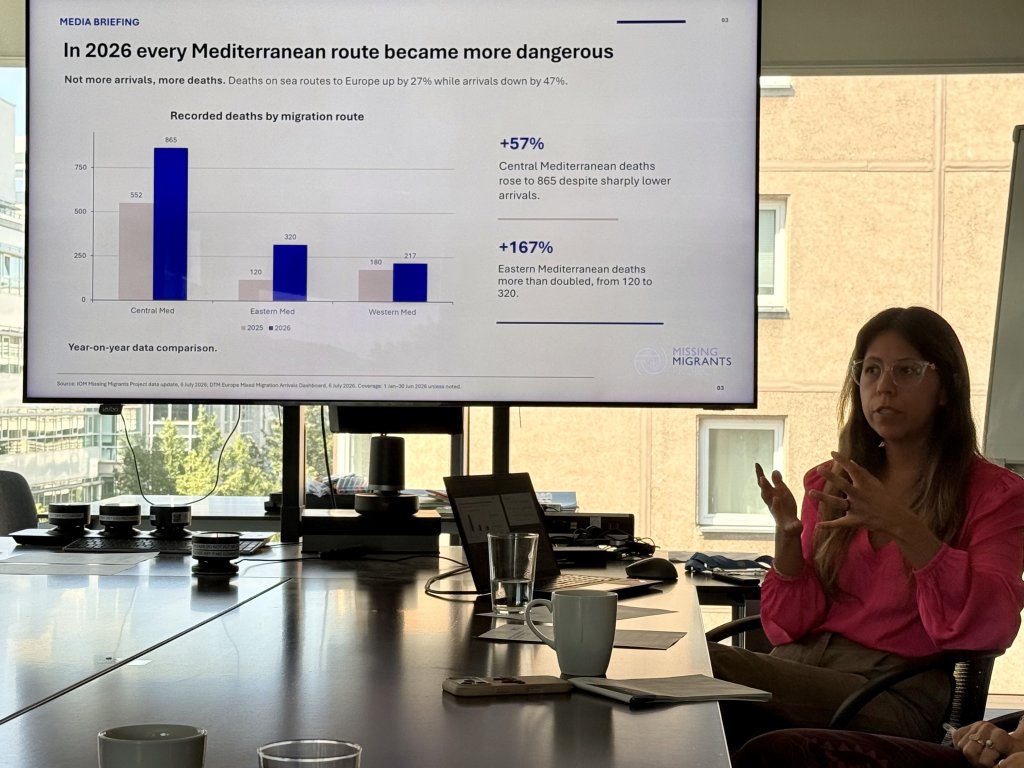
According to the IOM, every Mediterranean route -- eastern, central and western -- became even more dangerous this year. The Central Mediterranean route saw a 57 percent increase in recorded fatalities. In the eastern Mediterranean Sea, the death toll more than doubled, from 120 to 320, driven by an uptick in departures from eastern Libya to Crete.
"The distance to Crete of hundreds of kilometers is definitely not something you can navigate with rubber boats. Plus they are extremely crowded," Garcia Borja told InfoMigrants at the IOM office in Berlin. "But the main reason [for the high death toll] is that this emerging route lacks search and rescue capacity."
Similarly, the death toll on the Atlantic route to Spain's Canary Islands rose from 3.3 to 4.5 percent this year while the number of arrivals fell sharply (roughly 67 percent).
Read AlsoRefugees and migration: Is Europe closing its doors?
Aside from emerging migration routes with less SAR capacity, migration routes are becoming longer overall and thus more dangerous as migrants move to less-patrolled areas, which can go some way to explain the rising death toll.
Journeys to the Canaries, for instance, are starting further south, says Garcia Borja. "While people used to leave from Morocco or Mauritania, they now start in The Gambia. These are extremely long journeys of more than two weeks, which obviously increases lethality."
Updated on July 6, the IOM data is based on research by the IOM initiatives Missing Migrants Project (MMP) and Displacement Tracking Matrix (DTM) and covers January 1 to June 30, 2026.
More 'invisible' deaths
Another key trend in the IOM data is an uptick in so-called invisible shipwrecks and deaths.
"Not only are journeys becoming more dangerous, deaths are becoming less visible," Garcia Borja said. "As IOM, we are less able to record and verify those. We know that an additional 1,500 people were reported missing at sea last year, but we were not able to verify them and thus didn't include them [in the death toll]."
Read Also'Missing in the Mediterranean': Organization sounds alarm about missing migrants
2025 saw at least 270 unidentified human remains wash ashore along the Mediterranean Sea, according to the IOM. Additionally, three boats carrying 42 victims were discovered drifting in the Caribbean and near Brazil, having originated from the Canary Islands route.
Another example to illustrate Garcia Borja's point is that it is estimated up to 1,000 people may have gone missing in the Mediterranean due to Cyclone Harry that caused havoc and devastation in southern Italy and its surrounding seas in January.
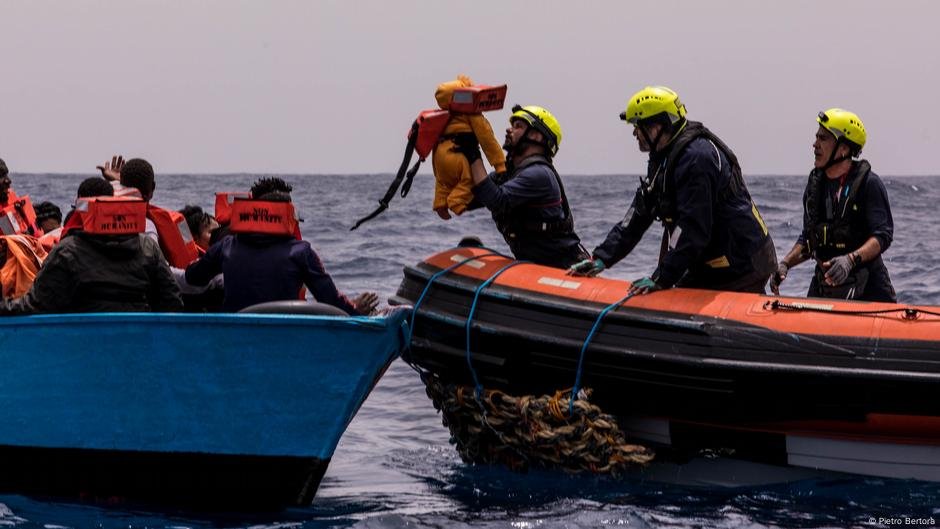
According to the IOM, the growing number of deaths that go unrecorded is mainly due to increasingly restricted access to search and rescue (SAR) operations and other data on European maritime routes, including interception figures, which have not been publicly available for a few years now.
Other reasons for the reduced capacity to record deaths include fewer private and state SAR missions as well as aid funding cuts to the IOM and other UN agencies.
In light of this, the IOM called on European countries to, among other things, restore SAR capacity, make prevention and protection "route-based" -- that is where fatalities recur in origin, transit and destination countries --, protect humanitarian space, restore funding to UN agencies, allow for information sharing and setting up "well-coordinated mechanisms" to identify victims' remains.
Not being able to verify death tolls is one reason why the real death toll is likely to be significantly higher, Garcia Borja stressed. "The figures are minimum estimates that only include verified cases and are not a real representation of the crisis," she added.
340,000 families affected
With most migrants who die on migration routes perishing at sea, the bodies of almost two out of three migrants are never recovered, according to the IOM's Andrea Garcia Borja. On the routes to Europe, she explained, 27,300 of the more than 35,000 registered as missing or dead on their website since 2014, were never recovered.
Yet "the search never really stops," she told InfoMigrants. "In the absence of knowing the fate of their loved ones, many families keep searching for answers" for a long time.
An association in Morocco illustrates this well: Over the years, mothers and sisters of missing persons there have brought together nearly a thousand relatives of those who went missing while attempting to reach Europe across various border zones -- from the Balkans to the Atlantic and the Mediterranean.
According to an IOM estimate from last year, some 340,000 family members worldwide are directly affected by these recorded fatalities.
Read AlsoMigration in 2025 – the year in pictures
A 'global humanitarian crisis' with Europe at the center
Since its inception in 2014, the Missing Migrants Project has recorded almost 84,000 deaths and disappearances worldwide, roughly half of them on land and sea routes to Europe. Of all migration routes, the Central Mediterranean route has been the world's most dangerous, with nearly 27,000 deaths, according to the Missing Migrants Project.
"While it is a global humanitarian crisis, Europe is at the center of it," Garcia Borja says.
Established in 1951, the UN migration agency IOM supports people around the world affected by displacement, conflict, disasters and humanitarian crises.
When asked whether the 2026 trend of an increase in lethality will get worse in light of European countries trying to control irregular migration with stricter migration and asylum policies, Garcia Borja stressed that the situation in destination countries is just one of "many factors" that influence migration decisions.
"It's also the drivers of migration, the situation in countries of origin and transit countries -- what enforcement measures are put in place and how migrants are treated there -- in addition to climate change and conflicts that play a role," she says.
Europe's refugee population plateaus
While irregular migration arrivals have been decreasing, Europe's refugee population started plateauing last year following a decade of growth.
According to a new report by the Rockwool Foundation, the number of refugees and asylum seekers in the EU and the UK stabilized in 2025 at 9.6 million, which was virtually unchanged from 2024 following a 6.3 percent rise the previous year.
Stable total numbers in the EU and the UK mask major changes in refugee demographics. While Ukrainians account for nearly half of all refugees and asylum seekers, the number of Syrian residents has fallen, while the Venezuelan population has grown.
These trends vary by country: Germany, Poland, and Italy saw declines, while France, Spain, and the UK saw growth.
Additionally, new asylum applications in the EU dropped for a second year, largely due to fewer Syrian claims. In Germany, the decline in numbers is driven mainly by naturalizations rather than people leaving.