
Located in the heart of Paris, Capsys is a hospital unit dedicated to providing psychiatric care for displaced people. Their team helps patients overcome the trauma of displacement and the hardships of living in precarious conditions in France.
With a crutch under each arm, Jérôme*, a 34-year-old from Congo-Brazzaville, slowly enters the doctor’s office. He moves his feet carefully across the floor, taking small steps; a backpack hangs from his left shoulder. He sets the bag down on the chair and then fixes his gaze on the woman across from him. "Thank you for seeing me today; I need help."
Since arriving in France in December 2025, he has struggled to make ends meet. "I am traumatized and suffering from severe memory loss," he says in perfect French. "I leave pots on the stove and forget about them; I’ve even nearly been hit by cars several times." Suddenly, the Congolese man breaks down in tears: "I feel like my brain is failing me."
"Take your time," the psychiatrist replies, handing him a tissue to dry his tears. She has been working as a psychiatrist at the Capsys unit, which specializes in psychological treatment for displaced people, since January. This is her first consultation with Jérôme. She is trying to uncover the root cause of his trauma.
Read AlsoFrance: Report documents impact of administrative procedures on foreign workers' mental health
'I keep seeing everything that happened'
Her patient quickly mentions nightmares and screaming in the middle of the night. "I keep seeing everything that happened," he says. Jérôme pauses. He searches for the right words. Then, he points to the scars on his legs -- marks left by the blows he endured. Tears well up again. "They beat me, tied me up, dragged me along the ground, and left me there on the sidewalk, left for dead." He was beaten for his political activism within his country's opposition movement -- the very reason he fled to France.
"You’ve been through so much; it’s normal for your brain to struggle to stay focused," the psychiatrist explains. "Memory loss is a symptom of this post-traumatic stress," she adds. Today, Jérôme is still looking for a reason to believe in the future and admits to having had "dark thoughts" on several occasions. He pauses again and rubs the back of his neck, complaining of severe pain there.
The first time he contemplated suicide was when he lost his daughter -- then just a few years old -- to illness. "The medication was right there on the table; I was going to do it. But I thought of my other children -- that’s what made me stop," the father says. He asks himself: "What did I do to deserve this? I’ve lost count of how many times I’ve cried over it in my life."
Read AlsoAccess denied: Undocumented migrants across Europe missing out on healthcare services
'The clinic of despair'
Like him, hundreds of people walk through the doors of Capsys every year -- a unit within the Paris University Hospital Group (GHU). Funded by the Île-de-France Regional Health Agency, this service, launched in 2021, specializes in psychiatric care for displaced people.
Here, two psychiatrists, a psychologist, a nurse, and interpreters see displaced individuals -- whether undocumented or with legal status -- from across the Paris region every day. They strive to help a population for whom anxiety and sadness are compounded by a traumatic migration journey. "It’s essentially a clinic for despair," Andrea, the psychiatrist and head of the unit, says succinctly. "What we do here is help them hold on."
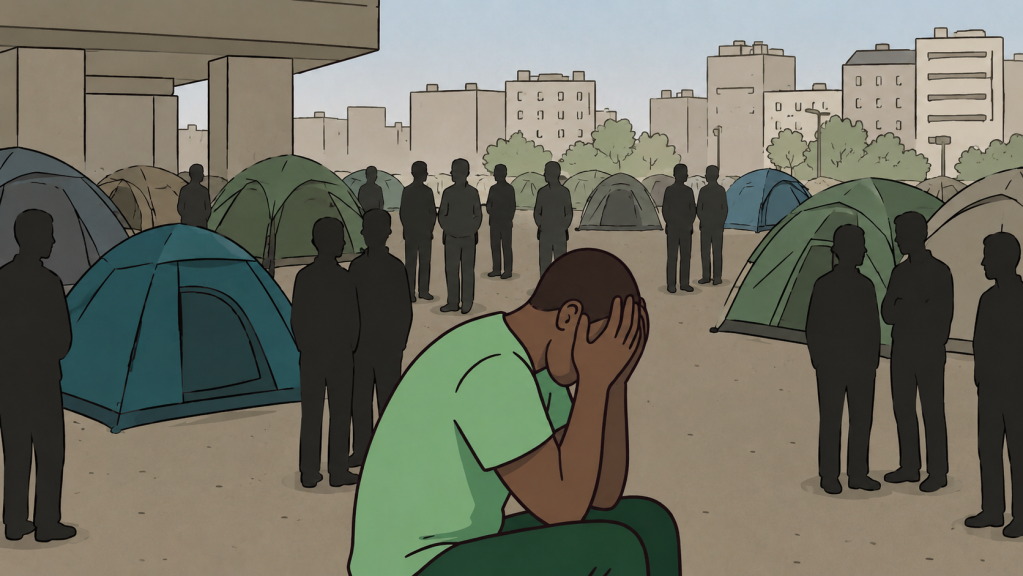
However, the patients' precarious situations -- whether financial, social, or administrative -- make the task difficult. The medical team attempts to manage an immense concentration of despair and the patients' volatile, "roller-coaster" morale. "We start treating them, and they improve. But soon, something always happens -- a residency permit or asylum application is rejected, they lose their housing, or a family ends up on the street. And then comes the relapse. We have to start all over again," the psychiatrist explains.
'I don't sleep anymore'
For Marie*, the relapse occurred when she received a photo of her daughter, whose eye was red and bloodshot after being struck at school. This 35-year-old Guinean woman, who has been receiving care for over a year, has not seen her children in nearly five years. Forced into marriage with a cousin who mistreated her, she fled to France, leaving her daughters with her sister in Nigeria.
However, lacking documentation, she was never able to visit them or bring them to France. Last May, after her asylum application was rejected, she obtained a receipt acknowledging her application for a residence permit on medical grounds, having undergone heart surgery. She also holds a disability card. These documents finally allow her to reside legally in France, but do not permit her to travel.
Speaking in a weak tone, she describes being overwhelmed by her thoughts. "I don't sleep anymore. Just an hour or two, then I wake up. During the day, I do nothing. I'm exhausted," Marie says, her voice trembling. Beneath her cap, dark circles under her eyes bear witness to her daily reality. With her gaze fixed on the floor, she repeats, as if trying to convince herself: "It's okay. It's okay. It's okay."
At the end of the consultation, doctors may prescribe medication: antidepressants, anti-anxiety drugs, or sleeping pills. This will be the case for Marie to help manage her stress and insomnia. Capsys has a small pharmacy for migrants who cannot obtain reimbursement. "With these treatments, we also engage in a great deal of preventive care, because without treatment, many pre-existing conditions could worsen," the unit head explains.
'You are a remedy'
After a few weeks of treatment, the patients are doing better. "We see so many people arrive in a terrible state, but improve significantly as the sessions progress," Mosadiq, one of the unit's interpreters, says. He arrived in France in 2017 from a country he prefers not to name -- fearing for his family's safety -- and was granted asylum. "But before that, I lived on the streets; I experienced the anxiety and the long wait for an appeal before the CNDA [asylum court]. And back then, a place like Capsys didn't exist," he says.
The growing number of patients demonstrates the value of such a service. "We support more and more people every year. Last year, we saw 1,000 patients. If we keep up this pace, we’ll have nearly 1,500 this year," the doctor notes with satisfaction. The unit's budget has even been nearly doubled recently.
"We get almost two new patients a day," the psychiatrist adds. "The demand is there, but we have to triage because we’re overwhelmed." She points out that "clinical need is the only criterion." "Administrative status is never a factor," she insists, looking at a schedule that is packed solid for months to come.
Despite the budget allocation, the care unit is operating with only half its staff. "We’re missing a doctor and two nurses, and all the social worker positions are vacant," the head of the unit says. The demanding nature of the job is to blame. "There is a heavy emotional toll to bear. We take in people's distress, and we have to be up to the task," she explains.
The waiting room is full. Merveille*, a Congolese woman, is leaving the room after her appointment. She brings good news: she has reunited with her husband, from whom she had been separated in Greece, and her Dublin procedure is coming to an end. She therefore hopes to apply for asylum in France. She has lived on the streets, in hotels, or in gymnasiums following "emergency shelter" operations. "I was also subjected to torture on the journey to Europe," she mentions briefly. "Coming here really helped me cope," she explains to InfoMigrants.
Across the hall, after an appointment lasting nearly an hour, Jérôme reaches for his crutches and prepares to leave. "Just being listened to has helped me. The pain in my neck has faded. Thank you so much; I needed to be heard. You are a cure," he tells the doctor as he leaves. His next appointment is scheduled for sometime this summer.
*All names have been changed.