
The Spanish Civil Guard has reportedly broken up a suspected migrant smuggling ring in Ceuta, arresting six people. The Spanish enclave has seen a sharp increase in irregular arrivals since the beginning of the year.
On Tuesday (July 7) morning, "several" Spanish Civil Guard officers carried out operations in different neighborhoods of Spain's Ceuta enclave in North Africa, news agency EFE reported on the same day.
The Civil Guard confirmed the arrest of six people allegedly linked to the smuggling of migrants, according to EFE. Officers from several units took part, supported by drones that provided aerial surveillance during the raids, reported the El Faro de Ceuta daily.
"The presence of official vehicles and the closure of certain streets attracted the attention of many residents, who followed the progress of the operation from outside their homes," El Pueblo de Ceuta wrote.
The operation, conducted by Spain's Civil Guard under judicial authorization, forms part of an investigation into a suspected migrant-smuggling network that allegedly organized the transfer of migrants from Ceuta to mainland Spain after they had been brought into the enclave.
The six arrested individuals, all residents of Ceuta, face charges related to criminal conspiracy and violating the rights of foreign nationals. This operation follows a similar Civil Guard crackdown earlier this year, known as 'Operation Barquera,' in which 11 people were placed in pre-trial detention.
Other than the number of people arrested and the areas where officers have been deployed, the Civil Guard Command has thus far not provided any details about the operation, which began shortly before 6 am on Tuesday morning.
Human trafficking aims to exploit people for profit through "recruitment, transportation, transfer, harboring or receipt of people through force, fraud or deception" according to the UN Office on Drugs and Crime (UNODC). Migrant smuggling, on the other primarily for "financial or material benefit".
Uptick in arrivals
Since the beginning of 2026, Ceuta has seen a sharp increase in irregular migrant arrivals. According to the Spanish Ministry of the Interior, nearly 2,500 people have arrived there since January 1, a 164 percent increase compared to the same period last year (978).
The uptick can be explained in part by the significant decline in arrivals to Spain's Canary Islands in the Atlantic.
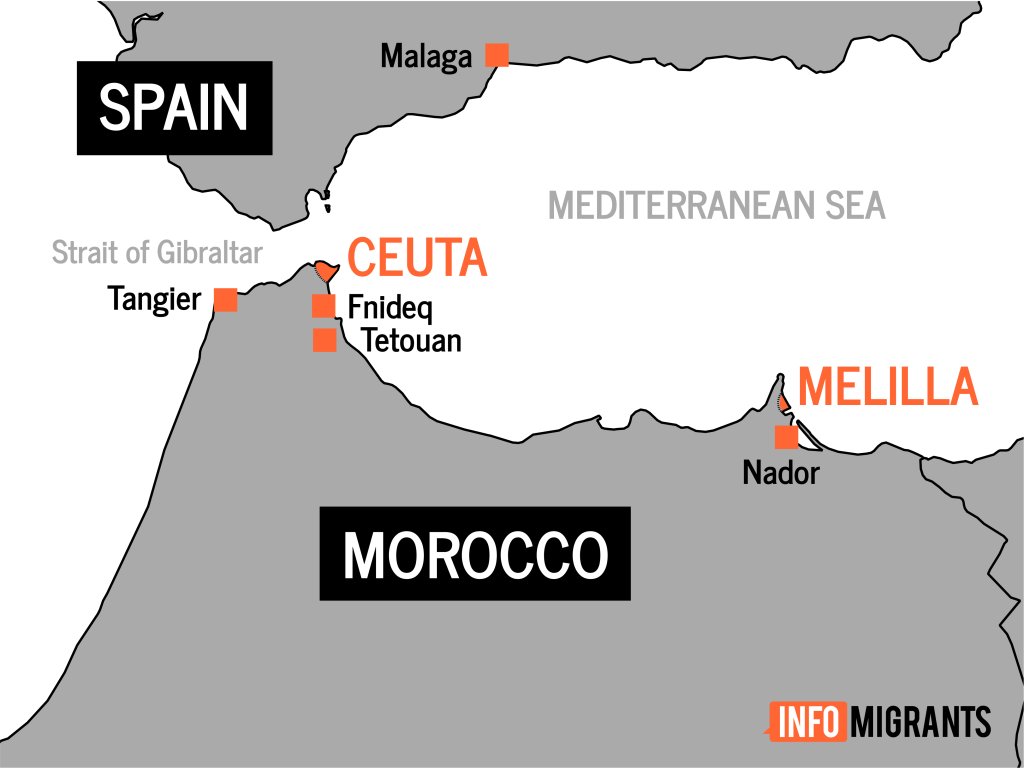
Trying to enter Ceuta or Melilla, Spain's other enclave in Morocco, is dangerous. The EU territories are surrounded by fortified barbed-wire fences and other barriers that stretch from the mountains to the sea. To bypass them, people either climb the fences or spend hours swimming from nearby towns like Fnideq or Benzu.
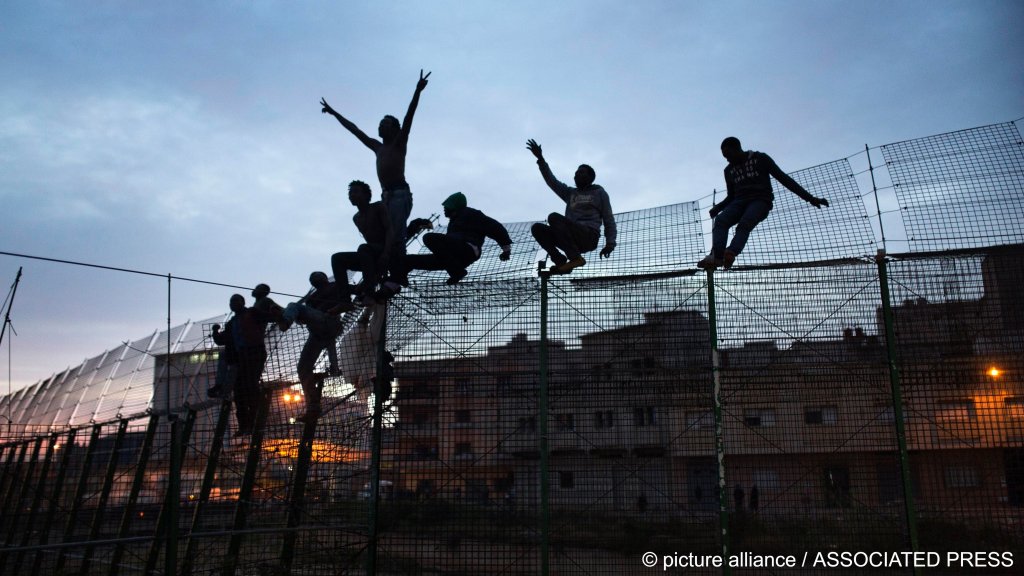
Adult migrants who reach Ceuta by swimming there meanwhile are increasingly sent back to Morocco quickly under various existing agreements between the Spanish and Moroccan governments.
The greatest number of migrants to ever reach Ceuta was on May 17, 2021, when over 8,000 people managed to swim there or succeeded in reaching Ceuta by scaling the border fence. One person died during that attempt.
Just over a year later, on 24 June, 2022, at least 23 migrants died while trying to breach the border fence at Melilla.
IOM: 'We record a lot of deaths of minors'
This year, there has been a "significant increase in fatalities" compared to 2025, says Andrea Garcia Borja of the IOM's Missing Migrants Project (MMP). While no deaths at the fence and 46 deaths on the sea crossings to Ceuta were recorded last year, the first six months of this year alone saw 38 deaths, of which three occurred after jumping the tall border fence.
One of the reasons for the rising death toll, according to Garcia Borja, is that more people are trying to reach the enclaves, particularly Ceuta. Another is that the crossing continues to be "extremely dangerous," she told InfoMigrants at the IOM office in Berlin.
"Some migrants swim in their swimsuits, others wear a wetsuit or vest. Overall, we record a lot of deaths of minors and other really young people," Garcia Borja said, adding that most victims are male and hail from Morocco or Algeria.
Another reason for the increase in deaths seems to be a greater willingness to risk crossing in adverse weather conditions. "Usually, people try to cross at night or during a storm, because there's less patrolling during that time."
Missing Migrants Projects data shows that at least 2,185 people died or went missing in the Mediterranean last year. The real toll is likely a lot higher.
Read AlsoAlmost 8,000 died on migration routes in 2025 worldwide, estimates IOM