
Members of the European Parliament, who were part of an unplanned visit to the Gjadër detention center in northwest Albania, expressed concern about being denied access to the facility.
A delegation of Green politicians from the European Parliament were denied entry to the Italian-run migrant detention center in Gjadër, northwest Albania, Euronews reported on Monday (June 29).
The visit was however unplanned and made on the sidelines of parliamentarians meeting with environmentalists and civil society leaders protesting the construction of a mega-luxury resort on Sazan Island in the Adriatic Sea off the southwestern coast of Albania, led by Jared Kushner, son-in-law and advisor to United States President Donald Trump, added the newspaper.
Tineke Strik, a Greens/EFA MEP who was among those on the visit, expressed her disappointment, telling Euronews, "We didn't get any data, they didn't answer any questions, and we were not allowed to really go into the cells and see what the situation is like," she said.
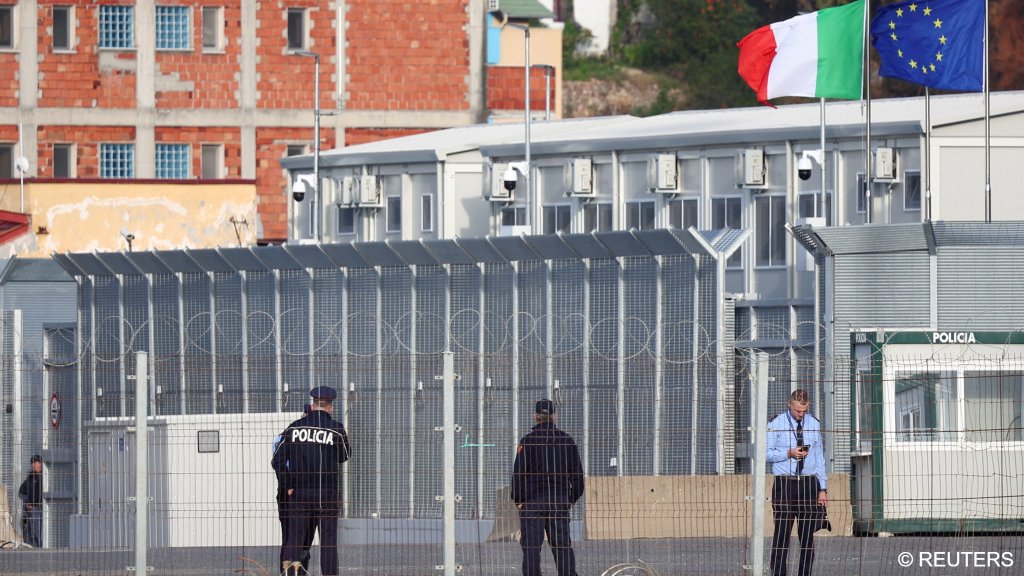
The Italian Catholic newspaper Avvenire, reported that some parliamentarians were however able to speak to some people in the detention center. The personal accounts paint a dire picture of a life in limbo waiting for asylum, not knowing if and when it will be granted, the newspaper recounted.
"We collected dramatic testimonies that describe a suspended and alienating daily life. In just one month, six suicide attempts were recorded, and one person who attempted suicide twice is still being held there without adequate assistance," AVS MEP Cristina Guarda reportedly told Avvenire.
The delegation did reportedly visit the processing facility at Shëngjin port, where migrants attempting to enter Europe by sea and are intercepted by Italian naval vessels are first disembarked and screened.
Controversy
The migrant detention center in Gjadër and the processing facility at Shëngjin port are at the symbolic center of heated debates about migration management policies.
Frontline countries such as Italy, Greece, and Spain have seen a larger number of irregular arrivals and are struggling to find ways to balance humanitarian needs and economic realities amid the mixed demands of citizens.
Italy, which has taken a hard-lined stance on migration introduced the Albanian facilities in 2023, in the hope they would be able to begin processing asylum claims under Italian jurisdiction but not situated on Italian soil. A kind of off-shore migration experiment, which foreshadows the EU concept of return hubs, now signed off by the European Parliament.
In 2023, Italy and Albania entered into a five-year deal estimated to cost Italy around €160 million ($185 million) annually for the hosting of a processing and detention center for adult males intercepted in international waters by maritime border security forces.
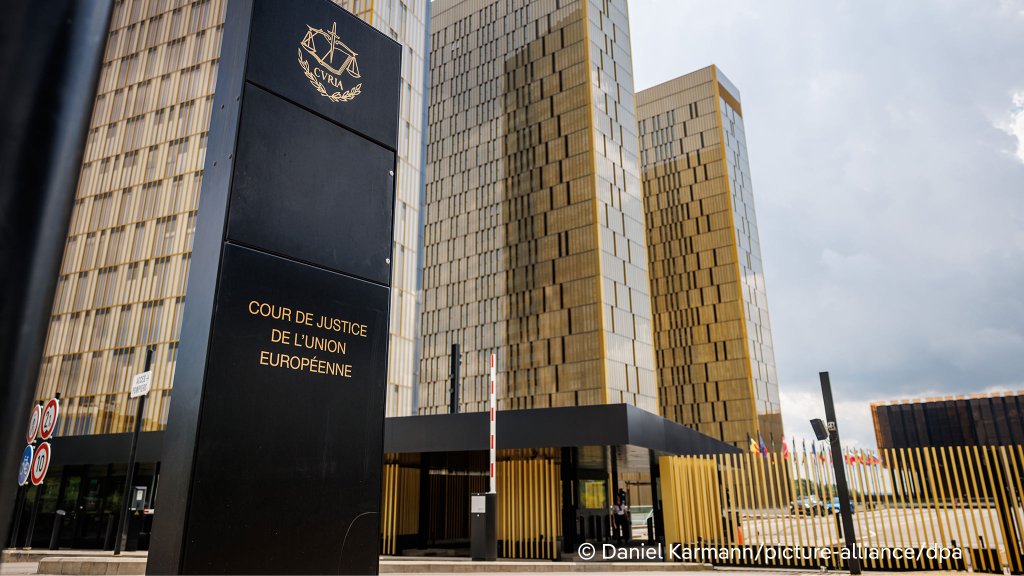
The implementation of the original deal was blocked several times by Italian courts and debated by the European Court of Justice. The centers' use was eventually modified so that they could host asylum seekers who had already been through Italy's asylum system and were detained in Repatriation Centers ahead of eventual deportation. In April, the ECJ issued a non-binding decision stating that Italy's controversial migrant deal is not in breach of EU law.
New guidelines
ECJ Advocate General Nicholas Emiliou published a legal opinion on April 23, saying that Italy's scheme to transfer some migrants to Albania while their case is being processed is compatible with EU legislation — as long as "the individual rights and guarantees of migrants under the European asylum system are fully maintained."
According to the left-leaning Italian online newspaper, Il Post in an article about the Albanian centers published on June 11 this year, a day ahead of the EU Migration and Asylum Pact entering into vigor. According to Il Post, the part of the Gjader center that was allowed to be used as a CPR for those awaiting expulsion from Italy has around 144 places. Around 70 of which were filled when the newspaper investigated on June 10. At that point, claimed the paper's journalists, the other center in Shengjin remained "unused."
The Italian government is hoping that now that the EU pact has entered into vigor, they can begin to use the centers in Albania as an accelerated processing center for asylum. However, according to the Italian government's own data from April 2026 and reported by il Post in June, in a year of the Gjader center being used as a CPR, around 536 people had transited the center. According to an independent Italian committee which oversees the management of migration policy and the centers used to carry that out, known as the "Tavalo d'asilo ed immigrazione" (Asylum and immigration committee), which has visited the centers several times since they were inaugurated, only around 90 of those 536 people were actually deported, and even these were first taken back to Italy before being flown to their final destination.
This, reports Il Post, is fairly indicative of the operation of CPRs in Italy in general. According to that newspaper, in 2025, only around a quarter of detainees in CPRs were actually deported, often because a lack of agreements with their home countries.
A model for the future?
The ruling could form the basis for other EU countries to roll out similar initiatives. Although Albania's leader Edi Rama has repeatedly said he does not envisage extending his facilities for other countries to use, emphasizing the special relationship his country holds with Italy.

A statement released on the official website of the Office of the Prime Minister of Italy earlier this month, said, that the State had "taken careful note" of the ECJ's decision.
"Considering that the conclusion and implementation of the Italy-Albania Protocol for strengthening cooperation on migration matters have always been inspired by full compliance with applicable international and European legislation, the Italian Government has decided to explicitly regulate the specific aspects mentioned in the Advocate General's Conclusions," read the statement.
Read AlsoEU pushes ahead with plans for migrant return hubs outside Europe
Albania: a litmus test for the EU
The news of the failed MP visit comes fairly fast on the heels of approval of the EU Pact on Asylum and Migration, an EU-wide overhaul of its migration policies which came into force on June 12.
The agreement across the EU-member states sparked harsh criticism from human rights campaigners.
"Despite its name, the pact mainly focuses on asylum, not on migration at large, and it draws a sharp line between 'legitimate' refugees and others, for whom deportation becomes the quasi-default option," said a statement on the Platform for International Cooperation on Undocumented Migrants (PICUM), a Brussels-based collective of organizations advocating for migrant rights.

"As a result, this pact will leave an increasing number of people in an administrative limbo, unable to access a residence permit, essential services, or decent work," claimed PICUM.
One of the pillars of the EU Pact on Asylum and Migration is the construction of repatriation centers similar to the Albania model. The Return Border Procedure Regulation sets out an accelerated return procedure for people whose asylum claims have been denied. For those who cannot return to their countries of origin in cases where their country is deemed unsafe or there are no agreements with the country of origin (such as the case of Afghanistan), migrant hubs in third countries are being proposed.
During European Council meetings last week, Italian Prime Minister Giorgia Meloni posted on X calling for the "rapid launch of concrete, effective, and replicable pilot projects" with other countries for the "possibility of joint repatriation centers in third countries."
"Italy will continue to work for a Europe capable of defending its borders, combating illegal immigration, and governing the migration phenomenon with pragmatism and determination," said Meloni.
Meloni has continuously defended her administration's policies on migration, describing it as a policy of "repatriation".
In an interview with the journalist Nicola Porro on Italian TV on June 29, Meloni continued to describe her policy of repatriations as a success, indicating that she had largely influenced the EU-wide policy and its evolution towards the idea of return hubs, although she didn't address the Albania centers directly.
Reportedly, Italy's government is hoping that the new EU pact rules will allow its centers in Albania, which operate under Italian jurisdiction, to be designated 'transit zones' where the norms and laws approved by Europe for return hubs would apply.
However, an expert at Italy's Association for Juridical Studies on Immigration (ASGI), told Il Post that whether or not the Albania centers could be designated 'transit zones' would depend on two big European legal judgements expected at the end of the summer.
Read AlsoWhat the new EU migrant 'return hubs' deal means in practice