
Supporters of a church asylum initiative in the Netherlands are calling on the government to grant residence permits to children of asylum seekers who have lived in the country for an extended period. The initiative is currently providing church asylum to a family of six from Uzbekistan, who could face deportation if they leave the church grounds.
Several hundred people gathered at the Malieveld field in the center of The Hague this week to protest against the possible deportation of around 420 children, despite having lived in the Netherlands for many years, Dutch local media agencies, NOS and RTV Oost reported on Tuesday (June 23).
The demonstration was part of a broader campaign organized by Kerkasiel Kampen (Church Asylum Kampen). The group called on the Dutch government to grant residence permits to around 420 children who have lived in the Netherlands for many years and built their lives there but still risk deportation.
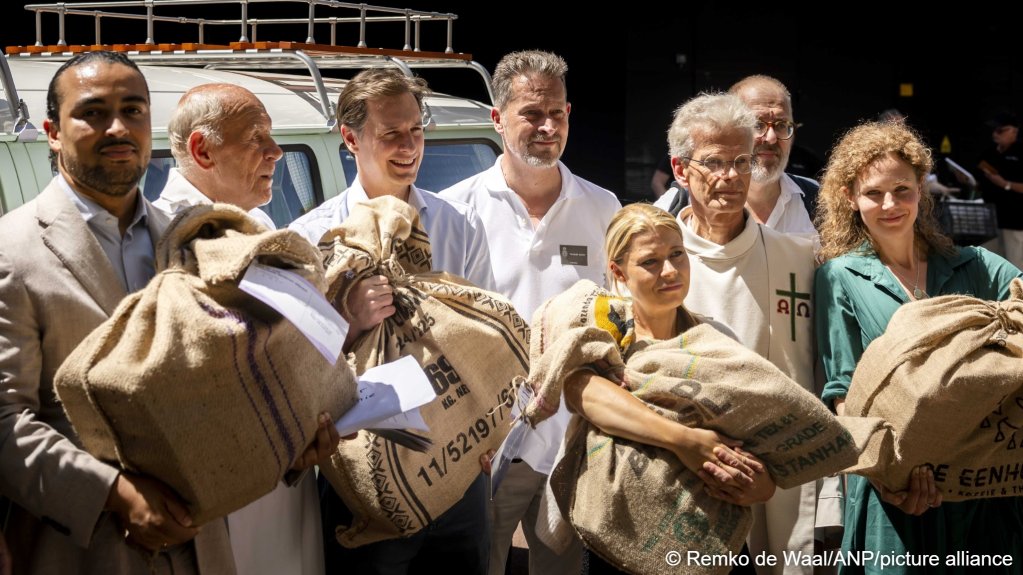
As part of the campaign, organizers delivered around 120,000 handwritten support cards to the Dutch House of Representatives, urging politicians to allow these children to stay.
Kerkasiel Kampen initiated the action and has drawn national attention through its ongoing church asylum case, in which it has been sheltering initiative that has been sheltering the Babayants family from Uzbekistan facing deportation since November 2024. Church asylum, known in the Netherlands as kerkasiel, allows churches to provide protection and temporary shelter for migrants in exceptional cases. Under Dutch law, police cannot enter a church while a religious service is taking place.
Read AlsoGermany: Church asylum on the rise amid mounting deportation pressure
'These are children we are talking about'
The campaign calling for children's residence permits began with an order for 25,000 cards, but organizers said the response quickly expanded. Within weeks, more than 120,000 cards had been collected, and the group wanted to bring them directly to parliament.
"It has completely gotten out of hand," Herman Stomphorst of Kerkasiel Kampen told RTV Oost. "We started with 25,000 cards, but they were gone within a day. Then more and more came in. We wanted to make sure that this voice was heard in The Hague," he said.
The cards were delivered by vans to the Standing Committee on Asylum and Migration, where they were received by members of parliament from several political parties.
Pastor Kasper Jager said the campaign is about seeing the humanity behind the migration debate.
"These are children we are talking about," he said, calling on Dutch politicians to visit Kampen in the north of the country and meet them directly.
The organizers of the campaign say the children have already laid down their roots in the Netherlands, including at schools and local communities. They want a solution that recognizes both migration policy and children’s rights.
"Children’s rights apply to them too," Jager said.
Who are the Babayants?
At the center of the campaign is the Babayants family: mother Karina, father Aleksandar, and their four children: Aram, 21, Amelia, 12, Ariana, 15, and Aleksa, 4. The family has lived in church asylum in the Open Hof Church in Kampen since November 2024, after facing removal from the Netherlands.
In July 2024, the family was removed from their accommodation, detained near the central city of Utrecht and later transferred to Schiphol Airport for deportation. A court decision halted the deportation at the last moment. Months later, the family entered church asylum in Kampen.
The church has maintained a continuous service so that police cannot enter and remove the family. Volunteers and clergy have organized a rotating schedule to keep services ongoing, passing a candle from one person to the next every two hours. For more than 500 days and nights, prayers, sermons and hymns have rolled on inside the church.
The Open Hof Church has received widespread support from both religious and non-religious volunteers, with people traveling intentionally to Kampen to help keep the service running.
The case has drawn criticism over Dutch migration policy, particularly with regards to the welfare of children who have spent years making friends, learning the language and adjusting in local schools.
Read AlsoDutch lawmakers reject proposed hardline asylum bill
Family argues returning to Uzbekistan would put them at risk
The Babayants arrived in the Netherlands in March 2014 and applied for asylum shortly afterward. According to court documents obtained by German newspaper Die Zeit, father Aleksandar told authorities he was persecuted by the Uzbek government and feared imprisonment. Much of the family's case remain unclear, including their past lives in Uzbekistan. Dutch authorities have repeatedly rejected the family's asylum requests, questioning the credibility of the family's claims and the evidence provided,
The family later presented further arguments and submitted new applications, claiming to have become well-established in the Netherlands, that son Aram might have to attend military service in the country, and that the daughters might face gender discrimination. After examination, the authorities ultimately rejected the asylum applications.
The family refuses to comment on the background of their case, according to Die Zeit's reporting on the family, and instead focuses on their attempts at establishing their lives in the Netherlands.
Over the years, the family lived in several asylum facilities, most recently in Emmen northeast of the country close to the border with Germany, where the children attended school and learned Dutch. They later argued that they had become deeply rooted in Dutch society and that returning to Uzbekistan would create new risks, including for their children.
Read AlsoNetherlands could expect nearly 20,000 more asylum cases if asylum reform laws are passed
Role of church in question
The campaign has also raised questions about the role of the church, and whether they have used the opportunity of church asylum and migrant families to enable their own survival. Critics may question whether the church is protecting the family, or whether it is the family which has brought new life to a church community struggling with declining attendance and dwindling popularity.
The Babayants are not an individual case. Other migrant families in the Netherlands have also sought sanctuary in churches to resist deportation. The Tamrazyan family, an Armenian family seeking asylum in the Netherlands, dodged deportation by taking refuge in Bethel Church in the capital, The Hague. Pastors and volunteers held a continuous 24-hour church service for 96 days. In January 2019, their marathon church service came to an end as the Netherlands granted the family a permanent residence permit.