
A growing number of immigrant workers has helped turn Spain into the world’s fastest-growing advanced economy over the past two years. Now the government is betting on its immigrant population to revitalize its rural areas.
The sun-drenched fields seemingly run on forever in La Mancha, the region that provides a backdrop to Cervantes’s Don Quixote. Rural areas like this one play an important role as Spain becomes increasingly diverse.
In less than 25 years, its foreign-born population has gone from one in 20 residents to nearly one in five. The growing number of immigrant workers, mostly from Latin America, has helped turn Spain into the world’s fastest-growing economy over the past two years.
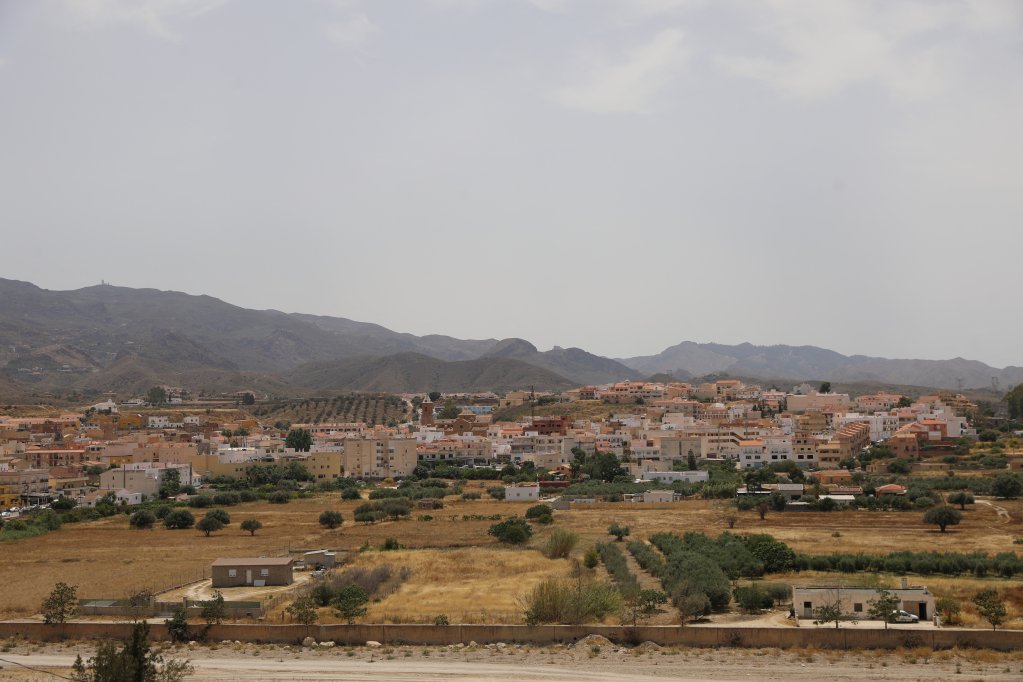
The government is now trying to tempt the newcomers to settle in areas called the "emptied Spain", where the younger generations have left and the older ones are dying.
In February, it launched a new national strategy aimed at attracting city dwellers to depopulated areas. In many cases, the families settling in the remote villages will be of migrant origin. Projects mostly led by local authorities help them find housing, jobs and language lessons.
"The greatest opportunity for rural areas -- and those most affected by depopulation -- to address demographic change lies in immigration," said Francesc Boya, secretary general for a ministry responsible for addressing the demographic challenge.
The strategy comes as Spain prepares to give half a million undocumented migrants the right to live and work in the country legally through an extraordinary regularization drive.
"The regularization of migrants who are already integrated into the Spanish labor market contributes to these objectives. Many of these people work in sectors essential to rural areas, such as agriculture, livestock farming, care-giving and other services where there are labor shortages and difficulties in ensuring generational renewal," Boya told InfoMigrants.
Read AlsoFor Sunanda, Spain's regularization means more than papers
Despite plunging birth rates and an ageing population, Spain’s total population of 49 million people is projected to reach 53 million by 2076. The growth will be entirely due to international migration, noted Spain’s National Institute of Statistics.
Yet the foreign-born population tends to remain in big cities like Madrid and Barcelona. In the inland regions like Extremadura, Galicia, Asturias and Castilla and Leon, people over the age of 65 make up 35 percent of the population. The average age is over 47.
"There is a paradox: thousands of job vacancies exist in rural Spain, and thousands of people are interested in settling and working in these areas, but they cannot do so due to a lack of housing," said Javier Otero, of the non-governmental organization Rescate.
Transportation represents another challenge: "There are many obstacles to validating driver’s licenses in Spain obtained outside the Schengen Area. Combined with the lack of public transportation, this makes it impossible for people to access basic services from rural areas," said Otero.
Read AlsoCan Spain's regularization process help tackle labor exploitation?
Then there is the employment barrier, which Spain believes its massive regularization drive can help overcome.
"The best way to prevent precarious employment is to recognize rights -- to ensure that those already living and working in Spain can pursue their life goals under dignified conditions," said Boya. "By gaining access to regulated jobs with social protection and labor rights, these people can fully integrate into their communities."
In what could become a virtuous circle, the presence of immigrants helps keep the local population in remote villages. "In isolated areas far from major urban centers, civil society is aware that the survival of schools, health centers, pharmacies, gas stations and so on depends on new people settling in these areas," said Otero.
Institutional support for projects combating rural depopulation is still "in its infancy stage in Spain ... which has only been taking measures against this sociological phenomenon for a decade," according to Otero.
In the town of Villagatón, in the Castilla y León region, the project Yo con ti, tu con mi (Me with you, you with me) is financed by the Ministry for the Ecological Transition and the Demographic Challenge. Over 40 children and adults from Senegal, Gambia, Guatemala, Venezuela and Colombia participate in activities designed to foster integration.
In Os Ancares, in the Galician province, Otero hailed “the commitment of businesses, neighborhood associations and local governments to integrate new residents into their communities. The community’s interest and support in welcoming its new neighbors is unwavering."
"Migration should not be viewed as purely utilitarian, but rather in terms of the benefits offered by a diverse society," said Ángela Vela Blanco of the Fundación Cepaim Soria in north-western Spain.
Read AlsoSpain’s extraordinary regularization: Who benefits and who is left out?