
The European Commission on Wednesday proposed a series of new measures to strengthen the EU's response to crime through its police agency Europol in what it described as an "evolving criminal landscape" that is becoming increasingly "sophisticated, international and digital."
"Crime is becoming more sophisticated," stated the European Commission in a press release on Wednesday (June 24). In an evolving criminal landscape, the Commission believes it needs new measures to tackle digital and cross-border crime.
That is why it is introducing two regulations to strengthen the mandate of not just Europol (Europe’s law enforcement cooperation center), but also Eurojust (the EU agency that helps prosecutors and judges cooperate on cross-border criminal cases), as well as adding a revision of the European Investigation Order and amendments to the Data Protection Regulation for union institutions and bodies.
The Commission stated that Europol is "crucial in investigating cross-border cases as national authorities don’t have the full picture of today’s criminal threats."
Read AlsoEuropol launches new unit to fight migrant smugglers
Digital technology and data sharing strengthened
Under the new rules, Europol will be better able to support member states to efficiently exchange secure information. Europol will establish a "secure, scalable and sovereign cloud infrastructure," and a shared police data space which will allow investigators to work remotely on common cases.
Europol often coordinates police forces from various member states on investigations, raids and arrests against suspected migrant smuggling operations. The current cooperation will be further strengthened by the setting up of offices in member states that will be staffed by Europol officers, working closely with national authorities.

A technology and innovation hub will also help member states provide an EU-wide picture of capability needs for law enforcement.
Via Eurojust, stronger support will also be offered to prosecutors and judicial authorities. The agency will expand its mandate, stated the press release, to help identify links between cases and strengthen its involvement in emerging areas of crime, like cybercrime, violations of EU restrictive measures and gender-based violence.
Read AlsoAustrian authorities bust smuggling gang that facilitated over 100,000 illegal entries into the EU
Europol budget to double
In order to do this, the European Commission has proposed doubling Europol’s budget to 3 billion euros under the next multiannual financial framework (2028-2034). The bigger budget will allow Europol to double its staffing capacity and develop more advanced technological capabilities.
The amendments to the regulations came following an evaluation report published by the European Commission in 2025. According to the press release, revisions for Eurojust are the first since its entry into force in 2018.
The European Commission believes that by connecting and strengthening Europol and Eurojust, and their mandates within and cooperation with member states, their police forces, and their judiciaries, the two agencies will help member states investigate, prosecute, and bring criminals to justice more effectively.
Both Europol and Eurojust will also strengthen their ties with other EU agencies like OLAF and AMLA to work on anti-fraud and anti-money laundering operations and with Frontex on "high-risk cross-border movements."
Read AlsoPolice dismantle smuggling route through Bulgaria used by migrants heading to Western Europe
Migrant smuggling is 'complex, ruthless' and 'generating billions'
On Europol’s website, combatting migrant smuggling is identified as one of the EU’s main priorities for the next three years (2026-2029). According to a Europol press release, "a complex, ruthless and multinational migrant-smuggling network has developed around Europe’s unprecedented migration crisis, thus generating billions of euros for the criminal groups involved."
Europol highlights that the millions of migrants who have arrived in Europe since 2014, most of them via smuggling networks, have had "a profound impact on Europe’s criminal landscape, with criminal networks substantially increasing their involvement in migrant smuggling."
According to Europol, more than 90 percent of the migrants traveling to the EU used smuggling services. In most cases, the agency states, "these services were offered and provided by criminal groups."
Europol estimates that more than ten years ago, criminal networks involved in migrant smuggling had a turnover of between three and six billion euros. These earnings have enabled the networks, which often smuggle people as well as drugs and arms, to become even stronger and more sophisticated in their techniques. And that is having a "significant negative long-term impact on Europe’s economy."
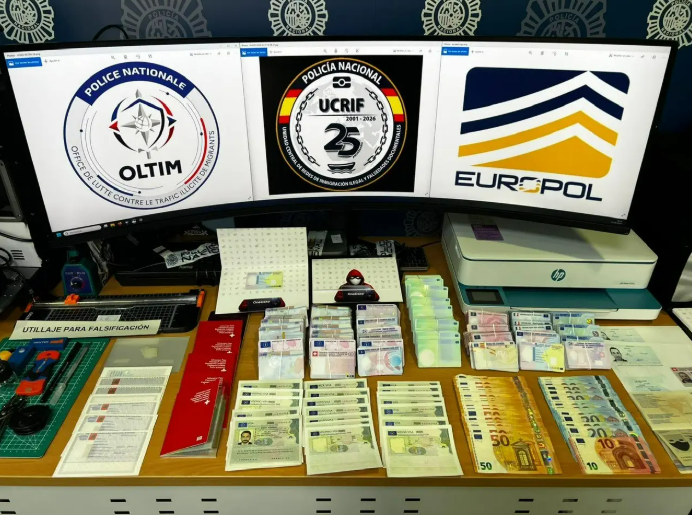
On June 4, Europol announced one of its latest collaborations against gangs involved in smuggling migrants. French and Spanish police, coordinated by Europol, dismantled a fake document factory in Spain and seized around 800 fake IDs, which were allegedly intended to be used by migrant smugglers and distributed via an online platform.
The operation, which took place on May 27, led to one arrest, the seizure of the 800 forged European documents, some document production equipment, digital devices, a vehicle and 1,850 euros in cash.
The suspect arrested is believed, stated Europol, to have been administering an online marketplace offering forged identity and administrative documents in both physical and digital formats to customers across Europe. The investigation, states Europol, was triggered by the identification of a website advertising counterfeit identity documents. They traced the suspect to Alicante, where he is believed to have been residing since 2024.