
Italy’s political right is entering a new phase of fragmentation, as mass protests over migration policy coincide with the rapid rise of a hardline challenger to prime minister Giorgia Meloni.
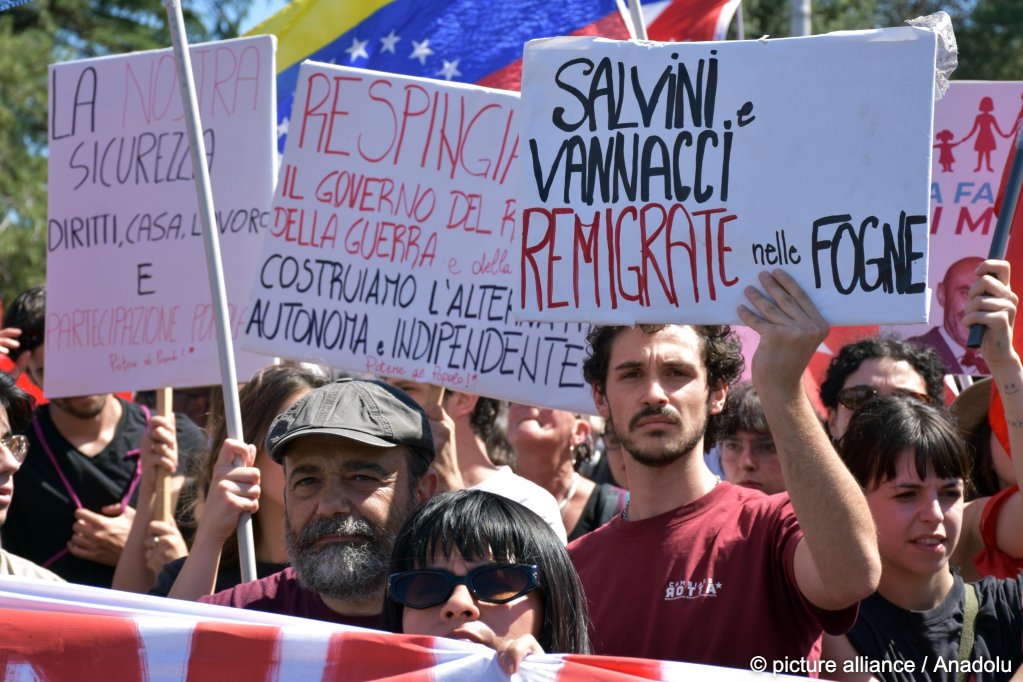
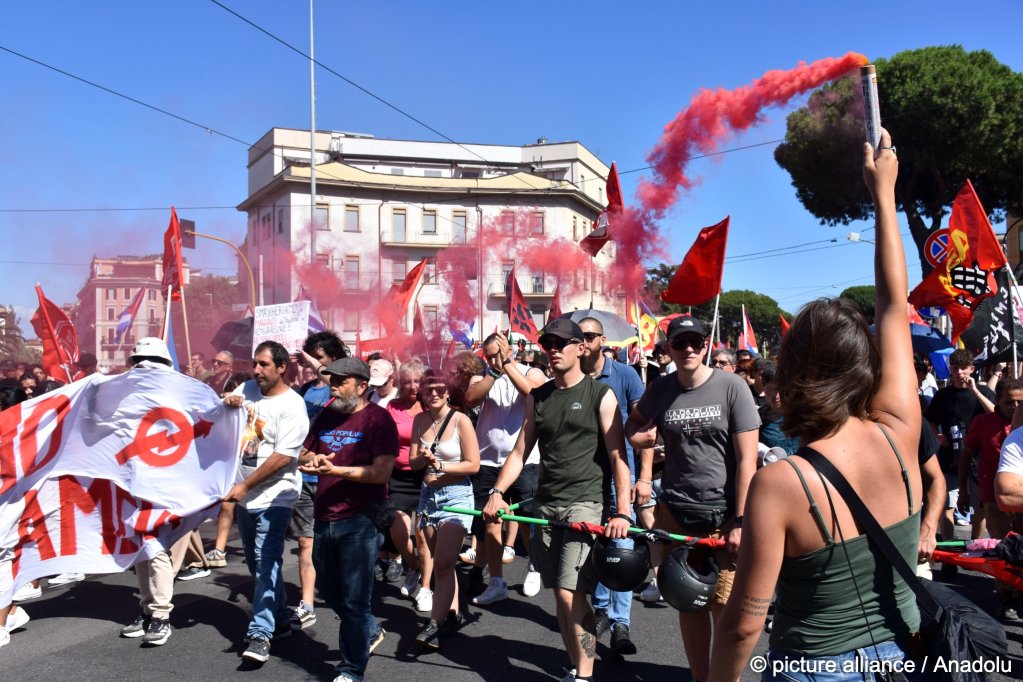
Over the weekend, tens of thousands of people took to the streets of Rome in rival demonstrations that underscored how deeply migration has re-emerged as a defining and polarizing issue in Italy.
Several thousand joined an anti-migration march in the capital's Prati neighborhood, while a much larger, pro-migration rally drew tens of thousands elsewhere in the capital.
Thousands of police were deployed to keep the groups apart, and no violence was reported, although flares and burning objects were pictured along the routes of the rallies.
Read AlsoThe EU Pact on Migration and Asylum: Questions answered
'Remigration' goes mainstream
The protests were triggered by a citizens' initiative titled "Remigration and Reconquest," which gathered the 50,000 signatures required to force parliamentary debate on the issue. The proposal calls for sweeping measures targeting foreigners, including coercive returns and incentives to leave Italy, and has pushed the once-fringe concept of "remigration" into the political mainstream.
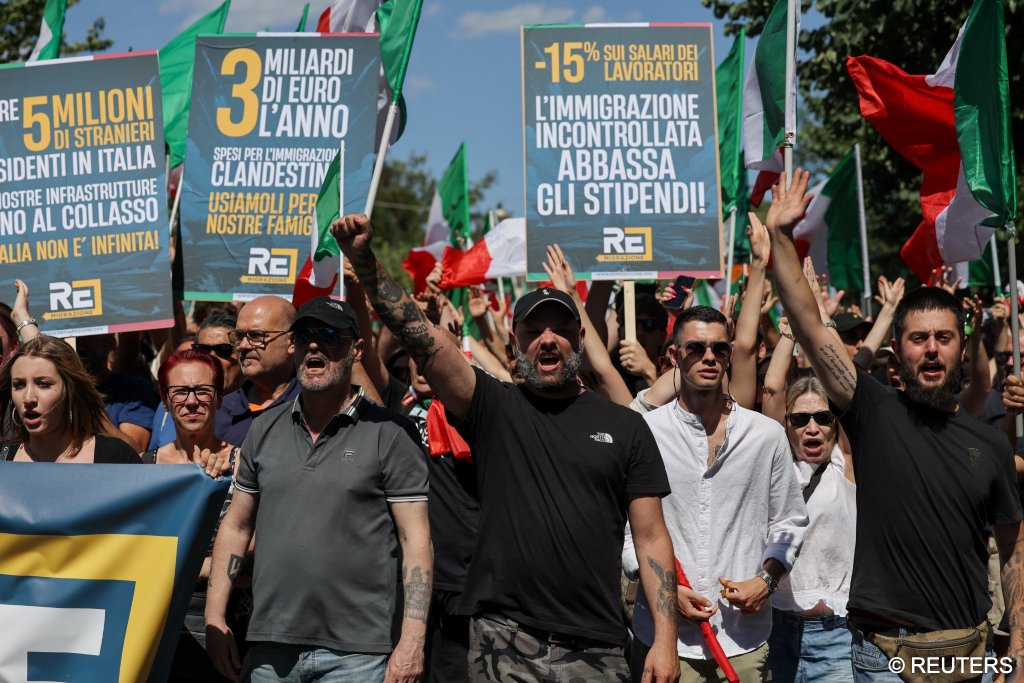
At the anti-migrant rally, rhetoric reflected the proposal’s hardline tone. "We want to kick the illegal immigrants out -- force them out, because they shouldn’t be here," said Luca Marsella, spokesman for the neofascist group Casapound. "And since we’re not politically correct, we’ll say we want to send the legal immigrants home, too – the ones who clearly haven’t assimilated or integrated."
Critics argue that such proposals risk breaching constitutional protections and international legal obligations. "The so-called remigration bill invokes a logic of exclusion based on ethnic and cultural background that is incompatible with the Italian constitution and the fundamental principles of the rule of law," said left-wing politician Angelo Bonelli.
Read AlsoItaly: Four migrant workers burned alive in suspected arson case linked to migrant mafia
Pressure on Meloni
The demonstrations come at a sensitive moment for Italian Premier Giorgia Meloni's government, which is attempting to balance a tougher line on irregular migration with a parallel policy of expanding legal labor migration to address workforce shortages. Meloni's government has declared 19 countries including Bangladesh and Egypt 'safe' for migrant returns, while also negotiating bilateral agreements to facilitate legal worker migration.

Like many other EU countries, Italy faces labor shortages of about one million workers across different skill levels, with more than 2.5 million foreign workers already accounting for around one-in-10 Italian jobs. The demonstrations are unfolding against the backdrop of newly implemented EU migration and asylum rules, designed to overhaul a system long criticized as ineffective.
At the same time, pressure on Meloni is mounting from within the broader right-wing space.
Rage bait approach
On Sunday (June 14), in a packed auditorium near the Vatican, Roberto Vannacci rallied supporters of his newly formed party, Futuro Nazionale (National Future), positioning himself as a disruptive force to the right of the current already right-wing governing coalition. "With us, Italy will once again be the home of Italians," he said, vowing he would slash the number of foreigners living in Italy from an estimated 12 percent to around four percent.
The former army general, entered politics after his controversial 2023 book "Il mondo al contrario" ("The World Upside Down”), which included attacks on LGBTQ+ people, migrants and minorities. After winning 530,000 preference votes with Matteo Salvini's far-right League party, he broke away this year to launch his own movement. His party now claims 100,000 members and eight deputies, including defectors from both parties, highlighting tensions within Meloni's coalition.
Vannacci has framed his movement as the "real right," rejecting the "far-right" label and accusing Meloni of failing to deliver on conservative priorities. He has ruled out cooperation with the governing bloc: "This is not my aim. It seems rather to be an expectation of this center-right camp."
Read AlsoItaly hosts Libyan, Turkish and Qatari delegations to discuss migration management
Shifting the Overton window
Vannacci's description of Meloni's far-right government as being center-right shows a clear shift of what is known as the 'Overton window,' where statements and policies that may have been unthinkable ten years earlier are becoming increasingly mainstream across many EU states.
Analysts say his emergence is reshaping Italy’s political landscape by opening space to the right of a government that has, in office, adopted a more pragmatic and pro-European stance than many initially expected.
Meloni's own party (Brothers of Italy) was formed from parties which had their roots pre-Second World War in Mussolini's fascist party. Meloni cut her teeth politically in the youth movement and organizations of Rome that were linked to those parties, evolving from the MSI (Movimento Sociale Italiano) to the Allianza Nazionale (National Alliance) that was formed to replace MSI by former leader Gianfranco Fini, before finally forming her own party, Brothers of Italy (Fratelli d'Italia).
"He is commanding a sort of political raid for hard-right votes within the main parties of the coalition," said Massimiliano Panarari, a politics professor at the University of Modena and Reggio Emilia. "Meloni’s strategy was to have no one to her right. Now she does."
Panarari described Vannacci as "an entrepreneur of fear," whose rhetoric revives themes -- such as explicitly anti-LGBTQ+ and anti-feminist positions -- that Meloni has largely avoided since taking office.
Polling suggests Futuro Nazionale could secure between four percent and five percent of the vote -- potentially decisive in a tightly balanced political system. "They could be the difference between finishing ahead or behind," said Lorenzo Pregliasco, a political analyst at YouTrend, who described Vannacci as a potential "wild card."
"Now there is a force outside the majority that challenges it on popular issues like migration, security and culture wars," he added.
Read AlsoItaly: Newborn dies after migrant rescue at sea near Lampedusa
Instability on the right
For Meloni, the challenge is both strategic and ideological. Incorporating Vannacci risks pulling her coalition further to the right and alienating moderate and pro-European voters, while confronting him directly could amplify his outsider appeal.
"In terms of political debate, he introduces instability on the right," Pregliasco said. "She and her allies must decide whether to absorb him into the coalition -- but that would create problems."
So far, Meloni has opted for a cautious approach, accusing Vannacci-aligned lawmakers of undermining the government while avoiding a direct personal confrontation. Her allies have ruled out electoral agreements, but the longer-term strategy remains unclear.
"The issue is what to do with this loose cannon of Vannacci, which could drag the right back toward the far right," Panarari said. "I’m not sure it would benefit Meloni to shift further right before general elections. Her approach will likely be marked by ambiguity and ambivalence, as long as possible."
With parliamentary debate on "remigration" looming and a new political challenger gaining ground, Italy’s migration debate is no longer just a policy question -- it is fast becoming the central fault line shaping the country’s political future ahead of the 2027 general election.
Read AlsoECJ judge issues legal opinion in support of Italy's migrant processing centers in Albania
Splitting the vote?
Vannacci's rise also threatens to fragment the far-right vote that could benefit the center-left. The center-left opposition, however, remains largely absent from this debate. While the pro-migration rally in Rome drew tens of thousands and backing from left-wing groups and trade unions, the Democratic Party has struggled to define a coherent response. The left faces its own dilemma: opposing Vannacci's hardline remigration proposal while avoiding the appearance of endorsing open borders, which could alienate voters concerned about migration.
With parliamentary debate on "remigration" looming and a new political challenger gaining ground, Italy's migration debate is no longer just a policy question -- it is fast becoming the central fault line shaping the country's political future.
In March, Italian voters rejected Meloni's proposed judicial reform in a constitutional referendum, with 54 percent voting "No" and drawing a turnout of nearly 59 percent. The reform, which Meloni framed as necessary to strengthen migration enforcement and speed up deportations, was seen as a proxy battle over her hard-line migration strategy. The setback as well as growing pressure from far-right rivals is likely to further complicate Meloni's prospects for winning the 2027 general election.
With AFP, AP, dpa and Reuters