
Northern Ireland is currently witnessing some of the most violent anti-migrant protests in living memory. What is the background to these unfolding events, and how do they tie in with the troubled region's past?
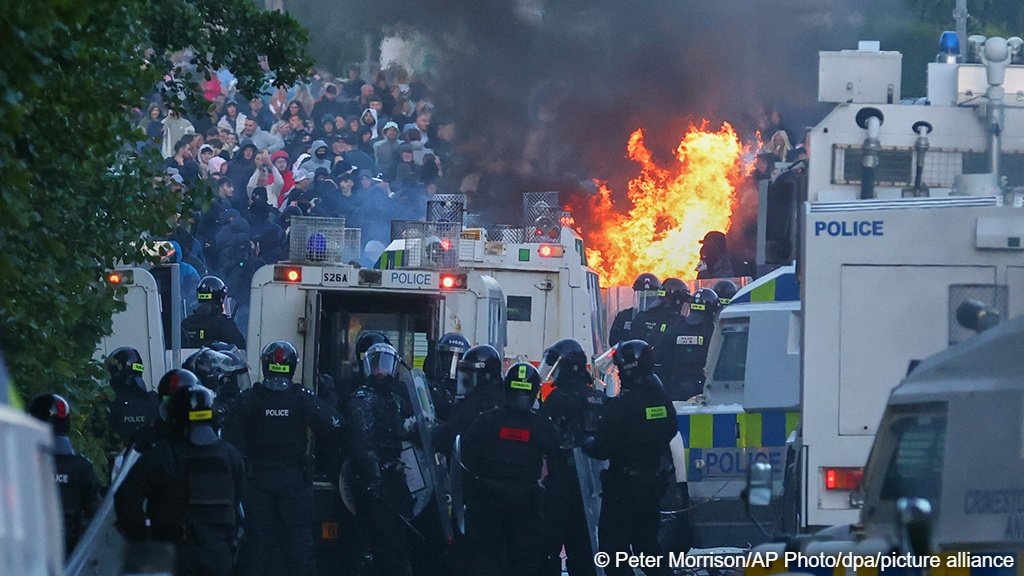
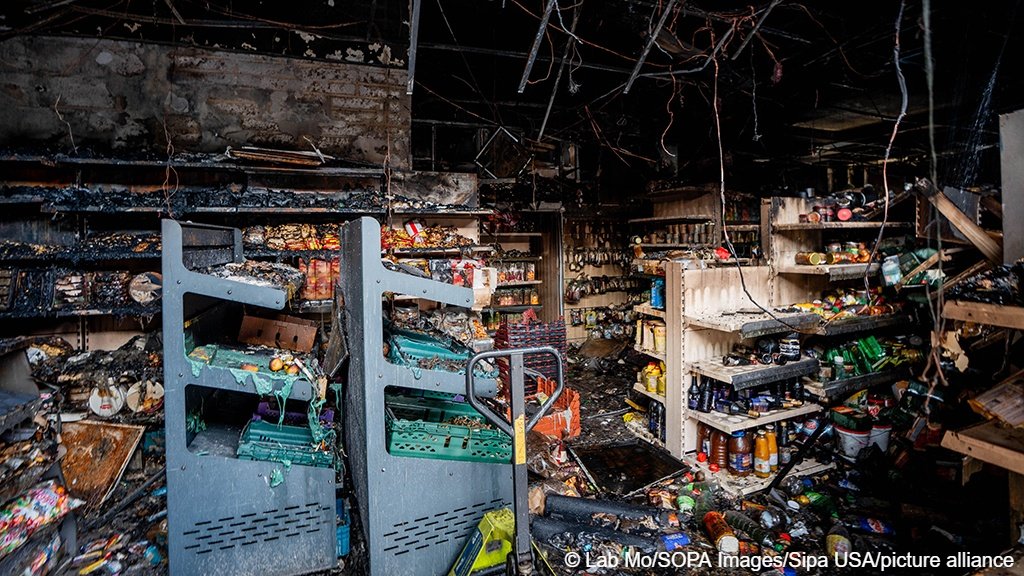
For two days, rioters — many of them masked in balaclavas — have been setting fire to homes and vehicles believed to belong to migrants, and fighting police on streets across the capital, Belfast, with bricks and rocks.
More than two dozen people have reportedly lost their homes in the attacks, while 12 police officers were reported to have sustained injuries.
Firefighters had to rescue several people from burning buildings while police eventually were forced to resort to using water cannons to quell the protests, also arresting an unspecified number of rioters.
Read AlsoUK: Police urge calm after 'sickening' Belfast stabbing
Harrowing attack turns mood against migrants
The rallies came after a brutal knife attack on the streets of Belfast earlier in the week, in which a 30-year-old Sudanese suspect assaulted a local with a knife.
It has since been confirmed that the victim, identified as Stephen Ogilvie, lost an eye in the attack while also sustaining other serious injuries.
The suspect has since been taken into custody and has been charged with attempted murder, threatening to kill a second person, and carrying a weapon.
The attacker did not enter a plea in court but is known to have confessed to police during his arrest that he believed he had killed Ogilvie.
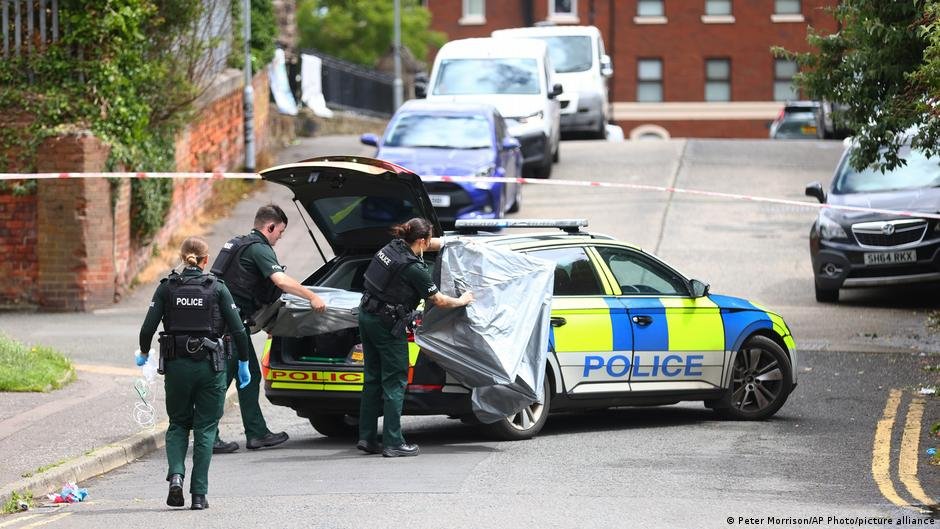
Police said that the motive for the savage attack is not believed to be linked to terrorism, though tensions remain high across the country, with protestors also seen to be gathering in other areas, most notably outside the Houses of Parliament in London.
Verdict in Southampton case added fuel to xenophobia
The current tensions build on xenophobic sentiments observed elsewhere in the UK in the course of last week, when protesters clashed repeatedly with police in the south coast town of Southampton over the sentencing of a British-born Asian man for the fatal stabbing last December of a local university student.
Though the suspect in this case was was sentenced to life in prison, protestors claim that the victim, identified by the name Henry Nowak, was treated unfairly when police arrived at the scene of the crime, mistaking the victim for the perpetrator, following a call by the suspect's brother claiming he and his brother had been the victim of a racist attack.
Police tape released after sentencing shows that officers at the scene initially dismissed Nowak's desperate pleas that he had been stabbed and couldn't breathe, and handcuffed him as he lay dying.
Read AlsoUK far-right group stages anti-immigration protest in London
Far-right emboldened amid slipping support for Labour
The response from some sections of the public to these stabbing attacks builds on growing anti-migrant sentiments across the UK. These come against a backdrop of economic and global challenges and a growing perception that the current Labour government is not doing enough to stop the arrival of migrants, despite recent data pointing to the contrary.
Opinion polls show that two years after Labour's landslide election win under the leadership of Keir Starmer, support for the far-right Reform UK party has skyrocketed, with Reform leader Nigel Farage pledging to send back migrants and even asylum seekers.
Read AlsoFact-checking Reform UK's migration policy claims
Meanwhile, these anti-migrant sentiments continue to be fuelled by misinformation and disinformation on social media, with global political figures as far afield as US Vice President JD Vance blaming some of the recent events on what he refers to as "politics of self-hatred and the mass invasion of migrants, many of whom despise the West and the people who love it."
Prime Minister Starmer meanwhile responded to the accusations, saying that these sentiments amount to "trying to interfere in our democracy and seeking to stir up division on our streets."
Starmer added that "there is no justification for the violence and disorder that we saw threatening our communities, nor for those who encouraged it, online or elsewhere."
Read Also
UK: Is there an increasing number of sexual assaults committed by male migrants?
The role of 'The Troubles' in current narrative
Back in Northern Ireland, those same tensions are playing into a complicated political context and decades of historic violence between those who wish to remain as part of the UK, known as 'loyalists', and tend to be of the Protestant faith, and those who would like to become part of the Irish Republic, known as Republicans and tend to be of the Catholic faith.
Recent events in Northern Ireland tie into this uneasy political history of the region, which were already complicated by the UK's departure from the European Union, (commonly known as "Brexit"). The island of Ireland represents the only land border between the UK (Northern Ireland) and the EU (the Republic of Ireland). Since Brexit, this border would normally be heavily controlled, but in order to maintain the statutes in the peace accords known as the 'Good Friday agreement', which ended decades of conflict between Loyalists and Republicans, it is subject to special rules, allowing for the free movement of people and goods between the two administrations.
The Committee on the Administration of Justice (CAJ) — a Belfast based human rights group — warned in a report published last year that incitement on social media was fanning the flames of riots and race-related violence in Northern Ireland and threatening the fragile peace in the region.
Authorities identified that the Sudanese assailant had entered Northern Ireland, which is part of the UK, from the neighboring Republic of Ireland in 2023, after reportedly flying there from Paris. Though he was technically supposed to show his documents on the border of his own accord, the man appears to have slipped in through the porous border unnoticed, presenting for asylum upon entering British territory.
Read AlsoBritain and Ireland in cross-border migration row
Upon review, he was given a five-year permit to remain in Britain as a war refugee fleeing the war in Sudan; however, it could be argued that he would not have been able to cross that border and claim asylum with relative ease in the UK if it wasn't for the tender political truce that has been in place in the region since 1998 — following decades of violence in the past.
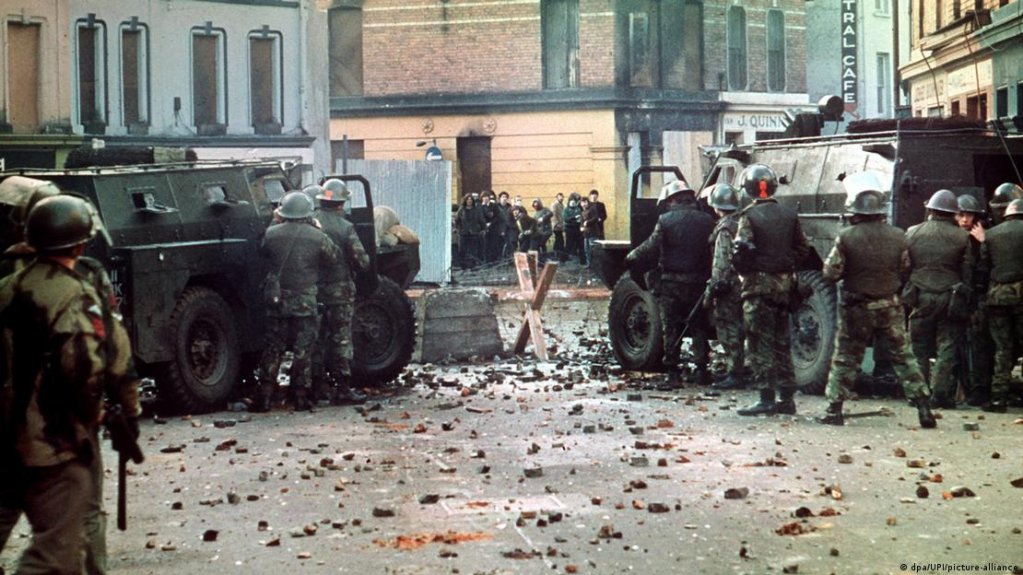
The conflict, known widely as "The Troubles," involved repeated sectarian clashes between Irish Republican militants (Catholics) and British Loyalist militants (Protestants), leaving almost 3,600 people dead until the signing of the Good Friday Agreement in 1998.
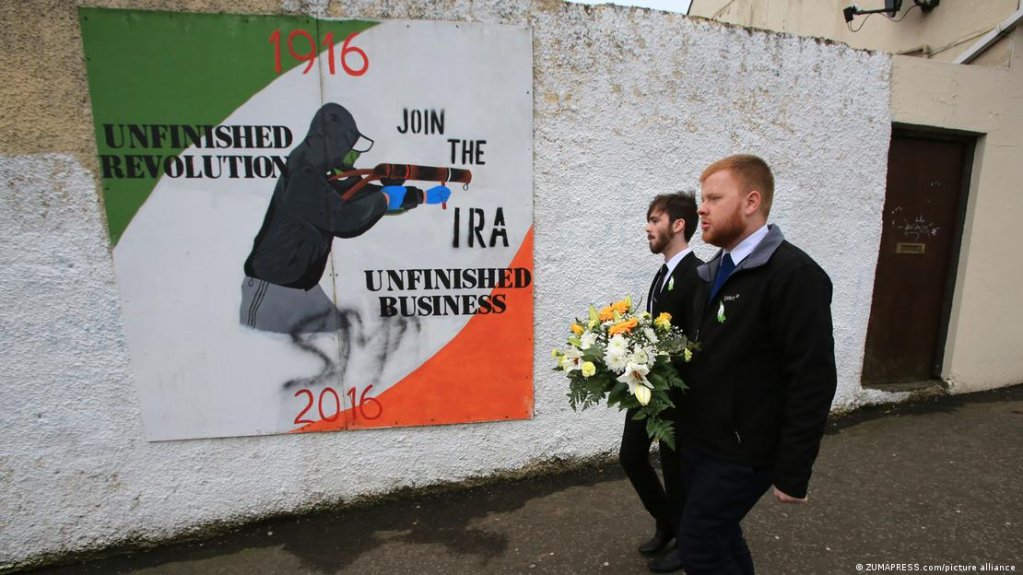
Allowing the free movement of people to either side of the border between Northern Ireland and the Republic of Ireland has since become a cornerstone of upholding that peace, which could not even be compromized during the negotiations for Brexit, which was finalized in 2020.
Since Brexit, the open border between the UK and Republic of Ireland is known as part of the Common Travel Area (CTA), which allows for passport-free travel and partly dates back to agreements originally reached in 1922.
Some politicians, however, have now suggested that the stabbing attack in Belfast should spark a review of the century-old open border arrangement, although many others fear that placing controls at the border could lead to a revival of animosities between Loyalists and Republicans.
Read AlsoNorthern Ireland: Plans to burn effigy of migrant boat condemned
Racism replacing sectarianism in Northern Ireland
The majority of the anti-migrant rallies in Belfast took place in impoverished working-class neighborhoods, where the former paramilitary groups still hold considerable influence to this day, though sectarian incidents between the two groups have considerably weakened.
In recent years, the history of sectarian violence between Catholics and Protestants appears to gradually be being replaced by growing incidents of racism and xenophobia.
Read AlsoAnti-migrant groups attack two cars in Belfast
According to authorities, there were 2,367 racially motivated incidents and 1,507 racially motivated crimes from March 2025 to March 2026 — the highest tally since records began in 2004.
According to a 2021 census, Northern Ireland's population is 97 percent white — however, immigration rates have been growing in recent years.
The number of asylum seekers in Northern Ireland meanwhile has more than tripled in the past few years, with about 2,500 cases throughout the territory at present, according to the UK Home Office.
It is unclear how many asylum seekers reach Northern Ireland by crossing over from the Republic of Ireland; an investigation by the Daily Telegraph newspaper in 2025 alleged that Albanian smuggling gangs were operating on this route, using forged documents to facilitate the crossing of the border.
Read AlsoCrossing the English Channel, or trying via Ireland: Migrants risk all to reach the UK
with AP, AFP, Reuters