
Poland's commissioner for human rights has challenged the government over the continued suspension of asylum applications at the Belarus border, warning that emergency restrictions introduced as temporary measures have now lasted more than a year.
Poland’s Commissioner for Human Rights, Marcin Wiącek, has raised questions about whether the government’s ongoing restrictions on asylum applications at the Belarus border remain justified after more than a year in force.
In a statement posted by the Commissioner’s office on the social media platform X, Wiącek said the "temporary restriction" on foreigners’ right to apply for international protection has become increasingly difficult to justify, especially as authorities continue to describe the migration situation as unresolved. He called on the Interior Ministry to consider replacing the current policy with measures that are "less burdensome" on migrants’ rights.
Though not rejecting Poland's right to guard its borders, the commission raises whether prolonged emergency measures are eroding the legal right to seek asylum.
Read AlsoMigrant truck drivers fill Europe's labor shortage, but face risk of exploitation
Border surveillance measures prioritized over international protection measures
The dispute centers on a law introduced by Poland in response to irregular migrant arrivals at its eastern border, where Belarus has been accused since 2021 of facilitating irregular crossings by migrants from Asia and Africa into the European Union. The Polish government argues the policy is necessary to counter what it calls "hybrid aggression" orchestrated by the Belarusian government, with alleged backing of the Kremlin.
In practice, the restrictions mean that many migrants arriving irregularly from Belarus are unable to formally submit asylum claims at the border. Instead, border procedures prioritize security controls and emergency measures over immediate access to international protection procedures.
Human rights groups and legal experts argue that such restrictions risk denying people fleeing war, persecution, or serious harm the opportunity to have their claims individually assessed. Critics also warn of possible "pushbacks," where migrants are prevented from accessing asylum systems altogether.
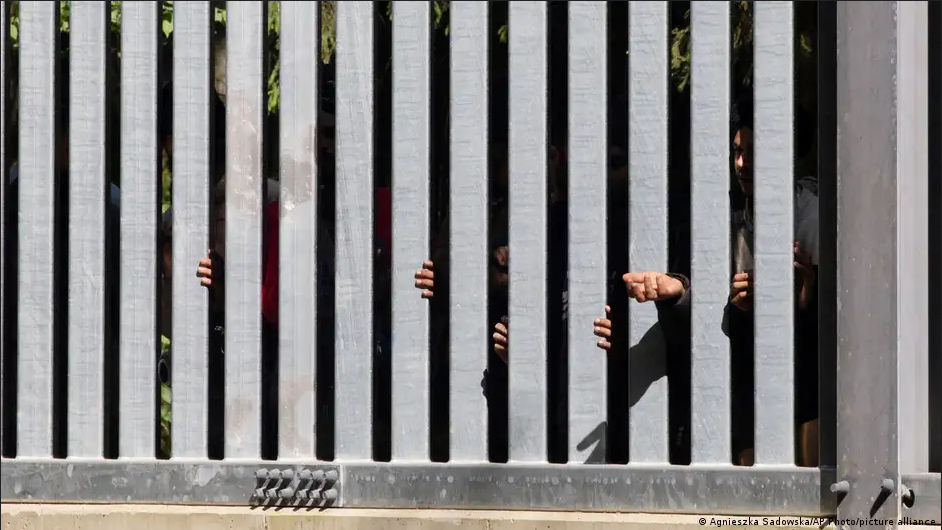
| Photo: Agnieszka Sadowska / AP Photo / picture alliance
Extended for seventh time
According to a report from the Krakow-based news provider Notes from Poland, the asylum suspension was originally designed as a temporary emergency measure lasting up to 60 days, but parliament has repeatedly renewed it. The ban has now remained in place continuously since March 2025 and was recently extended for a seventh time.
Wiącek argued that the government’s position contains a contradiction; officials have described the policy as effective while simultaneously insisting that migratory pressure remains high.
"When such an exceptional situation persists despite the instrument being used, the question arises as to whether it is the appropriate means to achieve the intended goal," he wrote in a letter to Interior Minister Marcin Kierwiński, according to Notes from Poland.
International and European law, including the 1951 Refugee Convention, guarantees the right to seek protection. Although governments may impose emergency border measures during security crises, rights advocates say that restrictions must remain proportionate, temporary, and compatible with fundamental rights.