
More than 800 migrants live beneath line 2 of the Parisian metro, in the last camp allowed by the city authorities. Associations say that "police harassment" has subsided in recent years, but the migrants still need proper accommodation.
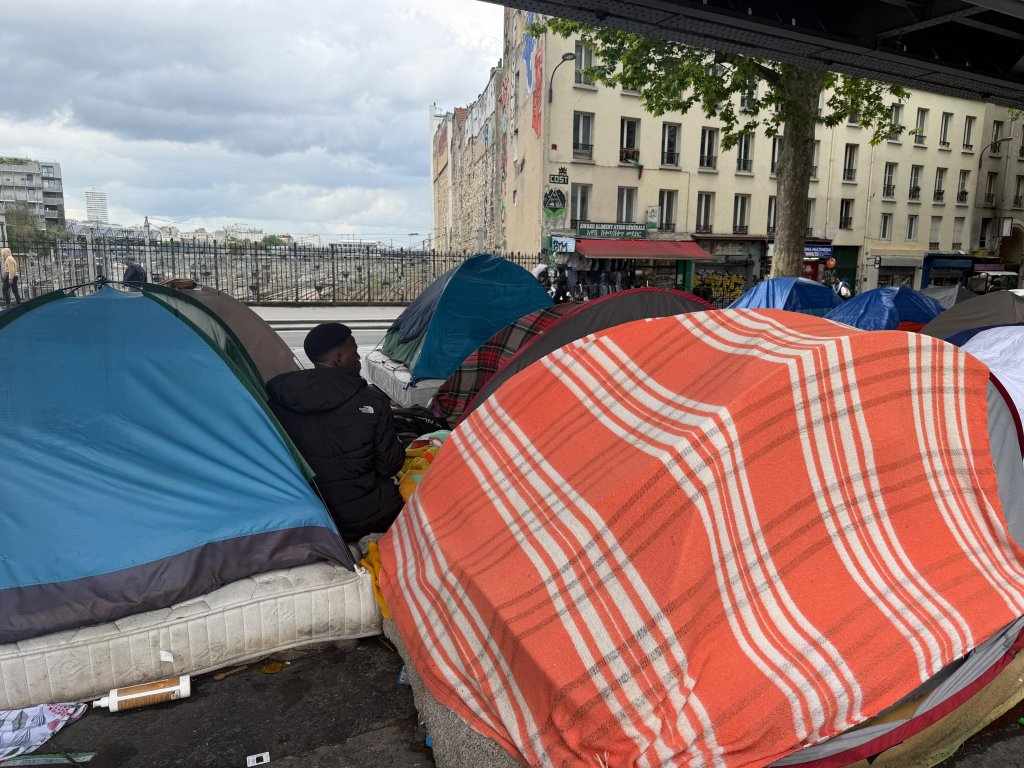
Anouar Mohamed Ibrahim chatted with one of his compatriots from Sudan who was wrapped in a yellow blanket. The 33-year-old arrived in Paris on May 16. "Since then, this is where I sleep," he said, pointing to his mattress on the ground, under line 2 of the Parisian metro, near the Stalingrad station.
"Say you are from Afghanistan, Sudan or Eritrea... You arrive in France to request protection, you won’t find a welcome center. You end up here in sordid conditions," said Paul Alauzy, coordinator at Doctors of the World (MdM), who comes every Monday with a mobile clinic to treat migrants on the street.
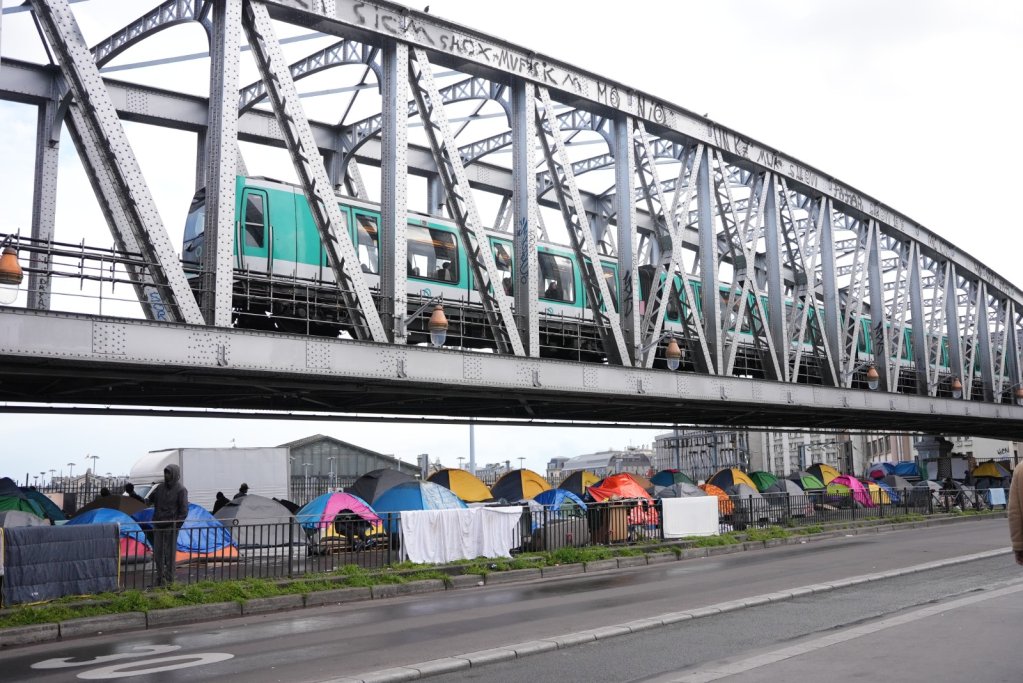
Dozens of tents have been set up under the metro in the camp located in northeastern Paris. More than 800 people live in the informal settlement located between the busy boulevards of La Chapelle and La Villette, where the sound of sirens of police cars and car horns continues night and day. Most of the camp’s inhabitants come from Sudan, Eritrea, and Afghanistan.
'A historic place'
Like the other inhabitants of the camp, Ibrahim didn't find the place by accident. “When I arrived in Paris, I met some Sudanese people in the street. They told me to come here," he said.
The camp is the oldest one in the capital. "It’s a historic place. Migrants were already here ten years ago," said Yann Manzi, founder of the Utopia 56 association, an association that regularly distributes tents and blankets throughout the camp. "After arriving in France, you go to La Chapelle. It's a place deeply rooted in people's journey to exile," said the activist.
Read AlsoFrance: New Paris mayor promises solutions to migrant camps on streets
Many kinds of migrants live in the camp: there are "Dubliners", people whose asylum request demands on the country in which they first arrived, migrants whose asylum demand was rejected but who can’t be deported because of their nationality and people officially recognized as refugees. Others are on their way to Calais in the hope of reaching the United Kingdom.
'We have just shifted the problem'
The precarious camp consists of tents, makeshift shacks, dilapidated sofas, and mattresses. It is the last large encampment tolerated by the authorities within Paris. For the past ten years, the state has pursued a policy of "no permanent settlements". Police would sooner or later dismantle any newly established camp. Aid organizations repeatedly slammed the practice along with the "police harassment" of migrants. The latter were frequently woken up early in the morning to be evicted – sometimes with violence.
In 2020, migrants were even pushed off the sidewalks of Paris, as far away as the Parisian suburb of Saint-Denis. Before and during the 2024 Paris Olympic and Paralympic Games, humanitarian organizations accused the government of carrying out "social cleansing" in the capital and its surrounding areas. The Revers de la médaille collective documented 42 camps dismantled in the Parisian region between May and July of the same year.
Read AlsoParis 2024 Olympics criticized for 'social cleansing' and lack of support for marginalized groups
Over the past ten years, informal settlements in northeastern Paris have been subject to nearly 400 eviction operations, according to statistics collected by MdM.
Yet the Stalingrad camp seems to be an exception to this rule. Authorities appeared to tolerate the camp and never carried out any large-scale evacuations.
Contacted by InfoMigrants, the prefecture declined to answer our questions about their apparent tolerance toward the camp.
'Not as bad as before'
Many evacuations followed by "re-locations" are still organized by the state, but many migrants refuse to go to the centers. Many only stay a few days before being forced back onto the streets because of their administrative status.
So, they resettle in the same place a few hours later, without being chased away by the police. The others return a few days later. "I went to centers twice, but after two weeks they told me to leave, so I always come back here," said Ahmed Ibrahim, a 22-year-old Sudanese man.
"We have shifted the problem and the problem has returned to Paris," said Alauzy of MdM. As a result, the camp has continuously grown over the months. The police have even been instructed to move anyone who sets up camp elsewhere, according to Alauzy. "The prefectural authorities have chosen not to establish a reception center, but they know full well that a buffer zone is needed for people to gather. It was therefore this area along metro line 2 that was chosen."
"Police harassment" no longer exists in the neighborhood, according to the associations and the migrants. "The police used to come every morning to tell us to leave. Now they just come to see the situation in the camp, but they don't say anything to us anymore," says Ahmed Ibrahim. The exile’s asylum application was rejected and he has been homeless for three years. "It's not as bad as before," said Alauzy.
A new humanitarian center?
The new mayor of Paris, Emmanuel Grégoire of the Socialist Party (PS), insists he is working on solutions to put an end to this type of camp. Since being elected, Grégoire has visited the Stalingrad district twice to meet with residents and associations.
"We need emergency spaces to accommodate these people. The situation is becoming entrenched, even though many people only want papers to work. Some have already obtained refugee status [. . .] I am ready to create large accommodation centers," said Grégoire in an interview with French daily newspaper Le Parisien during his most recent visit to the area.
Read AlsoA space of one's own: Reimagining refugee camps to make them more hospitable
The incoming municipal government may be considering a center modeled after "La Bulle", the humanitarian center established in La Chapelle between 2016 and 2018 under the leadership of former mayor Anne Hidalgo. Emergency shelters "for temporary or permanent use" could be created, said Grégoire in the interview, without offering further details on a potential launch date.
"We hope that the promises made during the municipal elections will be kept and that the government will move quickly to break this vicious cycle of informal living spaces," said Alauzy. To carry out his project, Grégoire will have to depend on the State, which has jurisdiction over the area. And it "doesn't seem willing to change its policy", said Manzi.