
Italy hosted a round of talks early in the week with official representatives from Libya, Turkey and Qatar, seeking new diplomatic alliances to manage migration as well as security issues across the Mediterranean Sea. On Wednesday, the EU was expected to sign off on the idea of 'return hubs' bringing the creation of these centers one step closer to reality, however, talks went into a second day late on Wednesday night.
The meeting between the four nations was held in Rome, where senior officials came together to discuss transnational coordination options for mitigating and reversing the effects of irregular migration and human trafficking.
Italy's delegation included some senior advisers to Prime Minister Giorgia Meloni as well as national security officials, underlining the strategic importance of migration management in Italy's overall security situation.
Turkey meanwhile was represented by senior presidential adviser Akif Cagatay Kilic, while Qatar sent its minister of state for foreign affairs, Mohammed bin Abdulaziz Al Khulaifi.

Managing migration from Libya remains one of the key political issues not only for Italy but also for the EU at large, resulting in sustained pressure on the EU's wider migration policy.
For over a decade, the North African country has served as the main transit point for migrants from all over the globe hoping to reach Europe.
While European countries — including Italy — would be happy to keep the migration phenomenon contained to Libya by empowering local authorities to exercise greater control on the ground, Libya's own longterm agenda might be different, giving the North African nation perhaps the strongest seat at the table during these multilateral talks.
Italy seeking partners as frontline arrival nation
For host nation Italy, the meeting provided an opportunity to discuss a further deepening of its existing cooperation with Libya. Despite the North African country being run by two rival governments — only one of which is recognized internationally — Italy has shown a willingness to approach both sides to negotiate policies to attempt to control the number of migrant arrivals on its own shores.
That being said, Rome has generally prioritized its cooperation with Libya's internationally recognized Government of National Unity (GNU) in Tripoli, led by Prime Minister Abdulhamid Dbeibeh, engaging with the rival Government of National Stability in the east of the country only on matters pertaining to migration and security.
Read AlsoEastern Libyan authorities recover 120 migrants from 'trafficking dens'
For Turkey and Qatar, however, the discussions may have been motivated by the two countries seeking to expand their political influence into Europe — as well as North Africa.
Closer coordination with Ankara and Doha may however also provide practical advantages on the migration front for Rome: Agreements on operational support for Libyan institutions, greater intelligence-sharing deals and a more regionalized approach to migration control can all help in addressing migration at an earlier stage and thus allow authorities to intervene sooner.
Read AlsoItaly: Migrant departures from Libya have increased, says Italian Foreign Minister
Libya: a reluctant kingmaker in the migration debate
Meanwhile for Libya, the biggest issue for the government is the view that Libya should not become a destination for longterm migrant resettlement.
"Libya is not a homeland for irregular migration and cannot become a migrant resettlement zone," authorities stressed, emphasising that voluntary return programs, support for migrants' countries of origin and an overall pursuit of economic stabilization measures were its main goals.
According to further statements issued by Libyan officials, the discussions in Rome chiefly thus focused on improving coordination against trafficking and smuggling networks operating across Mediterranean migrant routes.
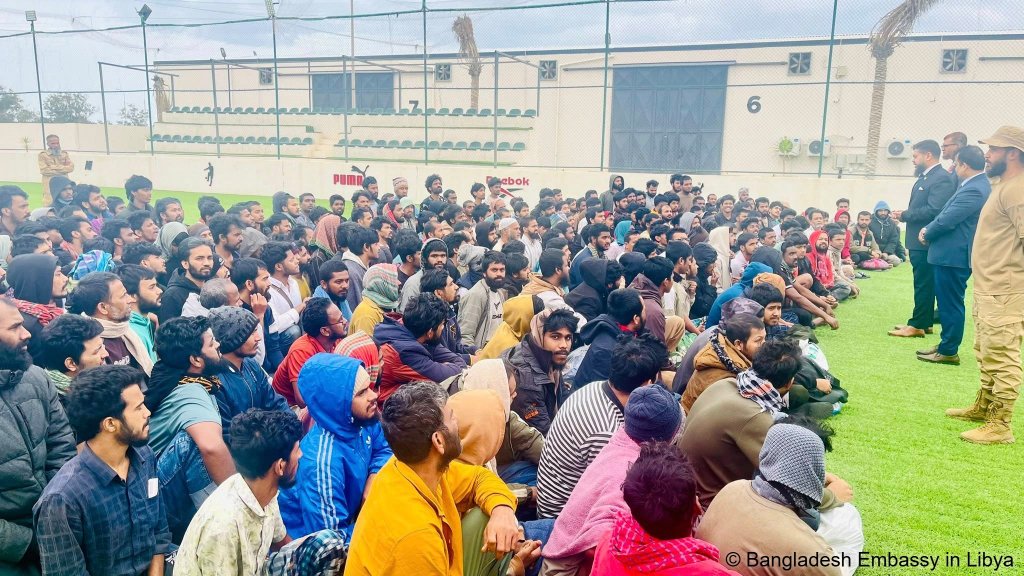
To that end, Libyan representatives presented measures introduced in the country in recent months, including new efforts to strengthen the operations of its coast guard. Libya's maritime defense forces, however, have repeatedly come under criticism in recent months after using heavy-handed methods to enforce migration controls, included mounting reports of fire being opened on charity-run rescue vessels operating in international waters off its coasts.
Furthermore, there have been reports for years of inhumane and exploitative conditions prevailing at Libya's migrant detention facilities, which often are run by government-affiliated militias.
The North African nation appears keen to change that image: In another statement following the meeting, Libyan authorities described irregular migration as a "sovereign, security and humanitarian" issue, saying that sustainable solutions require stronger domestic institutions within the country as well as greater international investment.
To this end, they also called for a "real international partnership" to support Libya's defense and interior ministries, alongside development initiatives in areas heavily affected by migration routes.
Libya's preferred position, however, is somewhat at odds with Europe's lived practise: Both the EU and individual governments within the block have struck repeated deals with the North African nation to reduce departure numbers from there.

Outcome of multilateral talks unclear so far
The longer-term significance of the discussions remains uncertain, as questions persist over how far each of the participating countries might be willing to go to meet Libya's request for more support for its security institutions.
Furthermore, it is unclear whether the minutiae of the meeting can evolve into a more solid coordination mechanism in general, with each participating country coming to the discussions with a different agenda.
But as Europe continues to seek new ways of reducing migrant arrival numbers across the Mediterranean, such multidimensional partnerships may being to play a growing role in determining how migration interventions can be applied at earlier stages in a migrant's journey.
This is also visible in the EU plans to move forward with new migration rules that would allow rejected asylum seekers to be transferred to so-called "return hubs" outside the bloc.
EU moves closer to launching offshore migrant return centers
These reform plans are part of a broader tightening of EU migration policy amid mounting political pressure across nearly all member states to gain control over irregular migration amid a rise of far-right parties across the bloc.
Under the proposed rules, rejected asylum applicants could be transferred to facilities outside the EU while awaiting deportation.
Several governments including Denmark, Austria, Greece, Germany and the Netherlands have already begun exploring potential partnerships to open such centers jointly, eyeing third countries like Rwanda, Uganda and Uzbekistan as possible host nations, according to media reports.
Read AlsoUK and Danish leaders call for reinterpretation of ECHR
However, while the measures might placate some voters who wish to witness EU governments gaining a stronger grip, there is a problem in terms of how sizeable the measure would be. Only thousands of people each year receive orders to leave EU territory, while tens of thousands are still arriving irregularly.
Furthermore, only around one in five are ultimately returned to their countries of origin at the current rate of deportations; if the offshore centers were to notably succeed, member states would have to raise the number of deportation flights significantly as well.
Nevertheless, many supporters of the scheme, including French lawmaker Francois-Xavier Bellamy, one of the main sponsors of the proposal, still believe that the idea could be a game-changer:
"This is not just another piece of legislation, but the condition for regaining control of migration policy in Europe," Bellamy told the AFP news agency.
Read AlsoBrussels: EU bolsters ties with Syria in the hope of increasing returns
EU countries changing their tune on migration
The proposals also reflect a wider shift in European migration policy: With irregular arrivals declining, attention is increasingly turning from border management measures toward enforcing returns and creating deterrent signals.
According to EU border authorities, irregular crossings have already fallen by roughly 40 percent during the first four months of 2026 compared with the same period last year, when they also were already on the decline.
Countries like Italy appear to already be one step ahead of the plans, which still will require further formal approval by EU institutions before becoming law, by holding multi-lateral meetings with players like Turkey and Qatar alongside Libya.
Read AlsoDeclaration to adapt wording of ECHR is passed, with potential to make migrant returns easier
*The introduction to this article was updated on Thursday, March 21 to reflect that the EU talks on return hubs has gone into a second day.