
The educational level of migrants coming to the European Union has risen steadily since 2017, according to a recent study. The research also reveals, however, that EU-wide averages in education levels also mask significant differences between various groups of origin, destination countries and genders.
A study by the Center for Research and Analysis on Migration at the Rockwool Foundation Berlin (RFBerlin) highlights that the proportion of highly qualified individuals among Europe's migrant population is on the rise.
The number of university graduates among EU-born migrants had risen from 29.4 percent in 2017 to 36 percent in 2025.
Among immigrants born outside the EU, it had increased from 26.0 to 32.6 percent during the same period.
By comparison, among the native-born population of EU nations, the proportion of university graduates grew from 30.3 percent in 2017 to 37.7 percent last year.
RFBerlin representative Tommaso Frattini told the Reuters news agency that this suggests that the skill profile of the European population was improving across all groups of origin: "Educational attainment is rising not only among native-born residents but also among migrants from both EU and non-EU countries," he said.
Read AlsoGermany trains immigrant teachers to fill gaps in schools
Variations between EU nations
However, the report also reveals significant differences among various European countries: In Ireland, Luxembourg, Denmark, Estonia, Latvia, Malta, Portugal, and the Czech Republic, migrants were more likely to hold a college degree than locals.
But in Germany, the proportion of immigrants born outside the EU with a so-called tertiary education degree stood at just under 32 percent, placing it slightly below the EU average of 32.6 percent.
Christian Dustmann, director of RFBerlin said that "integration and training policies must therefore be adapted to national circumstances," and that such policies should not rely solely on looking at EU averages.
The authors of the report argue in general that if the skills of migrants are developed and fully utilized as a matter of policy, they could become a major source of EU economic growth — rather than being viewed mainly through the lens of meeting existing labor shortages.
Read AlsoStruggling to retain workforce talent, some EU countries turn to recruiting from abroad
Ireland stands out as prime example of educational integration
The extensive report cites Ireland as a prime example of the impact of policy:
The proportion of college graduates in the island nation among both locals and EU migrants stood at around 55 percent each last year; among migrants from outside the EU, however, it reached a peak of just shy of 71 percent.
The report attributes this outlier situation to Ireland's targeted policy of recruiting highly qualified workers, for example through so-called "Critical Skills Employment Permits."
This approach is intended to attract skilled workers for occupations with severe shortages — such as IT, engineering, and healthcare.
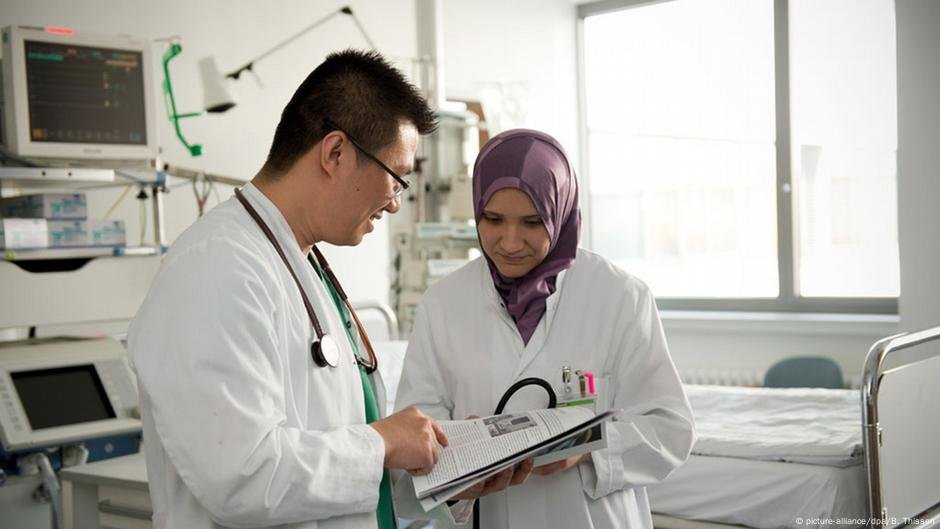
"Ireland shows that the educational profiles of migrants depend not only on who wants to migrate, but also on the migration pathways that states themselves create," Dustmann stressed.
Read AlsoGermany: Immigrant education levels reach new high
Differences between male and female populations
The RFBerlin report also highlights significant gender differences that came up in its research:
Across all groups of origin in the EU, women appeared to have higher overall educational levels than men.
At the same time, the gap in educational level attainment between migrant and refugee women and native-born women was the widest. This is particularly true for women who were born outside the EU and later immigrated to Europe.
These differences were especially pronounced in some countries such as Slovenia, Finland, and Spain.
While Slovenia and Finland have relatively low absolute numbers of migrants and therefore could qualify as statistical anomalies, Spain boasts an immigrant population of nearly 10 million people, accounting for over 20 percent of the overall population.
Read AlsoEmpowering women in Afghanistan: An Afghan migrant in Greece offers online coding classes
Strengths and weaknesses of the study
Broadly speaking, the various parts of the study make up a promising whole, but they do not point to a congruent pattern across Europe.
For example, the biggest long-term educational gains in university-level education since 2010 were observed in Poland and Latvia for both EU and non-EU migrants, with each of these nations marking a rise of 23 percentage points — or more — in the past 15 years.
However, again, these countries have not historically had high levels of immigrant populations, especially not from outside the EU.
Poland's unique role in the Ukraine crisis as the foremost recipient nation of war refugees may also have skewed its numbers from recent years.
Read AlsoWhy Germany struggles to attract African skilled workers
with Reuters