
The European Court of Justice (ECJ) in Luxembourg has issued a series of rulings that would appear to strengthen the EU's position on seeking to outsource asylum procedures to third countries, even though they were issued in a specific case, and pertain to an airport jurisdiction, rather than a third country.
The decisions state that EU member states are indeed allowed to detain asylum seekers in detention centers which are not necessarily located at the border of the member state concerned. However, in this case, the ECJ decision was issued with regards to the arrival of potential asylum seekers at an airport, whose jurisdiction is outside national territory until you have passed border control.
The ECJ added that the detention of asylum seekers in places not geographically located at the border may also be provisionally extended to a timeframe beyond a positive or negative decision being issued, provided that the rights of the affected asylum seeker are protected during this time.
The presiding judge, however, stressed in issuing the ruling that the detention of asylum seekers may not be arbitrary:
"I must nevertheless clarify that, to my mind, that does not mean that Member States may transfer applicants arbitrarily and on an ad hoc basis from their point of entry to any inland facility, subjecting them to uncertainty and unnecessary transfers. Rather, I consider, having regard to the need for legal certainty, that what may be permitted is the advance and general designation of places for detention for the purposes of the border procedure, which may well be situated inland, with a view to ensuring the most appropriate conditions for applicants," wrote Advocate General Nicholas Emiliou in the judgment.
The ECJ decisions would seem to strengthen the position of some EU member states like Italy, which have already built asylum processing facilities in third countries (in this case, Albania), and could help inform the way forward for the member of the bloc to realize their own plans to create such facilities in countries outside the bloc — commonly referred to as "return hubs."
Read AlsoMeloni stands firm on 'Albania model' for managing migration
Europe increasingly looking to outsource asylum
Under the terms of the new EU pact on migration and asylum, which will be rolled out from June this year, some EU member states are hoping that they can in future process the claims of asylum seekers more quickly if they are not able to set foot on EU territory until the claim has been assessed. That would mean in theory that those who are rejected can be deported more swiftly.
Those who come from a list of safe countries, or whose asylum application success rate is under a certain threshold would also be subject to speeded up procedures and assessments.
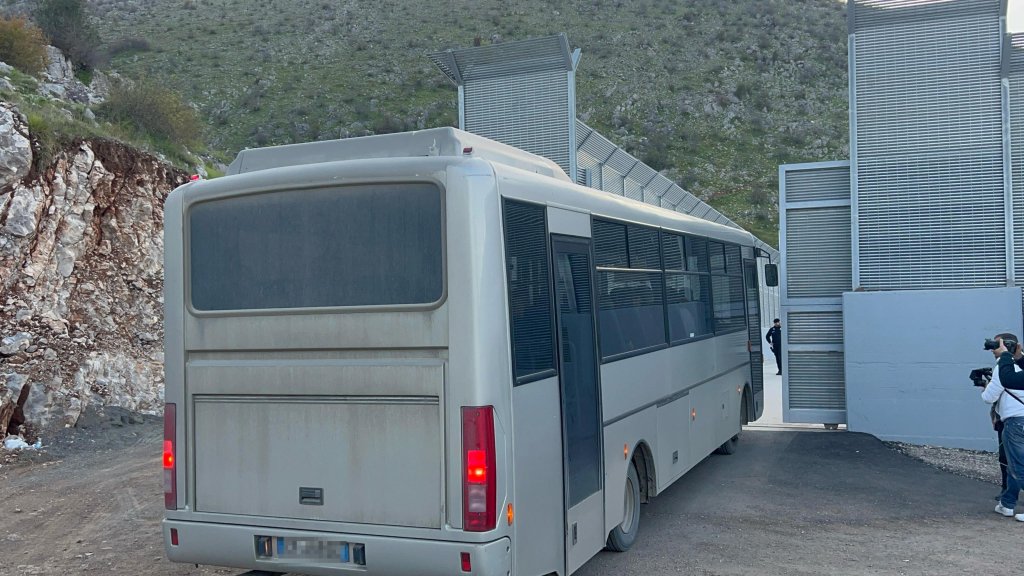
Recently, there has reportedly been a push by some EU members to have similar facilities built in locations completely outside the EU — in places such as North Africa or even Central Asia — in a bid to completely outsource asylum procedures and prevent migrants with little hope for asylum from ever getting near EU territory. However, actual centers have neither been agreed upon nor built.
While the EU has no plans to create such facilities with its own funds, it has recently green-lit plans of several of its member states to join forces to erect such facilities.
Read AlsoEU Council gives final greenlight to new EU asylum measures
Case highlights asylum situation in Belgium
The case before the ECJ was brought by Belgium. In 2023, a number of asylum seekers arrived by plane at Brussels Airport, which legally constitutes an EU external border prior to passing border control.
There, they applied for international protection; Belgian authorities denied them entry, as their cases did not merit immediate protection, and placed them in facilities about 40 kilometers away to process their claims.
The asylum seekers remained detained there beyond the prescribed four-week period. Authorities justified this on the grounds that there was a risk of absconding.
The asylum applications were further examined but were ultimately rejected. The asylum seekers then filed a case against this decision and against their treatment, aspects of which had to be escalated to the ECJ.
It should also be noted that Belgium is facing a severe housing shortage for asylum seekers and makes use of facilities that are detention centers rather than first-arrival accommodation in cases where officials can make a case for this.
Read AlsoBelgium fails to house asylum seekers adequately, ECtHR ruling finds
with AFP