
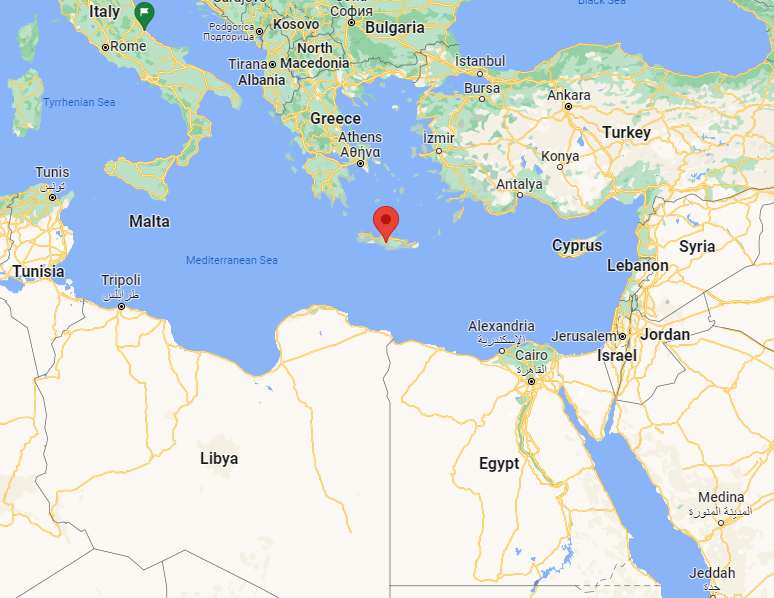
Greek authorities say they have rescued more than 300 migrants off Crete in recent days. The Greek island is increasingly playing a central role as a gateway to Europe from eastern Libya.
Greek authorities announced on Tuesday (April 14) that they rescued more than 300 migrants over two days in waters off Crete, as the island continues to act as an important entry point into Europe.
According to coast guard officials, nearly half of those rescued were picked up on Monday (April 13) from at least three makeshift boats navigating dangerous seas south of the island. Search and rescue operations continued into Tuesday despite strong winds, with multiple vessels deployed to locate additional boats believed to be in the area.
In total, 369 people have reached Crete since Sunday, authorities said, many of them originating from Bangladesh, Egypt, Yemen and Sudan. Several rescue missions involved coordination with European forces, including aerial surveillance by the EU border agency Frontex and assistance from a French navy vessel.
Officials said the migrants are currently being held by local police before being transferred to reception centers on mainland Greece.
A coast guard official said that more boats may already be en route after departing from Libya, with smugglers taking advantage of favorable weather conditions and calmer seas.
Crete has become a primary landing point for migrants departing from eastern Libya, particularly from the port city of Tobruk, ruled by the country's rival administration, Field Marshal Khalifa Haftar. The crossing is long and hazardous, spanning open Mediterranean waters. At the end of March, 22 people died during a failed crossing from Libya, with survivors later reporting that bodies were thrown overboard before the survivors were eventually rescued nearer Crete.
Read AlsoTwo separate incidents in the Mediterranean Sea leave 38 migrants dead
Migrants turning to longer, more hazardous routes
Situated at the southeastern edge of Europe, Greece has long served as one of the main entry points into the European Union for people fleeing conflict, instability and poverty across Africa, the Middle East and Asia. While many migrants attempt the shorter journey from Turkey to Greek islands in the Aegean Sea, as migration policies and patrol tactics shift, increasing numbers are now undertaking the far longer and more perilous route across the central Mediterranean from North Africa to southern Greek islands such as Crete and Gavdos.
The Mediterranean crossing remains one of the deadliest migration routes in the world. According to the United Nations’ International Organization for Migration (IOM), nearly 1,000 people have died or gone missing in the Mediterranean so far in 2026 alone, making it one of the deadliest starts to a year in over a decade. In just a 10-day period recently, more than 180 people were feared dead or missing in multiple shipwrecks.
"These tragedies show, once again, that far too many people are still risking their lives on dangerous routes," IOM chief Amy Pope said. "Saving lives must come first. But we also need stronger, unified efforts to stop traffickers and smugglers from exploiting vulnerable people, and to expand safe and regular pathways, so no one is ever forced into these deadly journeys."
Read AlsoTobruk-to-Crete migrant crossings intensify as Greece enforces strict sea patrols
Greece plans to send arrivals to third country 'return hubs'
Despite the dangers, tens of thousands continue to attempt the crossing each year. Official figures show around 20,000 people arrived on Crete in 2025 alone, highlighting the island’s growing role as a migration hub.
At the same time, Greece has adopted an increasingly strict stance on migration. The government has backed EU proposals to tighten border controls and accelerate deportations, including plans to establish so-called "return hubs" in third countries for migrants whose asylum applications are rejected.
Athens has also focused on increasing returns, arguing that current deportation rates lag far behind the number of arrivals. However, its policies have drawn criticism from human rights organizations and the United Nations, particularly over allegations of illegal pushbacks, claims the government denies.
With AFP, dpa and AP