
There are almost a million Syrians in Germany, most of them hold some kind of protected status in the country. But, since Syria’s interim President Al Sharaa visited Germany last week, the Syrian community has been forced to consider once again their relationship to their homeland, and whether they should stay in Germany or go back to Syria.
Huda* is from the Druze sect in Syria and originally from the town of Suwaida in south-western Syria, a heartland for the Druze community in the country.
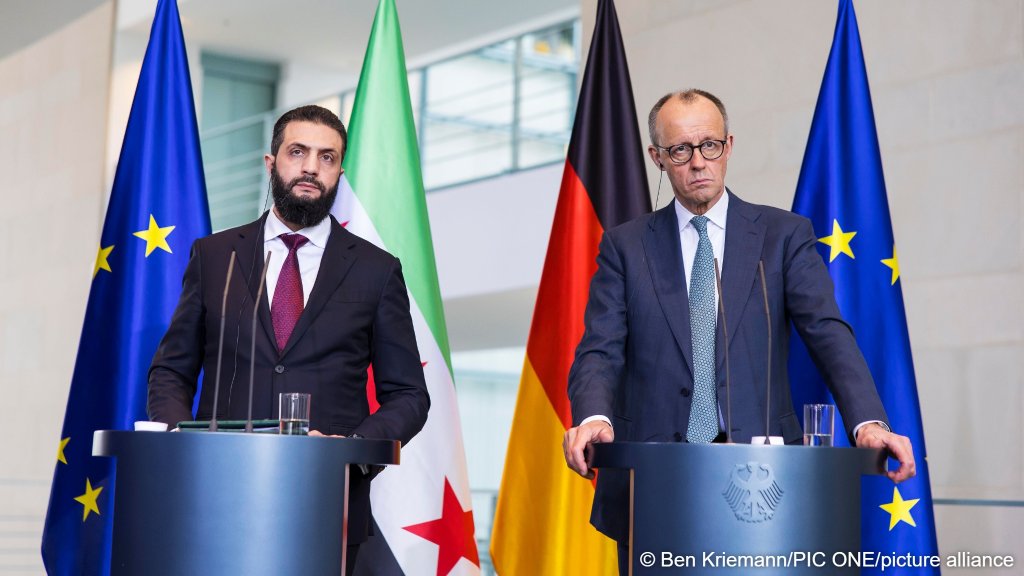
She has been in Germany for the last ten years. She told InfoMigrants Arabic she felt upset last week during the visit of President al-Sharaa to Germany, and especially after German Chancellor Friedrich Merz was quoted as saying that he and the interim president had agreed that around 80 percent of Syrians should return to their homeland over the next three years.
That’s because Huda can no longer see a life for herself in Syria. Speaking to InfoMigrants last week, Huda said: "I learned the language and started a new life here. It’s impossible for me to go back to Syria. The situation in Syria is still unsafe."
Read AlsoGermany: Chancellor Merz attracts sharp criticism over '80 percent Syria returns' comment
Druze in Syria
The Druze are a religious sect and a minority in Syria, accounting for about three percent of the population. It is often described as an offshoot of Shia Islam, but also combines elements of Greek philosophy and reincarnation. Many Druze do not see themselves as Muslim. You cannot convert to being a Druze. The Druze community tried to retain distance from the al-Assad regime and has attempted to do so with the interim government too. However, last July, and in the autumn last year fighting between local Bedouin groups and Druze was reported in Syria.
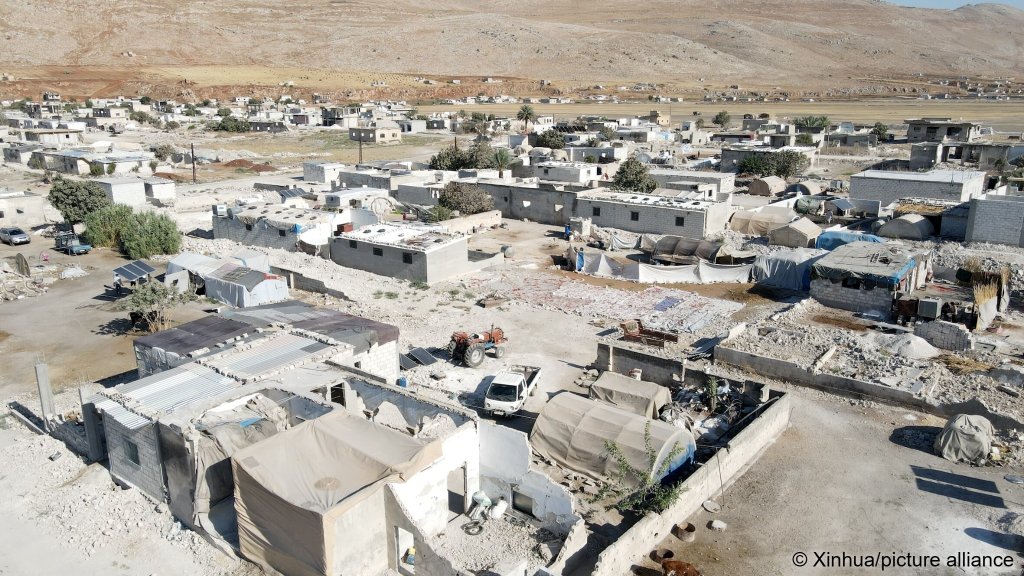
The Druze have been pressing the new authorities in Syria to uphold minority rights in the country. Since the collapse of the Assad regime in December 2024, some Druze leaders have voiced support for a unified and pluralistic Syria and have expressed willingness to work with the interim government, DW reported last week. Others have taken a more confrontational stance. The Druze have their own security forces and last year were still resisting centralization under the new interim government. Early in 2025, more than 100 Druze were killed in clashes with government forces.
In July 2025, al-Sharaa pledged to protect the Druze community from violence, saying he would hold accountable "those who transgressed and abused our Druze people, as they are under the protection and responsibility of the state," reported DW.
Read AlsoGermany hosts Syria's Al-Sharaa despite human rights issues
'Our village was completely burned down'
However, this pledge has not reassured people like Huda. She told InfoMigrants, "Our village was completely burned down, and I lost most of my family. Many were killed, and women were subjected to horrific abuse. I cannot go back after everything I saw and experienced."
Huda believes that Syria’s interim president and his government are not the image they are projecting on the world stage. She told InfoMigrants that when he was still fighting for groups linked to al Qaeda, he "stole Syria" and she said she was shocked that the German government welcomed him with a "red carpet," especially as she claimed "he is now committing new massacres against Christians in al-Suqaylabiyah."
The organization Genocide Watch, which, according to its website, is a non-profit run by volunteers and coordinates an alliance of over 90 organizations from around the world to try and prevent genocide, noted at the end of March that Christians and other minorities are "under genocidal attack," with Ahmed al-Sharaa in power.
The organization cites a March 22 statement issued by a Canadian non-profit, the Ethnikos Association of Latakia-Antaradus (EALA), which advocates for the human rights of Syria’s Alawite and Rum (Greek) communities. The organization said it had "credible first-hand accounts," indicating a "serious and rapidly deteriorating security situation for Christians in Kfarbo (Hama Governorate), Mhardeh (Hama Governorate), Al-Suqalabiyah (Hama Governorate, Wadi al-Nasara (Homs Governorate) and surrounding areas."
According to EALA, "armed groups affiliated with the Syrian Ministry of Defense and identified as 'Bedouins' have carried out acts of desecration, violent and armed assault, and attempted abductions of Christian women, while state authorities have failed to intervene and largely ignored the repeated citizens’ complaints while allowing armed militants to operate with impunity."
Read AlsoHow recent Syrian communal violence is impacting Germany
'As a woman and a minority, returning...is no longer an option for me'
Huda told InfoMigrants: "As a minority and as a woman, returning to the Middle East is no longer an option for me. Here I found freedom, and here I have a new life. My children play in German and do not speak Arabic fluently, even though we speak it at home."
However, Huda's wish runs counter to that reportedly expressed by Germany’s Chancellor Friedrich Merz last week, during the visit of Syria’s interim president. It was reported that Merz said he hoped more than 80 percent of Syrians would return to Syria over the next three years. A statistic that would be difficult to achieve for various reasons.
According to a recent study by Germany’s Mediendienst Integration, a central information and research unit for journalists writing about migration in Germany, and financed by various German foundations, as well as the offices of the anti-racism commissioner appointed by the German government (Beauftragte der Bundesregierung für Antirassismus), around 713,000 Syrians hold some form of protection status in Germany, at least that was the case at the end of 2024.
Read AlsoGerman court rules deportation of Yazidi family was legitimate
Syrians in Germany
Syrians in Germany represent 22 percent of all those holding protection status in Germany. Ukrainians form the largest group, holding 33 percent of the protection status in Germany. Around two percent of Syrians who have been granted protection in Germany were actually born here.
In total, on February 28 this year, German government statistics said almost a million Syrians were living in Germany (930,112). Out of this group, 10,718 people had been asked to leave Germany, and 9,787 of those roughly 10,000 had been granted a 'toleration' status (Duldung) -- possibly because they didn’t possess the correct papers, had not been recognized by their own government, or because the situation in their part of Syria might be too dangerous for them to be sent back. The toleration status can also be granted if someone is undertaking a course of study, is involved in an apprenticeship or for other family-related reasons too.
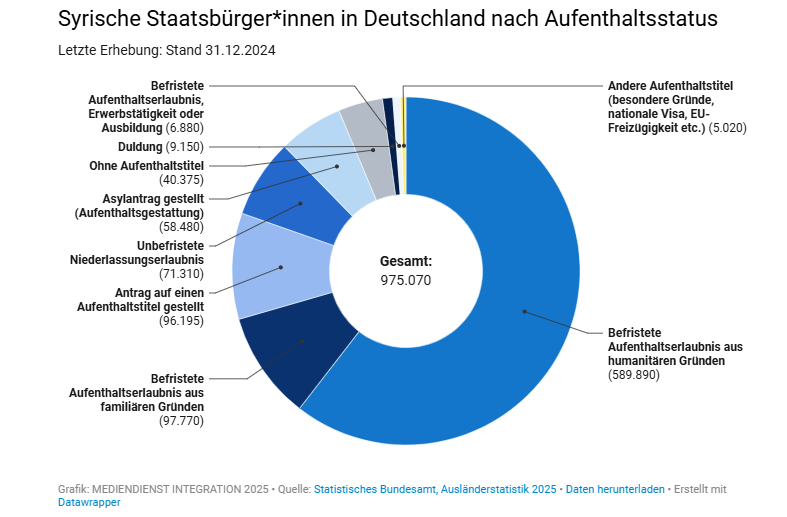
According to the German statistics office (Statistisches Bundesamt), the last available data published in 2025 and monitoring the situation for the end of December 2024, of the 975,070 Syrians in Germany, 589,890 have a time-limited protection status on humanitarian grounds. A total of 97,770 had time-limited protection status for family reasons; 96,195 had applied for a residence permit, while 71,310 had been granted permanent residence permits. Another 58,480 were still waiting for their asylum claims to be decided, 40,375 were in Germany without a residence permit, 9,150 were ‘tolerated’ (Duldung) and 6,880 had a time-limited residency on the grounds of their employment or course of study or apprenticeship.
Read Also'My heart is still in Aleppo, my life bound to Germany'
More than half are married and employed
The German Federal Office for Refugees and Asylum (BAMF) says that more than 60 percent of Syrians in Germany are married and 56,200 of them are children born in Germany to Syrian parents, more than 60 percent describe themselves as Syrian Arabs and more than 90 percent are Muslim. Fewer than two percent of Syrians in Germany are Christian and around one percent of them are Yazidis.
The number of Syrians employed in Germany is on the increase, indicate statistics from the German Federal Employment Agency (Bundesagentur für Arbeit). Around 317,000 Syrians are currently employed in Germany at the last count in September 2025. Around 245,000 are registered by the Federal Employment Agency as being on the lookout for work and 142,330 are registered as unemployed.
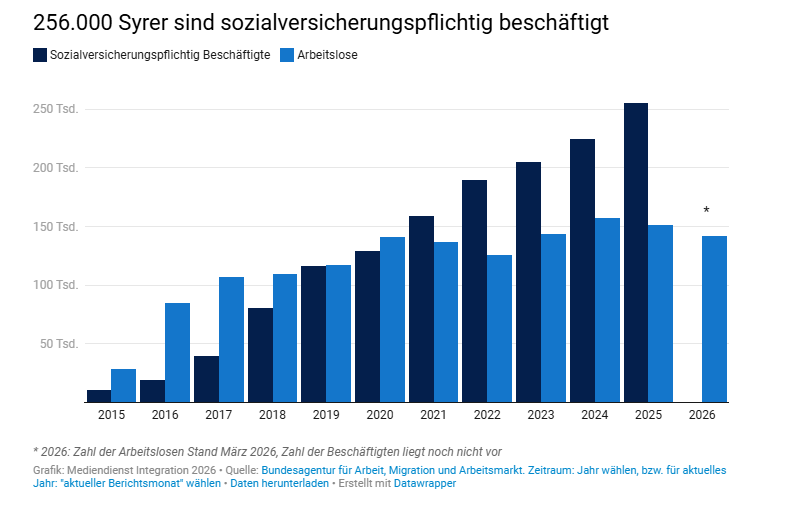
Also according to the Employment Agency, 256,000 Syrians are paying contributions to the welfare state via their work as of March 2026. There is quite a strong gender difference for employment of Syrians in Germany however. The majority of women are not employed; just 22,2 percent of Syrian women in Germany are registered as working, compared to 61,8 percent of men.
In comparison to other groups in Germany with asylum or refugee status, Syrians are classed in general as being relatively "qualified," meaning they have either studied or learnt a trade. Around 19 percent are training for a qualification in Germany.
Read AlsoGermany: CSU demands 'Roadmap of Returns' to Syria ahead of meeting
Syrians with a German passport
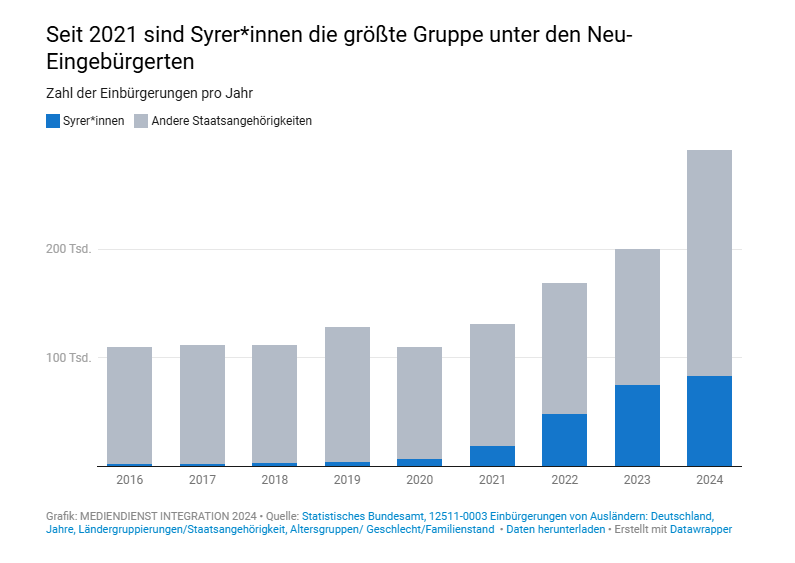
Syrians also represent the largest group in Germany of new citizens in the country. Between 2016 and 2024, around 244,000 Syrians have been granted a German passport, with around 85 percent of that number since 2022.
Between January and November 2025, only around 6,500 Syrians have voluntarily returned to their country. Germany has a special returns program offering travel money and some start-up costs after arrival in Syria for those who qualify for it. However, by October 2025, only 2,900 people had registered for this program.
Before the fall of the Assad regime, in December 2024, a survey conducted by the Institute for Employment Research (Institut für Arbeitsmarkt und Berufsforschung, IAB) found that 94 percent of Syrians surveyed wanted to stay in Germany full-time.
Between 2012 and 2025, no one was forcibly returned to Syria. In December 2025, one Syrian criminal was sent back to Syria and several more followed in January 2026. However, the overall situation in Syria is still judged to be "unstable" and so widespread deportations would be difficult to envisage at this point in time.
Read AlsoSyrian refugees in Germany face pressure to return
Situation in Syria still considered to be 'unsafe' for many
More Syrians are returning to Syria who moved just to neighboring countries like Lebanon, Turkey or Jordan. Many of these people had been living in tented settlements in those countries.
Some in Germany have begun to express interest in returning. Azzam* a father of four with protection status in Germany, told InfoMigrants that he had been separated from his family for more than three years and hadn’t been able to bring them over via family reunification. For that reason, he concluded, "I don’t see the point in continuing to be here without them."
Azzam admitted that he thought that "raising children in Germany" might be "difficult compared to Syria, even though it is a devastated country." He said if asked to return, he would never refuse. "If the security and economic situation improves, I am ready to return," declared Azzam, admitting that he thought three years might be enough for him to "sort out his situation."
Another woman, Fatima*, told InfoMigrants that she felt that the German government was disseminating "propaganda" about a mass return of Syrians, "especially with the rise of right-wing parties in some states [in Germany] and their increasingly vocal opposition to refugees."
She found the attitude expressed by Merz worrying and underlined that the UNHCR was in Syria recently, including two Germans on the team, who assessed the situation in Syria and confirmed it was still "unsafe." Fatima added that returning to Syria was just "unrealistic" at this point in time.
*Not their real name, changed to protect their identity